

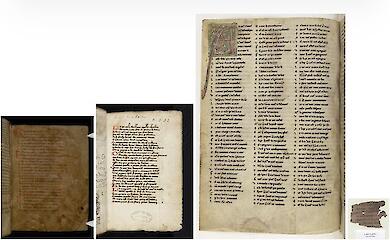
Why did medieval doctors consider love to be an illness?


Unrequited love could rob a person of sleep, appetite and strength long before the advent of modern psychology. Doctors in the medieval Islamic world took such suffering seriously and described agonising romantic obsession as a distinct illness.
They called this state ʿishq — ‘ishq’. At first, it was associated with licentiousness and an inability to control one’s desires. But over time, perceptions changed: doctors began to recognise that even virtuous people, saints and prophets could ‘fall ill’ with love.
The historian of medicine Nahyan Fancy has traced how, over the course of several centuries, medical explanations of lovesickness became intertwined with philosophy, literature and Sufi conceptions of love for God. The findings have been published in an academic collection on medieval Islamic societies.
What medieval doctors called the ‘love sickness’
The word ʿishq did not denote ordinary affection or a calm attachment. It referred to a powerful, all-consuming passion that could disrupt a person’s behaviour and affect their physical condition.
A person suffering from such love might grow weak, lose their peace of mind and think constantly about the object of their affections. Medieval physicians sought to understand why an experience that begins in the mind is capable of altering the condition of the entire body.
Unlike some ancient Greek authors, who linked lovesickness to melancholy, certain scholars in the Islamic world regarded ʿishq as a distinct ailment with its own causes and possible treatments.
At first, those in love were accused of licentiousness
In 10th-century medical texts, love obsession was often linked to a person’s moral character.
Some physicians believed that those particularly susceptible to it were the ignorant, the dissolute and those unable to control their desires. In this view, the condition was not merely a medical problem, but also a consequence of a weak character.
However, this view later began to change. Writers in subsequent centuries increasingly recognised that strong feelings could arise unintentionally. A person does not necessarily choose whom to fall in love with, and is not always able to put an end to such feelings through an act of will.
Thus, lovesickness gradually ceased to be seen solely as an accusation of immorality.
How Ibn Sina linked love to physical weakness
One of the most famous physicians and philosophers of the Middle Ages, Ibn Sina—known in Europe as Avicenna—described cases in which intense emotional distress caused noticeable physical symptoms.
In one of his 11th-century texts, he recounted the story of a woman who, due to lovesickness, became physically weak and ill.
For Ibn Sina, mental and physical states did not exist in isolation. Emotions could alter the body’s functioning, whilst physical health could influence thoughts and feelings.
This bears a distant resemblance to the modern understanding of the mind-body connection, but a direct parallel cannot be drawn. Ibn Sina explained illnesses through the medical theories of his time, which were based on the balance of humours, temperaments and vital forces.
Why was lovesickness linked to bodily fluids?
In the 13th century, the physician Ibn al-Nafis proposed a more physiological explanation for lovesickness. He linked it to the accumulation of seminal fluid in the body.
In his view, young and unmarried people were particularly vulnerable to this. At the same time, the condition could also affect a virtuous person who had done nothing reprehensible.
From the perspective of modern science, this explanation is incorrect. However, for medieval medicine, it represented an attempt to identify a physical mechanism linking desire, thoughts and physical well-being.
Rather than simply condemning the patient, doctors sought to answer the question: what exactly happens in the body of a person who cannot stop thinking about their beloved?
How doctors proposed to treat love
The methods depended on how a particular author understood the cause of the illness.
If lovesickness was linked to unfulfilled physical desire, one possible remedy was considered to be permitted sexual relations — primarily within marriage. It was assumed that relieving physical tension might alleviate the condition.
But this approach posed a complex problem. What should be done if such suffering is experienced by a person who cannot be accused of licentiousness — for example, a saint, a prophet or a religious mystic?
Later authors sought to distinguish between carnal passion and spiritual love. They argued that a righteous person’s infatuation might not be accompanied by sexual desire and therefore required a different explanation.
These historical remedies do not correspond to modern medicine and are not recommendations for the treatment of emotional or mental health problems.
Why love could strike even a saint
By the late Middle Ages, physicians’ views were increasingly intertwined with philosophy, poetry and Islamic mysticism.
In the Sufi tradition, love could signify a person’s yearning for God. It was perceived not only as an earthly emotion, but also as the force underpinning the existence of the world.
The so-called Sufi path of love, associated in part with the works of the poet and mystic Jalaluddin Rumi, became particularly influential.
Against this backdrop, it was already difficult for a doctor to maintain that any all-consuming love arose from ignorance or licentiousness. If the great mystics described love as a path to God, the emotion itself could not be regarded solely as a vice.
Medicine had to explain why similar outward signs — obsession, forgetfulness, and a renunciation of ordinary desires — could accompany both earthly passion and religious experience.
How a court physician distinguished between earthly and spiritual love
Nahyan Fensi paid particular attention to the works of Ibn al-Mubarak — a physician who served at the court of the Ottoman sultans Selim I and Suleiman the Magnificent.
Ibn al-Mubarak expanded on Ibn al-Nafis’s idea that lovesickness can arise unintentionally and affect moral people particularly deeply.
However, he drew a distinction between different kinds of love.
Ordinary lovesickness could be accompanied by sexual desire; therefore, consensual sexual relations were regarded as a possible means of relief. The love of prophets and saints, by contrast, could be entirely devoid of such desire.
Ibn al-Mubarak explained this by the chastity of the lover themselves or by the perfection of the beauty of the Beloved—God. Contemplation of this beauty supposedly caused a person to forget the physical aspect of love.
Thus, the same state of being was given two explanations: a physiological one—for earthly passion—and a spiritual one—for religious love.
Was love considered a mental disorder?
Medieval physicians did indeed describe lovesickness as a distinct illness. But to call it a fully-fledged psychiatric diagnosis would be an anachronism.
Modern psychiatry is based on clinical criteria, research and international classifications. Authors from the 10th to the 16th centuries operated within a completely different system of knowledge.
They did not draw such a strict distinction between mental and physical health as is often done today. Thoughts, morality, the functioning of the organs, bodily fluids and spiritual life could all be regarded as parts of a single human condition.
It is therefore more accurate to say that ʿishq was perceived as a specific medical ailment affecting both the soul and the body.
What this study reveals about the Middle Ages
This work challenges the simplistic notion that medieval physicians explained emotional suffering solely in terms of sin, weakness or supernatural forces.
Some of them closely observed how emotional experiences manifested in the body, compared different cases and debated the possible causes of illness.
Their theories may seem strange from the perspective of modern science. But behind them lay a desire to understand real human suffering — loss of sleep, weakness, obsessive thoughts and the inability to return to normal life.
The study also shows that medical knowledge did not develop in isolation from culture. Concepts of love were shaped by philosophy, poetry, religious debates and Sufi mysticism.
Can we speak of the views of the entire Islamic world?
No. The historian studied the works of specific physicians, philosophers and theologians, produced in different regions and across different centuries.
These texts show how the ‘sickness of love’ was discussed by learned authors and representatives of the medical tradition. They do not allow us to claim that all members of medieval Islamic societies perceived love in the same way.
Therefore, the statement ‘in the Middle Ages, everyone regarded love as an illness’ would be incorrect.
It would be more accurate to say that some influential physicians in the Islamic world identified pathological love obsession as a distinct ailment and debated its nature.
Why this is important
The history of ʿishq shows that people were trying to understand the destructive power of unrequited love over a thousand years ago.
Medieval explanations differed significantly from modern ones, but the symptoms themselves remain recognisable: obsessive thoughts, loss of energy, sleep disturbances and the sensation that emotional pain has become physical.
At the same time, attitudes towards the sufferer themselves changed. Initially, the sufferer might have been accused of licentiousness and a lack of self-control. Later, doctors began to recognise that such a condition could arise without conscious choice and did not automatically indicate moral decline.
This was a significant turning point: lovesickness began to be viewed not merely as a vice, but as a form of suffering that deserved an explanation.
Background
Concepts of lovesickness existed not only in the Islamic world. It was discussed by ancient Greek and Roman physicians, and later by European authors of the Middle Ages and the early modern period.
However, the medical tradition of Islamic societies developed its own debates regarding the connection between ʿishq and melancholy, bodily processes, morality and religious love.
Nahyan Fensi specialises in the history of science and medicine in Islamic societies from approximately the 11th to the 16th century, with a particular focus on the interaction between medicine, philosophy and religion.
Source
Nahyan Fancy,“Medical Discussions on Lovesickness (ʿIshq) during the Postclassical Period”, Chapter 9 in the collection *From Cairo to Jerusalem and Beyond: Studies of the Later Islamic Middle Period in Honour of Linda Stevens Northrup*, Brill, 2026.
Maria Grynevych, project manager, journalist, co-author of Guidebook Sacred Mountains of the Dnieper Region, Lecture Course: Cult Topography of the Middle Dnieper Region.
Related news
Historians have discovered an unexpected origin for the term ‘burnout’

Moonlight has helped solve the mystery of Egypt’s sacred baboons


The history of silk turned out to be almost two thousand years longer
A gold tiara found in a woman’s tomb has astonished archaeologists
Popular news

How to cook sweetcorn properly so that it’s juicy and sweet: the best method revealed


Archaeologists have discovered who actually built Colombia’s ancient canals

Russia has received new weapons from North Korea: which regions of Ukraine could be at risk

Bones of ancient humans found on the seabed of the Taiwan Strait suggest they were up to 190 cm tall

News about war


An expert explains how Russia is changing its tactics for strikes on Kyiv


The UN has reported a sharp rise in the number of Ukrainian civilians killed as a result of the war

