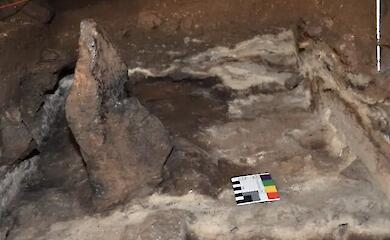

A gold tiara found in a woman’s tomb has astonished archaeologists


Around 3,400 years ago, a wealthy woman from Cyprus wore a gold diadem featuring an unusual design: the heads of bulls crowned with sun discs. Beside these, the jeweller had placed palm trees and rosettes — motifs reminiscent of the art of several ancient cultures at once.
The find caught the attention of archaeologists not only because of its beauty. The bull was usually associated with the masculine principle; however, the ornament lay next to the remains of a woman aged 35–40. This suggests that such depictions were not intended exclusively for men.
Strictly speaking, the scientists did not discover the diadem in a separate woman’s grave, but in a burial chamber that had been reused multiple times and contained the remains of several people. The researchers linked the ornament to a specific deceased individual based on its position amongst the remains.
Details
The diadem was found near the ancient city of Hala Sultan Tekke in south-eastern Cyprus. During the Late Bronze Age, the city stood by a sheltered sea cove and was one of the largest trading centres in the eastern Mediterranean.
Between 2016 and 2024, archaeologists excavated seven chamber tombs and one shaft tomb near the city. These were in use over several generations — roughly from the 15th to the 13th century BC.
In total, the researchers examined nine gold diadems and two small plates, which were placed on the lips of the deceased during burial. Unlike the ornate diadems, these funerary plates were predominantly plain.
The most striking diadem is adorned with bull’s heads featuring sun discs. This motif is reminiscent of Egyptian depictions of the sacred bull Apis. At the same time, the palm fronds, flowers and rosettes on the ornament have parallels in the Minoan art of Crete and the culture of Mycenaean Greece.
This does not mean that the diadem was brought from Egypt or Greece. The characteristics of its craftsmanship and the combination of motifs suggest that it was most likely created by Cypriot artisans. They did not simply copy foreign images, but combined them in their own artistic style.
Some diadems show noticeable signs of wear. The heaviest examples weighed between 11.7 and 23.14 grams and were probably worn whilst their owners were still alive. They may have been worn during festivals, ceremonies or other important events, and then left with the deceased after their death.
The more delicate pieces, weighing between 1.02 and 2.66 grams, showed no obvious signs of having been worn. It is possible that they were made specifically for funeral rites.
The diadems were fastened to the forehead using cords threaded through holes along the edges. Sometimes, the gold plate may first have been attached to a fabric or leather base, which has not survived.
Archaeologists discovered one of the diadems directly on the forehead of a child who had died at the age of four or five. Lying nearby were a necklace of 68 gold beads, four gold earrings, silver objects and a carved seal. Such a burial shows that high status could be inherited and extended even to children.
A city that traded with the ancient world
Hala Sultan Tekke flourished from around 1630 to 1150 BC. Geophysical surveys have shown that the city covered at least 25 hectares. This makes it the largest known urban centre in Bronze Age Cyprus and one of the largest in the eastern Mediterranean.
Its inhabitants smelted copper, produced pottery and textiles dyed with precious purple dye. The harbour enabled them to exchange local goods for gold, silver, ivory, glass and precious stones.
Among the artefacts found in the city are items linked to Egypt, Anatolia, the Levant, Mesopotamia, Sardinia, Minoan Crete and Mycenaean Greece. Lapis lazuli came from areas of present-day Afghanistan, carnelian from India, and amber from the Baltic region.
However, this does not necessarily indicate that Cypriot merchants travelled such distances themselves. The goods may have passed through a long chain of intermediaries before reaching the island.
Why this is important
The gold diadems show that Bronze Age Cyprus was not a peripheral region, but a vital crossroads of trade routes. Alongside metals and precious materials, images, technologies and religious beliefs were also circulating throughout the Mediterranean.
Cypriot craftsmen selected recognisable motifs from different cultures and combined them into new compositions. Consequently, these ornaments cannot be described as Egyptian, Minoan or Mycenaean: they reflect the distinct style of a society situated at the crossroads of several ancient worlds.
The context of the diadem featuring bulls is also unusual. Its discovery alongside the remains of a woman suggests that modern notions of ‘masculine’ and ‘feminine’ symbols cannot automatically be applied to the Bronze Age. However, it is impossible to determine this woman’s status, her occupation or the significance of the diadem on the basis of a single piece of jewellery.
Researchers have also not yet found the workshop where such ornaments were made. Their local origin remains the most likely, though not definitively proven, explanation.
Background
During the period when Hala Sultan Tekke existed, Cyprus was one of the main suppliers of copper in the Mediterranean. This metal was required for the production of bronze, which is why the island played an important role in international trade.
The burial chambers were reused on multiple occasions — sometimes over a period of around 150 years. They were hewn out of clay soil and marked with inconspicuous stones. It is possible that this simple design was intended to protect the rich burials from grave robbers.
Over time, the ceilings of the chambers collapsed. For those buried there, this meant the destruction of their graves, but the collapse proved helpful to archaeologists: a layer of soil covered the remains and valuable artefacts, preserving them for thousands of years.
So far, only a small part of the city and its cemetery has been excavated. According to the project leader’s estimate, a full investigation of the site at the current rate would take several centuries.
Source
Peter M. Fisher’s study, ‘Cultural fusion in Late Bronze Age goldwork: Diadems and mouth-pieces from Hala Sultan Tekke, Cyprus’, was published in 2026 in the Oxford Journal of Archaeology.
An independent researcher, interested in archaeology and sacred geography. He researches them and writes about them.
Related news
Almost 500 blue artefacts have linked Iron Age Iran with ancient Egypt

A Chinese inscription has debunked the legend surrounding the Boston Tea Party relic
How new technologies have debunked old myths about African history
Scientists have investigated how a seashell bead travelled 8,500 years ago
Popular news

Ukrainian security services have been recognised as among the best intelligence services in Europe – L'Express


Irina Levchenko, the abducted Ukrainian journalist, has been transferred to the Donetsk remand centre: what is known

Scientists have put forward an explanation as to why there were no tiny dinosaurs


How to cook sweetcorn properly so that it’s juicy and sweet: the best method revealed
News about war

The UN has reported a sharp rise in the number of Ukrainian civilians killed as a result of the war


3 July has been declared a day of mourning in Kyiv. The number of dead and injured is rising