

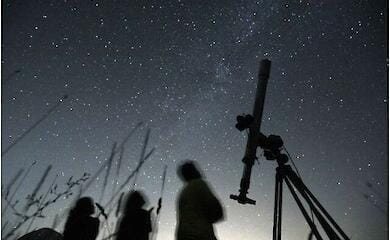
Thursday night to Friday night is a total lunar eclipse


In the coming night from Thursday to Friday, the moon will "try on" a reddish hue.
A total lunar eclipse will be visible in the Western Hemisphere. Residents of North and South America will see the most spectacular show, but in parts of Africa and Europe, visibility will be limited by the waning Moon as it "sets" over the horizon.
How does it work?
A lunar eclipse occurs when the Sun, Earth and Moon line up. The Earth casts a shadow that may partially (in a partial eclipse) or completely (in a total eclipse) obscure the Moon's disc. If the eclipse is total, the Moon enters the so-called "blood red" phase: the Sun's light, passing tangentially through the Earth's atmosphere, colours the lunar disc in copper hues.
According to NASA, between four and seven times a year there are lunar and solar eclipses on our planet, with total lunar eclipses occurring less frequently. The previous one was observed in 2022, and in 2024 (in September) the inhabitants of America, Africa and Europe observed a partial eclipse.
When and where to watch?
- Main phase: from 2:26 a.m. (Eastern Time, EST) to about 3:00 a.m., Friday.
- Best time: closer to 3:00 a.m. (EST), when the Moon's disc will be completely shadowed and take on its characteristic copper hue.
- Equipment: no special protective glasses are required to observe (as with a solar eclipse). Good weather and an open view of the sky are sufficient.
- Regional limitations: in Europe and Africa, the total eclipse phase can be harder to catch because by this time the Moon will already be low above the horizon or setting.
What if you miss it?
The next total lunar eclipse is expected as early as 7 September and will cover regions of Asia, Africa, Australia and Europe. For residents of the Americas, a similar event will again be available in March 2026.
A brief historical note
- Ancient civilisations: for thousands of years people have been observing lunar eclipses and giving them a special meaning. In Mesopotamia, the reddish Moon was considered an "ominous sign" for the king, which sometimes even led to a "substitute" ruler being placed on the throne for the duration of the eclipse.
- Scientific Facts: In the 4th century BC, Aristotle noticed that the Earth's shadow is always round, which was one of the proofs of the planet's spherical shape.
How to prepare for an observation
- Check the weather: if the sky is cloudy, visibility will be limited.
- If possible, find a place without city lights: a dimmed environment will allow you to enjoy the eclipse in all its glory.
- Don't worry about eye protection: unlike solar eclipses, lunar eclipses are perfectly safe for the naked eye.
Mykola Potyka has a wide range of knowledge and skills in several fields. Mykola writes interestingly about things that interest him.
Related news
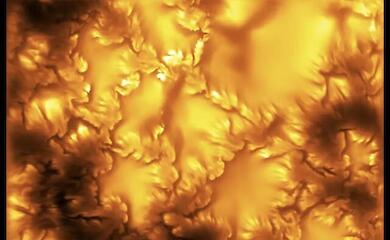
Scientists have observed tiny vortices on the Sun’s surface for the first time

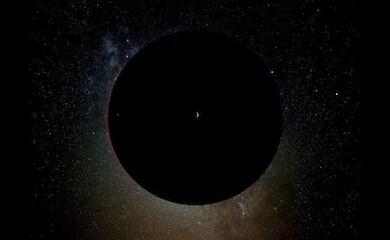
A scientist has proposed a way to preserve life on Earth after the Sun’s demise
Astronomers have determined just how large the Universe’s largest galaxy is
Popular news

How to cook sweetcorn properly so that it’s juicy and sweet: the best method revealed


Archaeologists have discovered who actually built Colombia’s ancient canals


Scientists have put forward an explanation as to why there were no tiny dinosaurs

Scientists have discovered how snakes lived during the age of the dinosaurs
News about war

An expert explains how Russia is changing its tactics for strikes on Kyiv


The UN has reported a sharp rise in the number of Ukrainian civilians killed as a result of the war



3 July has been declared a day of mourning in Kyiv. The number of dead and injured is rising