

How dinosaurs took to the skies: a computer model has provided an unexpected answer


One of the oldest known birds may have taken to the air in a completely different way to modern birds. A new biomechanical model has shown that Archaeopteryx, which lived around 150 million years ago, probably used its powerful hind legs: two or three successive leaps allowed it to build up speed, after which its wings took over the main work. The findings provide new quantitative support for the scenario in which early bird flight may have begun directly from the ground.
Archaeopteryx has long held a special place in the history of bird evolution. It already had feathers and wings, but retained many characteristics of its dinosaur ancestors.
At the same time, its shoulder girdle differed markedly from that of modern birds. Limited shoulder mobility and the specific features of its wings may have prevented it from generating the same powerful take-off flutter that enables modern birds to lift off the ground so quickly.
The researchers therefore decided to test another possibility: what if the main work during take-off was done not by the wings, but by the legs?
They found the answer in jumping
The team used data on the take-off of modern birds and built a computer model, which they then adapted to the anatomy of Archaeopteryx.
The calculations took into account the movements and loads on the joints of the hind limbs, as well as the muscles’ ability to generate the necessary force. For the model, they used a mass of around 400 grams for Archaeopteryx — a figure the authors consider biologically plausible, given the uncertainties in reconstructions of the fossil animal.
The modelling showed that Archaeopteryx could gradually build up the speed required for sustained flight.
The sequence might have looked something like this:
jump → jump → jump → flight
or
jump → wingbeat → another jump → flight.
According to the researchers’ calculations, the hind limbs were sufficient to reach the minimum speed required for sustained flight after two or three consecutive leaps.
The legs may have been more important than the wings
This conclusion is consistent with the take-off behaviour of many modern birds.
Even today, crows, magpies and some other species do not always make a single maximum leap straight away. During a calm take-off, they may use several steps or leaps and only then switch fully to wing power.
The authors believe that early birds may have used a similar principle: the hind legs first generated the speed required for take-off and acceleration, and only then did the wings come into play.
This helps explain how an animal with a still relatively primitive flying apparatus could take off without necessarily having to climb a tree or rock.
Does this mean that birds learnt to fly from the ground?
Not definitively.
The origins of bird flight have been debated for over a century. Some hypotheses suggest the gradual development of flight in ground-running animals, whilst others link it to gliding from a height.
The new study shows that it was biomechanically possible for Archaeopteryx to take off directly from the ground, and that this did not require a single powerful, modern-style leap. The authors regard the result as new quantitative evidence in favour of the ground-based scenario.
However, the computer model cannot prove that Archaeopteryx always took off in this way. In real life, it may have used different modes of locomotion depending on the terrain and situation.
Why this is important
Archaeopteryx lived at a time when evolution had already produced winged bird-like dinosaurs, but the modern mechanisms of avian flight were still only just taking shape.
The study shows that the transition to active flight did not necessarily require the immediate development of a perfect, modern-style wing. Strong hind limbs could have compensated for the limitations of the shoulder girdle and helped early birds build up speed before take-off.
It appears, therefore, that one of the key stages in the transformation of terrestrial dinosaurs into flying birds may have depended not only on the evolution of wings, but also on how effectively the animals were able to jump.
Source
Study: E.A. Meilak et al. ‘Hop, hop and away: On the take-off of Archaeopteryx using a multiple leaping mechanism’.
Journal: Developmental Biology, 2026.
Mykola Potyka has a wide range of knowledge and skills in several fields. Mykola writes interestingly about things that interest him.
Related news

People laugh, but cats are suffering: scientists have analysed popular pet videos

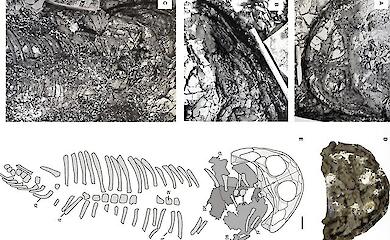
Scientists have unravelled the mystery of a fossil left in the Arctic almost 80 years ago

A single line in a 236-million-year-old bone changed the history of mammals

Scientists have discovered how snakes lived during the age of the dinosaurs
Popular news

How to cook sweetcorn properly so that it’s juicy and sweet: the best method revealed

Archaeologists have discovered who actually built Colombia’s ancient canals

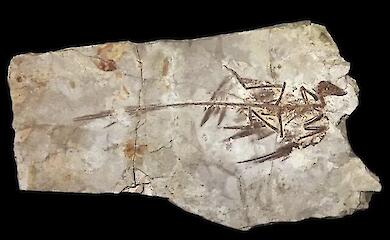
Scientists have put forward an explanation as to why there were no tiny dinosaurs
Scientists have discovered how snakes lived during the age of the dinosaurs
News about war

An expert explains how Russia is changing its tactics for strikes on Kyiv


The UN has reported a sharp rise in the number of Ukrainian civilians killed as a result of the war



3 July has been declared a day of mourning in Kyiv. The number of dead and injured is rising