
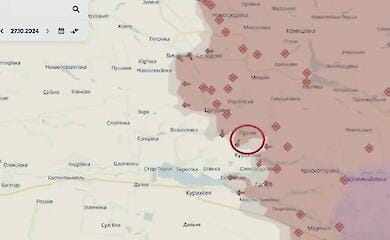

Whole species are disappearing: war is wiping out wildlife in Ukraine


Ukraine has 10 million hectares of forests, 19 nature reserves, 53 national parks and five biosphere reserves.
War has a devastating impact on wildlife and their habitats. The military conflict, now in its third year, has caused mass killings of animals, destruction of ecosystems and loss of biodiversity. Since the beginning of the Russian-Ukrainian war, Russian troops have occupied, destroyed or damaged dozens of protected areas, Sil.media writes.
Ecologist and conservationist Oleksiy Vasilyuk, who is referred to by the publication, points out that there is no exact data on such losses. According to him, our state has not kept a precise count of animals, birds and plants, and therefore it is hard to say what part of the territory has been destroyed.

At the same time, he pointed out that it is possible to make preliminary estimates.
Kakhovka reservoir
According to the publication, the Kakhovka HPP explosion caused the destruction of the habitat of the sand lance, an extremely rare species that lives mainly on the sands along the Dnieper in the Kherson region. The water flooded about half of the area where the animal lived. It is difficult to say how many animals died in the process.

A similar situation with the steppe rare rodent, the Nordman's mouse. Places where the animals lived have fallen into the flood zone. According to preliminary estimates, about 70 per cent of all mice died when the Russians blew up the Kakhovskaya HPP.
Fish and plankton, rare leeches and crustaceans living in the lower part of the Dnieper were also killed during this catastrophe.
We don't know exactly how many, but we know that all of them. As for the rare organisms in the lower Dnieper, they could have been carried out to sea. If so, they no longer exist. A huge amount of silt was carried out from Kakhovka, thickly covering a large area. It is not known who survived this pollution," Oleksiy Vasilyuk said.
Also due to the Kakhovskaya HPP breakdown the populations of more than 70 species of fish were affected, among which 18 are red-listed. The greatest losses were suffered by sturgeon fish, which at that time were making spawning migration and concentrated near the dam.
In particular, Vasilyuk pointed to the sea pikeperch.
The Kakhovka attack spoilt a zone of moderate salinity at the point where the Dnieper flows into the Black Sea. For the rare sea pikeperch it was a specific, comfortable place, thanks to which it survived," the ecologist said.
He admitted that the terrorist attack on the hydropower plant could have completely destroyed the fish's habitat and we would never see them again.
I think that two species of ants and sea pikeperch may end up on the list of extinct animals. If no one finds them in a few years, we will know that they became extinct because of the Kakhov HPP explosion," he said.

Vasmlyuk also drew attention to the catastrophic situation with forests. He noted that many forests were burnt down due to numerous enemy shellings. animals escaped from the burnt forests.
Of the animals in this area there are badger, marten, mink, long-eared owl, ossoid, river otter, ferret and others. They moved to other regions, but we don't know how their fate turned out," Vasilyuk said.
He also noted that the constant noise and explosions prevent animals and birds from breeding.
The expert pointed out that the war causes great suffering to birds. He pointed out that in the south of Ukraine in the Kherson region there is one of the largest locations in the Black Sea region for stopping birds, for example, from Scandinavia, Russia, the Baltic region, which fly further south.
The south of Kherson is a place where birds rest during their flight. They fly over the mainland, then stop at the lakes of the Kherson region and feed. This is the place where they need to fatten up to make the hard dash over the sea. Because of the Russian invasion, the birds have not been able to do this for 2.5 years. This does not mean that birds will become extinct in the whole of Europe, but we know for sure that it has created the most famous obstacle on their way," Oleksiy Vasilyuk said.

The ecologist also pointed out that the situation with nature reserves remains catastrophic, a significant part of which is occupied by Russians and nobody knows what is going on there. Among those reserves that have suffered due to the actions of the invaders is Askania - Nova.
Biosphere Reserve has been since the beginning of the Russians' full-scale invasion of Ukraine. The occupants have appropriated the property of the reserve, ravage the steppes, the animals are frightened by aviation.
The ungulates that are artificially kept there may not have suffered. But, for example, those living in the steppe could be killed by fires. And, of course, insects. For in a steppe fire, the fire spreads as fast as the wind blows. Therefore, no one will die out completely in Askania, but many will die in fires, - Vasilyuk pointed out.
The Black Sea Biosphere Reserve is partly located in Kherson and partly in Mykolaiv regions. The territory consists of island, seaside and forest-steppe areas protected by UNESCO. Birds that migrate here find shelter. The water area of the reserve is also home to 80 species of fish, which is almost half of the total species composition of the Black Sea, 2200 species of insects and over 50 species of mammals, among which there are red-listed ones: badger, river otter, monk seal, steppe mouser and dolphin.
The reserve has been occupied since the beginning of the full-scale invasion and suffers from fires due to Russian shelling. In June 2023, it was in the flood zone due to the Russians blowing up the dam of the Kakhovskaya hydroelectric power station.
Vasilyuk noted that everything that happens on the territory of the occupied reserve remains a mystery.
He also noted that the Luhansk Nature Reserve was also affected. Rare steppe species of animals live there: steppe viper, sarmatian stripe, big tushkan, steppe mouse, steppe surak. The reserve consists of several compartments. According to the specialist, its most part was damaged and what happened to its animals is unknown.
Also occupied Azov-Sivash National Natural Park. It is in the zone of active hostilities. Therefore, animals die and stop breeding.
TheVelikiy Lug National Nature Park in Zaporizhzhya region, where rare birds are found: yellow heron, killer whale, magpie sandpiper, black-footed booby, grey goose, white-tailed eagle, caraway, grey duck, is mined, the Russians are digging trenches there.
Among those affected is the Oleshkovskie Sands National Nature Park. This is one of the largest sand massifs in Europe in the Kherson region. Rare animals live there. The occupants set fires and dig trenches there.
TheKremen Forests National Nature Park in the Luhansk region, based on the North Donetsk National Nature Park, was home to the rare grey crane, Imperial Eagle, river otter, ermine and mink. The park has been mined.
Oleksiy Vasilyuk emphasises that nature has seen more cataclysms than war over billions of years and expressed hope that the destroyed territories will produce a new fauna of animals, birds and organisms for which these areas will be comfortable for life.
Elena Rasenko writes about science, healthy living and psychology news, and shares her work-life balance tips and tricks.
Related news

Scientists have uncovered the story of a plastic lid that floated across the ocean


Court allows construction of Osokorky Ecopark in Kyiv. Environmental activists say fight will continue

3 July has been declared a day of mourning in Kyiv. The number of dead and injured is rising

Popular news


Scientists have discovered that power among the Scythians was passed down through the family line


Navrotsky has announced a ban on the red-and-black flag in Poland: what will change

News about war
The UN has reported a sharp rise in the number of Ukrainian civilians killed as a result of the war

3 July has been declared a day of mourning in Kyiv. The number of dead and injured is rising