
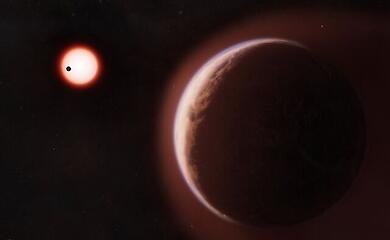
The ‘James Webb’ has accidentally discovered a new planet


The James Webb Space Telescope has accidentally discovered a giant planet in one of the most extensively studied young star systems. Astronomers were not looking for it as a separate point of light — the planet’s existence was revealed by the chemical ‘barcode’ of its atmosphere.
The new world has been named Beta Pictoris d. It is located approximately 63 light-years from Earth and is at least twice as massive as Jupiter. This is now the third known planet in the system of the young star Beta Pictoris.
There is little hope of it being habitable. Beta Pictoris d is a hot gas giant with no solid surface. The significance of the discovery lies elsewhere: the new method will enable the search for planets that are obscured by cosmic dust and the light of their host stars.
Details
The star Beta Pictoris is located in the constellation Pictor. Its age is estimated at around 23 million years — which is very young by cosmic standards. By way of comparison, the Sun is around 4.6 billion years old.
The young star is surrounded by a large disc of dust, gas and debris. This is material left over from the formation of the planets. Thanks to its proximity to Earth and the disc’s almost edge-on orientation, the system has become a unique natural laboratory in which astronomers study the birth and early evolution of planets.
Prior to this new discovery, two gas giants were known to exist in the system — Beta Pictoris b and Beta Pictoris c. Both have been directly observed using telescopes. This means that astronomers have detected the light from the planets themselves, rather than just their effect on the star.
The researchers used the NIRSpec spectrograph on board the James Webb Space Telescope to study the atmosphere of the previously known planet Beta Pictoris b. The instrument simultaneously captures an image and breaks down the light from each part of the image into individual wavelengths.
In one section of the data, where a relatively flat light curve from the dust disc was expected, the scientists observed an unexpected sequence of peaks and troughs. This pattern is created by carbon monoxide molecules in the atmosphere of the large planet. The authors compared it to a chemical barcode.
By analysing the shift in the spectral lines, the researchers determined the object’s velocity. Its position, motion and orientation relative to the dust disc indicated that it was a planet orbiting Beta Pictoris, rather than a distant star or a brown dwarf that happened to be in the same region of the sky.
Subsequent observations using another instrument on the James Webb Space Telescope, MIRI, revealed traces of water vapour and methane in the atmosphere. The presence of these substances is not indicative of the possibility of life: water, methane and carbon monoxide may be common components of the atmospheres of young gas giants.
According to current estimates, the mass of Beta Pictoris d is around 2.4 times that of Jupiter, whilst its radius is approximately 30 per cent larger than Jupiter’s. The temperature reaches approximately 600 kelvins, or 325 °C. The planet still retains the heat left over from its formation.
It is located approximately 26 astronomical units from its star. One astronomical unit is equal to the average distance between the Earth and the Sun. If Beta Pictoris d were in our solar system, its orbit would lie between Uranus and Neptune. It takes approximately 91 years to complete one orbit around its star.
Independent discovery
Almost simultaneously, another group of astronomers confirmed the existence of Beta Pictoris d. They used the European Southern Observatory’s Very Large Telescope in Chile and spotted a faint planet in images of the system.
The researchers then reviewed archived observations and discovered that the object had been visible in the images for more than ten years. It had not been noticed before because it is about 100 times fainter than Beta Pictoris b and blends in with the light from the dust disc.
These are therefore two independent and complementary studies. Ground-based telescopes helped to track the planet’s motion and assess its key properties, whilst the James Webb Space Telescope detected molecular signatures in its atmosphere. The discovery was announced by NASAand the European Southern Observatory.
Why this is important
Beta Pictoris has become only the second known system in which at least three planets have been directly observed. Another such example is the HR 8799 star system.
The new planet may explain some of the peculiarities of the disc surrounding the star. It has a sharply defined inner edge and other unusual structures. Astronomers had previously speculated that these features might have been formed by the gravity of another, as yet undiscovered, planet. The mass and position of Beta Pictoris d are consistent with this scenario, although this remains to be verified through further observations.
The method of discovery itself is no less important. In standard images, a faint planet may be indistinguishable from a glare, instrument noise or a region of the dust disc. The spectrum allows researchers to search for specific molecules characteristic of a planetary atmosphere and to ignore much of the background light.
Beta Pictoris d became the first directly observed planet to be initially identified primarily from a medium-resolution spectrum. In the future, this approach may help to find other worlds in young, dust-filled systems.
Background
Most known exoplanets cannot be seen separately from their stars. Astronomers detect them indirectly — for example, by a slight dimming of the star’s light as the planet passes in front of it, or by wobbles in the star’s motion caused by the planet’s gravity.
Direct observation is considerably more difficult. A star can be millions or even billions of times brighter than the planets surrounding it. This method works best for young gas giants located far from their star: they have not yet had time to cool down and continue to emit a great deal of heat.
Beta Pictoris is particularly well-suited to such studies. It is relatively close, and its young planets are bright enough in the infrared spectrum. However, the dust disc surrounding the star both helps us to study the formation of the system and hinders the search for faint objects within it.
This new discovery shows that even well-studied systems can harbour unknown planets. It also allows us to compare three gas giants at once, which formed at roughly the same time and from the same material.
Source
The main study by Aidan Gibbs and his colleagues, ‘Discovery of an Exterior Third Planet Orbiting β Pictoris’, was published in *The Astrophysical Journal Letters* in 2026.
Mykola Potyka has a wide range of knowledge and skills in several fields. Mykola writes interestingly about things that interest him.
Related news
Scientists have observed tiny vortices on the Sun’s surface for the first time

A scientist has proposed a way to preserve life on Earth after the Sun’s demise
Astronomers have determined just how large the Universe’s largest galaxy is
A new crater is set to form on the Moon – scientists will be watching it come into being
Popular news

Ukrainian security services have been recognised as among the best intelligence services in Europe – L'Express


Irina Levchenko, the abducted Ukrainian journalist, has been transferred to the Donetsk remand centre: what is known


Russia has attacked Lviv with drones and missiles: dozens of residential buildings have been damaged and there are casualties

Traces of a vast ancient civilisation have been found beneath the Amazon rainforest

News about war

The UN has reported a sharp rise in the number of Ukrainian civilians killed as a result of the war


3 July has been declared a day of mourning in Kyiv. The number of dead and injured is rising