


Budanov tells journalists "good news" about the situation at Zaporizhzhya NPP


The threat level of a terrorist attack and a man-made disaster at the Zaporizhzhya NPP has decreased. But the situation is unpredictable as the Russians are still occupying the plant.
The head of the Main Directorate of Intelligence, Kyrylo Budanov, said this in an interview with Reuters.
According to him, the threat of a terrorist attack at the Zaporizhzhya nuclear power plant by the Russians has decreased. However, Budanov did not comment on what has been done to reduce the threat.
I`m sorry, I can`t tell you what`s happened recently, but the fact is the threat is diminishing," he said. - It means that at least all of us together through our joint efforts have somehow postponed a man-made disaster.
He added that the threat will remain as long as the occupants remain at the plant.
It has not been eliminated. As long as the station is occupied, it may never happen again if they want to," he said.
Budanov also commented on the Ukrainian counter-offensive
The counter-offensive is continuing. On the whole, let us say, it is going on. There will be success, but later," he said.
He compared the Ukrainian operation to the Russian Federation's months-long attempts to seize Bakhmut.
I want to remind you of that famous Bakhmut story. The Russians attacked it for more than 10 months. Our task is a bit bigger than Bakhmut, but we have a bit less time than 10 months.
Recall that the Russians mined the ZNPP as early as last year. However, in the summer of 2023, Ukrainian intelligence reported that the occupiers had planted additional explosive devices, booby-trapping the cooling pond, and satellite images recorded new unknown objects on the roof of Unit 4.
Budanov then claimed that the invaders had already selected and approved a plan for the terrorist attack.
The Ukrainian Defence Ministry said the Russian Federation deliberately escalated the situation near the Zaporizhzhya nuclear power plant. This is probably how the enemy wants to take advantage of the situation to turn the tide of the war in its favour.
One of the workers, who remain at the plant, said there are no signs that the Russians will leave the plant. On the contrary, he said, the occupiers are building up their presence and establishing firing positions around the perimeter of the ZNPP.
According to Volodymyr Borysenko, head of the nuclear energy department at the Institute for Nuclear Power Plant Safety Problems of the National Academy of Sciences of Ukraine, there will be no "second Chernobyl" if ZNPP explodes.
If there is an explosion.
Scientists found out that radiation could first hit the south of Ukraine, particularly Kherson and Zaporizhzhya, and then spread throughout the entire territory of Crimea. Next, radiation across the Black Sea could move to the southwestern part of the planet, affecting at least five countries: Turkey, Greece, Bulgaria, Moldova and Romania.
The State Agency for Exclusion Zone Management noted in August 2022 that in case of a terrorist attack at the ZNPP, the exclusion zone of about 30,000 square kilometres would become uninhabitable and uneconomic for the next 100,000 years.
Two million people would have to be resettled. Ukraine could experience a release of radioactive caesium in amounts dangerous to all life, which would contaminate soil and water.
Radioactive substances could spread to Europe, Belarus, or Russia, depending on the weather.
The consequences will depend on the speed and direction of the wind," the head of the All-Ukrainian Environmental League, Tetyana Tymochko, warned.
According to her, in case of a terrorist attack on the Zaporizhzhya nuclear power plant (ZNPP) the possible consequences could be similar to the devastating consequences of accidents at the Japanese Fukushima nuclear power plant and the US Three Mile Island nuclear power plant.
Possible consequences of a terrorist attack at a ZNPP include:
An exclusion zone of approximately 30,000 square kilometres.
Contamination of the territory of about 2 million square kilometres.
Uninhabitable area of the Zaporizhzhya region for hundreds of years.
Potential radiation contamination of up to one million people.
Loss of life of tens of thousands of people due to radiation contamination.
Pollution of Dnieper, Black and Azov seas.
Potential contamination of citizens of neighbouring countries.
What happens if the cooler at ZNPP fails
It will theoretically take years for the cooler to be emptied, Peter Kotin, Chairman of Energoatom, said in an interview with RBC-Ukraine.
According to him, the information about mined Zaporizhzhya NPP cooler appeared quite long ago.
We know that first they started mined the perimeter of the plant and the coastal part where it joins the Kakhovka reservoir. And that is where the basin line is located - it joins completely to the reservoir", - said Kotin.
He specified that it is not yet clear where the mines are located. However, no matter where the explosives are located, it is almost impossible to detonate them in such a way that water starts flowing out of the basin.
There is a chandora, a vertical gate that blocks the flow of water from the pool into the reservoir. You can either open them or blow them up. Even if they are blown up, the pond is left with a dead water level of 12.8 metres. All the water will not come out of there. It can then drain out on its own from behind the ground. But it will go one centimetre a week. It will theoretically take years to empty the cooler," said the head of Energoatom.
For now, the water level in the ZNPP cooling pond is stable
Despite the Russian occupants' undermining of the Kakhovskaya HPP dam, the situation remains stable and under control.
As of 08:00 on 7 July, a slight decrease in the water level in the cooling pond is recorded. It now stands at 16.54 m. This is sufficient to meet the needs of the plant.
The water level in the TPP channel, from which the ZNPP pond is fed if necessary, is at 11.15 m. It should be noted that lately, the water level in the channel has not dropped significantly and no longer depends on the Kakhovka water reservoir.
It should be remembered that the power units of Zaporizhzhia NPP have not been operating since September 2022, so there has been no active water evaporation from the cooling pond since then.
Earlier Socportal wrote about the dangers of uncontrolled intake of potassium iodide.
Artur Zayonts specialises in news from the frontline. A historian by education, Arthur has always sought to bring depth and context to his journalistic work.
Related news
3 July has been declared a day of mourning in Kyiv. The number of dead and injured is rising


Why migration policy in Ukraine is becoming a matter of rebuilding the country

Strikes on both sides of the Crimean Bridge: Zelenskyy announced that Russia’s key logistics and air defence systems had been destroyed

Popular news



Scientists have discovered that power among the Scythians was passed down through the family line



Navrotsky has announced a ban on the red-and-black flag in Poland: what will change
News about war
The UN has reported a sharp rise in the number of Ukrainian civilians killed as a result of the war

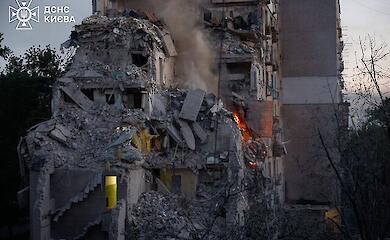
3 July has been declared a day of mourning in Kyiv. The number of dead and injured is rising