After the front, a unionist is running for the head of the largest trade union federation in Ukraine


Pavlo Prudnikov took the call sign "Atom" in honour of his Atomprofsoyuz while serving in the AFU. He was severely injured at the front, and now he is running for the post of the head of the Federation of Trade Unions of Ukraine (FTU), the largest trade union association in the country. The activist with 25 years of experience says that trade unions have enough instruments of influence - from participation in the formation of state policy to opposing laws that restrict workers' rights. The only question is how to use them.
Trade unions remain one of the few instruments through which employees can influence government decisions. They participate in the formation of the General Agreement, the document that defines basic social and economic guarantees, and can participate in the drafting of laws and block initiatives that worsen the situation of workers. In war conditions, their role is only growing - in particular, in protecting mobilised workers, veterans, and people with disabilities.
Last year, the head of the Federation of Trade Unions of Ukraine, 77-year-old Hryhoriy Osovoy, stepped down early. The FPU is due to elect a new chairman in May this year. One of the contenders is Atomprofsoyuz deputy chairman and veteran Pavlo Prudnikov.
Earlier, Socportal asked him about the participation of trade unions in the reintegration of veterans. Now Pavlo has told how he wants to change in Ukrainian trade unions and what countries he is oriented on the examples of.
Is Ukraine a social state
- During one of your speeches, you noted that according to the Constitution of Ukraine, it is a social state. What do you understand by this?
Everyone considers this question through their own instruments. For some people, a social state is a paternalistic state that takes care of all segments of the population, especially the vulnerable. It has a very serious social policy and spends everything on assistance, invests a lot of money in pensions, and helps people with disabilities. For some people, such as me, a social state is first of all one that gives all segments of the population an opportunity for a decent life.

Big pensions - they don't come out of nowhere. Businesses must work for this, and people must work for this to get big salaries. Education and health care must work for this, so that people are healthy, so that children are born, so that people are not afraid of it. A social state is, first of all, where the person himself, his life, and his health are the priority of any policy.
- And now we have this?
It is not so now. Our priorities are God knows what, but not the human being. If we look at labour relations.... An employer is a slave owner, and a working person is not a person at all. He has to work for pennies, and without holidays, without days off, and if possible 12 hours a day.
- What is the role of trade unions to remedy this situation?
Key. The current situation in Ukraine is a vivid example of what is happening in a state where trade unions do not work. It seems that we simply do not have them. Trade unions should be the voice of justice, defending the dignity of every person: employed, unemployed, pensioner, or student. But I do not hear their voice. It is only occasionally heard on Labour Day or May Day. There is no systemic work and purposeful struggle for social justice in Ukraine yet.
Trade unions are an instrument of influence
- What can trade unions influence? What important influence do they have?
We all saw 2019, when the Verkhovna Rada tried to pass the bill "On Labour", which, at the legislative level, finally turned a working person into a slave. We saw the street, the anger of the people. We saw thousands, and if you count all the cities in Ukraine, millions of people. We saw a single outburst, self-organisation, a single attribute: "Stop labour slavery". We are capable of such things. But today, for example, there is a draft of the Labour Code. I don't see any direction to overcome it. Of course, there is the war, the banning of solidarity actions, but we have huge tools in the media space.

We can organise big information campaigns there. In addition, we have a weighty tool in our hands: a memorandum was signed in 2025 in Rome at the Recovery Conference, which clearly states that it is necessary to meet in working groups to reform labour legislation. The government makes certain commitments, and the unions make certain commitments. I expected people who make decisions in this country - in the government, in business, and in the unions - who would realise movements in this direction, systematic work, and meetings. But nothing is happening.
- How would you characterise the consolidation of the role of trade unions in the European integration documents?
When I was in rehabilitation in Germany, we had very long dialogues with the leaders of German trade unions. Then the conference on the reconstruction of Ukraine should be in Berlin. And I persuaded them to insist that Ukrainian trade unions should be in the delegation, in these processes. Then, the trade union representatives did not include any delegation or working groups on the reconstruction of Ukraine. And then indeed the German trade unions talked to the German government to put it forward as a condition for the participation of the Ukrainian delegation that there should be a trade union there.
The reconstruction of Ukraine is impossible without a clear social dialogue, without the labour component of all infrastructure and investment projects. Trade unions should participate in shaping how and under what conditions Ukraine will be rebuilt, and most importantly, what kind of Ukraine we will build, what kind of socio-economic model it will have. Therefore, we are back to the social state. Are we going to build a social Ukraine? Or what kind of Ukraine? And based on what industries, what sectors?

Industrial recovery is a matter of survival
- What industries will be prioritised during the recovery, and what about the avenues in these industries?
As a trade union, I see that the reindustrialisation of Ukraine is necessary; there is bound to be a very powerful huge industrial complex. Not the model of an agrarian republic, or only providing services, we will not go far, especially with such a neighbour. We must have a very strong production and industrial base. A very strong scientific complex of innovations and, of course, a digital industry. Before the war, there was an IT union. What's wrong with it now, I can't say. In the energy sector, the unions are very powerful. As far as I can see, the coming changes, it will have to be dispersed energy and probably based on building small modular nuclear reactors. It is unlikely that anyone will rebuild thermal power plants. As far as I know, DTEK is now working on this topic very carefully. The trade unions there are very powerful. And in general, trade unions have always been strong in production and industry. This is their base. Trade unions of metallurgists, railway workers or construction workers. These are serious trade unions.
- Do you have any models to imitate trade unions from other countries? First of all, with the European Union.
Of course. Our partners are the German mining, chemical, and energy trade union IGBCE. Also, the Finnish unions are very strong. The Danish 3F has been our mentor for many years. Now we have a lot of joint training seminars with them.
- If we hope that there will be an industrial recovery in Ukraine, will industrial recovery be a new impetus for Ukrainian trade unions?
I hope that there will be an industrial recovery. Otherwise, we have no options for coexistence with the aggressor. Industrial recovery is one of the main factors of Ukraine's survival. And further, if there will be re-industrialisation, then of course trade unions cannot fail to spring up there.
- Are certain neoliberal reforms that our government is proposing presented as European integration reforms? Do trade unions have the ability to check this?
We work directly with global unions, with the Office of the International Labour Organisation, and with the European Commission. And we can always check whether there are actually such demands. We always have clear, reliable, and truthful information about what the requirements for European integration are and the adoption of this or that law.
- After the Russian invasion, has your international co-operation intensified?
It has become closer now. We now have a lot of information from that side and about the European integration process.
Veterans at work: what needs to change
- Can you tell us how many unions are serving in the army now?
According to our Atomprofsoyuz, 5% are in the ranks of the AFU. And we have a hundred per cent reservation at almost all enterprises. That is, 5% are those people who left as volunteers. Now we had a meeting with the Trade Union of Railwaymen of Ukraine. They have about 15 thousand workers in the ranks of the AFU.
- Can we say that the skeleton of the army is the industrial working class?
Yes, of course. Or the self-employed. I had a lot of people in my unit, FLPs, at best, or just self-employed people who were engaged in repairing flats, repairing equipment, service, providing services, transport, etc. Now they're still serving, somebody died. This is also the working class, right? A person earning with their own hands, but many of them were in the shadow sector. Still, they worked from dawn till night, no weekends. Now they're all at war.
- What should be the veteran policy of trade unions?
Trade unions must implement the veteran policy at the enterprise level. At the level of the state, at the level of the ministry, at the level of local councils, they are actively working on this policy, and it has an effect. There are commissioners for veterans' affairs. But it is at the enterprise level that, when a person returns to his workplace, the system must also work. Psychologists must work.
Firstly, with the staff: how to communicate with a veteran. These same psychologists must also work with returning military personnel. We are lucky that our nuclear facilities have such psychologists on staff. They themselves, on their own initiative, have worked out such seminars, trainings on helping families, working with personnel, working with management, and how to behave properly with a veteran.
Secondly, when a veteran comes to his workplace, you have to work with him as a specialist, because during the years he was at the front, he lost a lot of professional skills. He learnt how to fight, how to load and unload a car, or drive tanks. He has learnt a lot of things, but his professional skills as a specialist at work are improving little by little. He should have a course to update his professional skills. If he returns with such an injury that he cannot fulfil his previous work function, the company must bear the cost of retraining him. And in the occupation that suits him. And it's not just one person coming back; there will be several. They need somewhere to meet, to socialise. Trade unions can take the initiative and create such a system at enterprises.
Military experience in rethinking the role of trade unions
- Did the military experience make you rethink the role of trade unions?
Yes. Perhaps we should talk less and work more. If you've made a decision, you have to carry it out. If you have a chance to do something, you have to move forward.

- Can we say that to a certain extent, this pushed you to the decision to run for the head of the Federation of Trade Unions of Ukraine?
This was one of the main motivations. In my opinion, today there is really a huge crisis in the trade union movement. And no offence to the management team of the Federation of Trade Unions of Ukraine, but I think we need a slightly different team with a different vision. I have a different approach to what the FPU should be doing. That is why I made the decision to head the Federation of Trade Unions of Ukraine.
- And what urgent changes in the work should there be?
A change of logic in the transition from a reactive position, when we only react, to a proactive one. When we have to build the future ourselves. We must have our own vision of reform, our own vision of national standards, our own vision of fair wages. And we must also have very high negotiating skills. So that we can defend our vision. Or if not enough of our own teaching, at least to counter the most anti-union and anti-worker initiatives. I don't see that now.
- What is the most anti-union and anti-labour bill right now? Is it the draft of the new Labour Code?
Yes, the new Labour Code of Ukraine. But I would not drop the draft law on social dialogue and I would not drop the draft law on workplace safety and health care. These are three bills on which there are very huge risks today that worsen the situation of the wage earner.
"Ukraine has always had strong solidarity"
- Why should Ukrainians think about trade union membership, those who are not yet members of trade unions?
Because Ukraine has always been a strong supporter of solidarity. That is, both self-sacrifice and solidarity helped Ukrainians to survive throughout our history. Only that. And solidarity and self-sacrifice are the basic principles on which the trade union movement stands. We are not proposing anything new - we are proposing to live in the paradigm of Ukrainianism. The trade union movement is inherent to Ukraine.

Expert on women's rights, persons with disabilities, motherhood in the modern context, health care reform, education and social welfare.
Related news

Court allows construction of Osokorky Ecopark in Kyiv. Environmental activists say fight will continue


The invisible labor of war: why Ukraine should review salaries and social guarantees

50% of workplaces in Ukraine do not meet safety standards — head of the Builders' Union
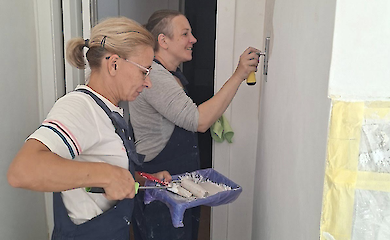
To Rebuild Ukraine: Why People of Different Professions Are Mastering Construction Professions
Popular news
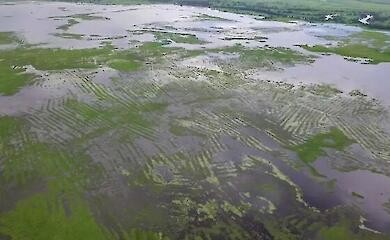
Archaeologists have discovered who actually built Colombia’s ancient canals

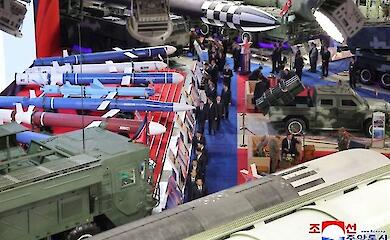
Russia has received new weapons from North Korea: which regions of Ukraine could be at risk

Henry VIII’s long-lost castle has been found inside another castle
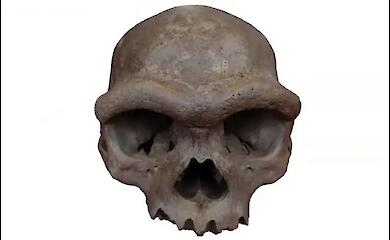
Bones of ancient humans found on the seabed of the Taiwan Strait suggest they were up to 190 cm tall

News about war
An expert explains how Russia is changing its tactics for strikes on Kyiv

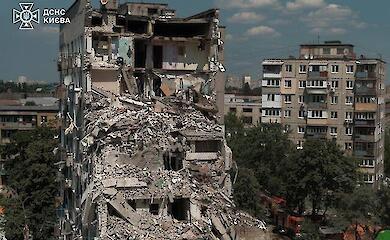
The UN has reported a sharp rise in the number of Ukrainian civilians killed as a result of the war