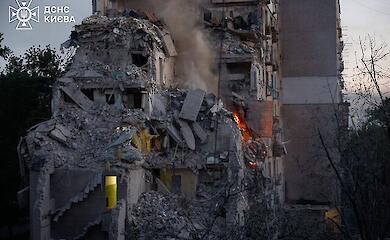
How Hungary said goodbye to Orban. Photo report
- Home
- Overseas
- War in Ukraine. The storybook
- How Hungary said goodbye to Orban. Photo report


Hungary's openly anti-Ukrainian Prime Minister Viktor Orban is resigning for the first time in 16 years. The Socportal publishes a report from the fateful election day.
The 2026 parliamentary elections in Hungary were marked by the highest turnout since 1990 - about 78 per cent. Tensions were high, and the ruling "Fidesz" party, which at the end of its rule had become an outspoken follower and ally of Putin's Russia, resorted to direct manipulation.

Hungarian cities were plastered with photos of Ukrainian President Volodymyr Zelensky, allegedly running as the opposition candidate of the Tisza party, Péter Madjár. Artificial intelligence-generated videos of Hungary being drawn into war were published. Viktor Orbán claimed that only his candidacy would ensure the country's independence from external rule by Brussels and Kyiv.

However, he kept silent about his growing dependence on Russia. For example, shortly before the election, recordings of conversations between Hungarian Foreign Minister Péter Szijjártó and Russian Foreign Minister Sergey Lavrov appeared in the media, in which Szijjártó gave Moscow information from closed EU discussions and promised to block Ukraine's financing and accession to the EU.
For his part, opposition figure Madjar pointed both to the internal problems accumulated during Orban's 16-year unchallenged rule and the risk for Hungary of becoming a puppet of the Kremlin. That threat probably looks far more ominous to the Hungarian voter than subordination within the EU, much less the hypothetical influence of a Ukraine desperately fighting for its freedom. At one of the largest election rallies in support of the opposition, the main slogan of the 1956 Hungarian uprising was "Ruszkik haza", "Russians, go home!"

Although during his rule, Orban significantly changed the electoral system, tweaking it to suit himself and restricting freedom of speech, he lost the election. The visit of American Vice President J.D. Vance on the eve of the vote did not help either.
For her part, European Commission President Ursula von der Leyen wrote on social media immediately after the results were announced:
Hungary has chosen Europe. The country is returning to its European path.


How Hungarians celebrated Orbán's defeat
Despite the tense media environment before the election, voting day itself was peaceful. Opposition supporters gathered on the Danube embankment overlooking the parliament. Large screens broadcast the vote count and an address by opposition leader Peter Madjar. At the beginning, he was cautious and noted that he assessed the results with cautious optimism. However, it soon became known that Tisa had gained a constitutional majority - 138 out of 199 mandates. This allows to radically change in the policy of the state. After the results were announced, an atmosphere of popular festivities prevailed: people chanted opposition slogans in the metro and on the streets, congratulating each other on the victory.
Ukraine and "Friendship" issues
Ukrainian President Volodymyr Zelensky also congratulated Madjar on his victory.
Ukraine has always sought good-neighbourly relations with everyone in Europe, and we are ready to develop cooperation with Hungary," he wrote on social media.
This is an important moment for Ukraine, as an openly hostile politician has effectively lost power. According to Politico, to mend relations with Brussels, Hungary is likely to unlock a vital €90bn loan from the EU for Ukraine. It is on this very issue that relations between Kyiv and Budapest have been extremely strained in recent weeks. This culminated in the detention of a car of the Ukrainian Oschadbank's cash collectors, who were taking valuables from Austria to Ukraine through Hungarian territory. By the way, the money and gold bars confiscated by the Hungarians, allegedly as evidence of the financing of the military mafia, have still not been returned.

At the same time, "Tisza" party leader Madyar opposes supplying Kyiv with weapons and direct financial aid, and promised to put Ukraine's accession to the EU to a referendum. Madjar also wants to resume supplies through the Druzhba oil pipeline. Slovak Prime Minister Robert Fizzo supports him in this. These countries plan to give up Russian energy resources gradually.
Madjar comes from Orban's entourage, who scandalously left the party in 2024. After that, he created his own political force, "Tisza". At the same time, he visited Ukraine.
"Tisza" should become a transitional parliament that would restore the rule of law and democratic practices, reverse Orban's constitutional changes, launch anti-corruption investigations against some of Orban's oligarchs or against Foreign Minister Szijjártó for state treason. And restart the party system anew - already with real ideological parties instead of the old discredited ones, says Denys Pilash, a political scientist and activist of the Social Rukh organisation.
According to him, "Tisza" is a kind of "empty signifier" with the most blurred ideology, which can be conditionally referred to the liberal-conservative spectrum. However, its members include, for example, a writer and human rights activist in favour of Roma rights.
ʼ

Currently, only three parties have made it into the Hungarian parliament: the opposition, which has become a "mono-majority"; the representatives of the previous government; right-wing conservatives "Fidesz"; and the far-right "Our Homeland" (Mi Hazánk Mozgalom).
More photos and videos from the day of the Hungarian parliamentary elections on 12 May 2026, check out our Instagram.
Expert on women's rights, persons with disabilities, motherhood in the modern context, health care reform, education and social welfare.
Related news
Callas: The EU is preparing its largest package of sanctions against Russia since the start of the full-scale war

Why Ukrainians may not return home after the war: it's not just about security

The European Union has explained why Ukraine’s accession process is being delayed – FT

Refugee policy as a test for European integration: how Ukraine and other candidate countries pass it

Popular news

Russia has received new weapons from North Korea: which regions of Ukraine could be at risk
Henry VIII’s long-lost castle has been found inside another castle


Bones of ancient humans found on the seabed of the Taiwan Strait suggest they were up to 190 cm tall


News about war
An expert explains how Russia is changing its tactics for strikes on Kyiv

The UN has reported a sharp rise in the number of Ukrainian civilians killed as a result of the war