The rock had been kept in the museum for 30 years — it turned out to contain the bones of a mosasaur


A piece of rock containing the remains of a mosasaur — a huge marine reptile that lived during the age of the dinosaurs — had been kept in a Japanese museum for around 30 years. When scientists decided to re-examine the unprocessed specimen, they discovered four more fossilised bones inside.
Among them was the very front part of the upper jaw. This is the first premaxilla of a mosasaur to have been positively identified amongst the finds from Japan.
Another bone, which in life was situated near the base of the brain, differs from similar bones in known mosasaurs. The researchers suggest that the remains may belong to a new species. However, this is still a preliminary conclusion: a scientific paper formally describing the animal has not yet been published.
Details
The fossils were discovered between 1990 and 1992 in the Sobura area of Kaizuka City, located in Osaka Prefecture, Japan. The specimens were subsequently transferred to the Kishidawa City Museum of Natural History.
Some of the bones were visible and examined immediately, but certain fragments remained embedded within the unprocessed rock. Around three decades later, researchers decided to revisit the old find and discovered a further four bones.
The most notable find was the premaxilla — the front section of the upper jaw where the teeth of mosasaurs were situated. Previously, this part of the skull had not been definitively identified among Japanese fossils of these marine reptiles.
According to the researchers, thirty years ago there was considerably less comparative material available. Over the past decades, palaeontologists have found and described new mosasaur remains from various parts of the world. Thanks to this, the bone from the Japanese museum could be compared with other specimens to determine which part of the skull it belongs to.
A possible unknown species
It was not the premaxilla but the main sphenoid bone, located near the base of the skull, that proved particularly interesting. On it, the scientists noticed an unusual combination of features.
The bone retains short, laterally directed processes, but lacks a longitudinal groove on its lower surface. This combination has not yet been observed in previously described mosasaurs.
This suggests that the Japanese remains may belong to an unknown species. However, this hypothesis can only be confirmed following a more detailed anatomical comparison and the publication of the results in a scientific journal.
For the time being, the animal has no new name, and the researchers have not officially designated it as a separate species. The findings were presented at a scientific conference and have not yet undergone a full peer-review process.
What were mosasaurs?
Mosasaurs were large marine reptiles that inhabited the oceans during the Late Cretaceous period, approximately 98 to 66 million years ago. Some species grew to ten metres or more in length and occupied the top of marine food chains.
Despite often being depicted alongside dinosaurs in films and popular books, mosasaurs were not marine dinosaurs. They represented a distinct group of reptiles, related to modern lizards and snakes.
Mosasaurs had elongated bodies, powerful jaws and limbs adapted into flippers. They hunted fish, cephalopods, turtles and other marine animals. The group became extinct around 66 million years ago during the mass extinction at the boundary between the Cretaceous and Palaeogene periods.
Why this is important
The discovery expands our understanding of the mosasaurs that inhabited the north-western Pacific Ocean. Fossils of these animals are found in Japan, but many specimens are fragmentary, making it difficult to reconstruct the diversity of local species.
If the differences in the bones are confirmed, scientists will be able to describe yet another mosasaur from this region. This will help to provide a more accurate picture of which marine predators lived near the territory of modern-day Japan at the end of the Cretaceous period.
History also demonstrates the value of museum collections. Unprocessed pieces of rock can harbour unnoticed bones for decades, whilst new methods and a wealth of comparative material allow discoveries to be made without the need for further excavations.
Background
Museum finds are often re-examined decades later. When a specimen first comes into the hands of scientists, it may be impossible to clean it thoroughly or identify it accurately due to a lack of time, equipment or comparative material.
As palaeontology advances, old fossils are given a new context. A bone that previously seemed to be an unidentifiable fragment can now be compared with recently described skeletons and its position within the animal’s body determined.
In the case of the Japanese mosasaur, it was precisely the anatomical data accumulated over 30 years that made it possible to identify the premaxilla for the first time and to note features that potentially distinguish the animal from known species.
Source
The find was studied by a team from Okayama University of Natural Sciences, Tokyo City University, the Kishidawa City Museum of Natural History and other Japanese institutions. The study was conducted by Yasuaki Takano, Shōji Hayashi, Yasuhisa Nakajima, Satoshi Utsunomiya, Yuma Asai, Miho Kazama and Katsunori Watanabe.
The findings were presented on 27 June 2026 at the 177th Annual Meeting of the Palaeontological Society of Japan at Osaka Metropolitan University. The researchers reported on four bones recovered during a re-examination of a museum specimen, including the first premaxilla of a mosasaur to be positively identified in Japan.

Mykola Potyka has a wide range of knowledge and skills in several fields. Mykola writes interestingly about things that interest him.
Related news
A reptile that lived before the dinosaurs appeared has been discovered in Brazil

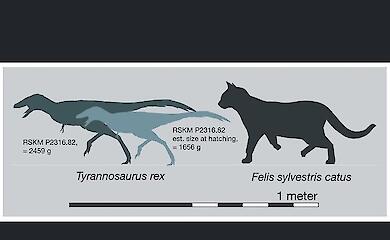
Scientists have discovered how Tyrannosaurus rex hatchlings were born
A tiny bird from the Jurassic period has revealed how dinosaurs lost their tails
Popular news
An antidote to one of the most potent marine venoms has been found in frogs
Traces of water heated to 300 degrees have been found near the “Lost City”

Navrotsky has announced a ban on the red-and-black flag in Poland: what will change

News about war

The UN has reported a sharp rise in the number of Ukrainian civilians killed as a result of the war



3 July has been declared a day of mourning in Kyiv. The number of dead and injured is rising