Astronomers have discovered a super-Earth in a neighbouring red dwarf


Astronomers reported the discovery of a new planet at the star Ross 318 - a small red dwarf, which is about 28 light years from Earth. The planet has been named Ross 318 b. According to calculations, it is at least 6.2 times heavier than Earth and makes a full revolution around its star in about 39.6 days.
Such planets are called super-Earths. This does not mean that they are necessarily Earth-like or habitable. The term refers only to size or mass: super-Earths are heavier than our planet, but usually smaller than Neptune.
Ross 318 b is interesting because it receives less heat from its star than Earth does from the Sun, and may be in the so-called habitable zone. But that's not proof of life, or even proof of water. So far, we are talking about calculations and observations published as a preprint on arXiv, that is, before a full journal review.
Details
Ross 318 is a red dwarf. Such stars are smaller and cooler than the Sun, but are often magnetically active. This makes it difficult to find planets: spots and flares on the star can create signals that look like the footprint of a planet.
To test the signal, the researchers used data from the CARMENES and HIRES spectrographs collected over 15 years, as well as observations from the TESS space telescope. The planet was found not from a direct image, but from a faint "wiggle" of the star: the planet's gravity shifts the star slightly, and this can be seen in its spectrum.
The authors estimate that Ross 318 b is about 0.16 astronomical units away from its star. That would be very close for the solar system, but the red dwarf is much dimmer than the Sun, so conditions there may be more moderate.
The planet's minimum mass is about 6.21 Earth masses. The radius has not been directly measured: the authors estimate it to be about 1.74 Earth radii, but this is a calculation, not an observation. TESS did not see the planet pass through the star's disc, so its size and atmosphere cannot yet be studied as conveniently as those of transiting planets.
The authors estimate the equilibrium temperature of Ross 318 b to be about 237 K, that is, about -36 °C. This is not the surface temperature in the usual sense: the actual temperature depends on the atmosphere, clouds, surface composition, and other factors.
Why it matters
Ross 318 b is relatively close to us by astronomical standards. Such planets are particularly interesting because they are easier to study with repeated observations.
The discovery also shows how difficult it is to find planets in active red dwarfs. The star Ross 318 itself creates a lot of "noise", and astronomers had to separate the possible signal of the planet from the activity of the star. If the findings are confirmed, it will be a good example of how old and new observations can be combined to find small planets near the solar system.
Background
Red dwarfs are the most common stars in the Galaxy. They live very long lives and often have planets. That's why astronomers look carefully for Earth-like and super-Earth-like worlds in them.
But these stars have a problem: many of them are active. Flares, spots and magnetic processes can affect the conditions around the planet and interfere with the observations themselves. That's why every new discovery in a red dwarf requires particularly careful testing.
Ross 318 b was discovered using the radial velocity method. This is one of the main ways to search for exoplanets: it does not show the planet directly, but allows you to notice its gravitational influence on the star.
Source
G. Conzo, M. Moriconi, and S. A. Corrêa, "Detection and Characterisation of the Temperate Super-Earth Ross 318 b", arXiv, 2026.
In the paper, the authors reanalysed 15 years of CARMENES and HIRES data and supplemented them with TESS observations. They reported a Ross 318 b planet with an orbital period of about 39.63 days and a minimum mass of 6.21 Earth masses. The paper is still posted as a preprint, so the findings should be considered preliminary until peer-reviewed publication.
Mykola Potyka has a wide range of knowledge and skills in several fields. Mykola writes interestingly about things that interest him.
Related news
A scientist has proposed a way to preserve life on Earth after the Sun’s demise

Astronomers have determined just how large the Universe’s largest galaxy is
A new crater is set to form on the Moon – scientists will be watching it come into being
Ancient astronomers could see a star that was 12 times brighter than it is now
Popular news
Ukrainian security services have been recognised as among the best intelligence services in Europe – L'Express


Irina Levchenko, the abducted Ukrainian journalist, has been transferred to the Donetsk remand centre: what is known

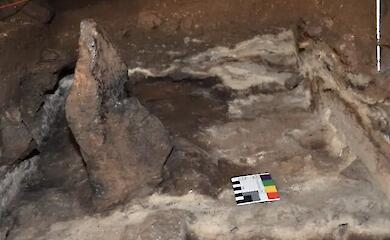
Evidence has been found in Australia of an unusual ritual that has been practised for thousands of generations

News about war

The UN has reported a sharp rise in the number of Ukrainian civilians killed as a result of the war


3 July has been declared a day of mourning in Kyiv. The number of dead and injured is rising