

A new dwarf galaxy has been discovered near Andromeda. Details


An international group of astronomers reported the discovery of a new dwarf galaxy called Pegasus VII (Pegasus VII).
A galaxy about 2.4 million light-years away has been identified thanks to data from the UNIONS (Ultraviolet Near-Infrared Optical Northern Survey). A paper detailing the discovery appeared on 13 February on the arXiv preprint server.
Why dwarf galaxies are important
Dwarf galaxies are characterised by their low luminosity and negligible mass: they typically contain "only" a few billion stars. Their evolution and activity are thought to depend heavily on interactions with larger galaxies. Due to the relative proximity of Andromeda (also known as Messier 31 or M31) and the possibility of deep surveys of its halo, this particular region has become one of the key areas for the search for new dwarf systems.
- Authors of the study: A team led by Simon E. T. Smith (Simon E. T. Smith) from the University of Victoria (Canada).
- Data: The photometric catalogues r and i from the UNIONS project were used, followed by additional observations from the CFHT (Canada-France-Hawaii) and Gemini-North telescopes.
- Location: Pegasus VII is located about 1.08 million light-years from the centre of Andromeda, implying its recent "entry" into the region of influence of M31.
Characteristics of Pegasus VII
- Luminosity: The absolute stellar magnitude in the V band is estimated to be -5.7^m, and the surface brightness at the centre is 27.3 mag/arcsec².
- Size: It has a half-light radius of about 577 light-years, making Pegasus VII the dimmest known companion to Andromeda and at the same time larger than many globular star clusters.
- Ellipticity: A magnitude of about 0.5 indicates a noticeable elongation that may be the result of gravitational influence from Andromeda.
- Metallicityand age: Metallicity is of the order of -2.0 dex, and the estimated age is about 10 billion years.
- Mass: The total mass of the stellar component is estimated to be 26 thousand solar masses.
Given the orientation of Pegasus VII, astronomers believe that the galaxy may have been tidally influenced by M31, which explains its elongated shape. Interestingly, the system has probably been "isolated" for quite some time and has only recently begun to enter the outer part of the Andromeda halo.
Why is this discovery important?
Scientists believe that Pegasus VII is just one of many dwarf galaxies yet to be discovered. In recent years, theoretical models and empirical evidence have indicated that there may be a whole "zoo" of dim galaxies lurking around Andromeda. The new finding supports this idea and contributes to a fuller understanding of how large systems like M31 and its many satellites evolve.
Details:
Smith S.E.T. et al. "Deep in the Fields of the Andromeda Halo: Discovery of the Pegasus VII dwarf galaxy in UNIONS" arXiv (2025), DOI: 10.48550/arxiv.2502.09792.
Mykola Potyka has a wide range of knowledge and skills in several fields. Mykola writes interestingly about things that interest him.
Related news
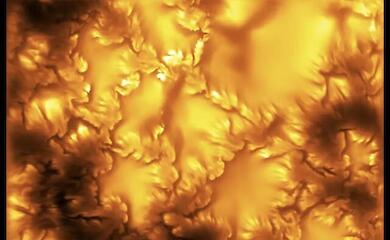
Scientists have observed tiny vortices on the Sun’s surface for the first time

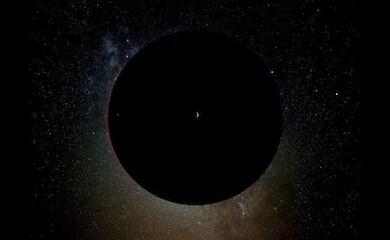
A scientist has proposed a way to preserve life on Earth after the Sun’s demise
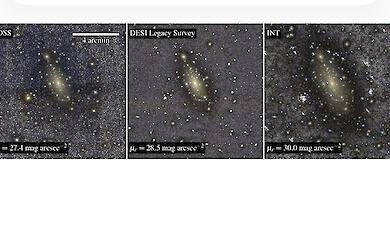
Astronomers have determined just how large the Universe’s largest galaxy is
Popular news

Ukrainian security services have been recognised as among the best intelligence services in Europe – L'Express


Irina Levchenko, the abducted Ukrainian journalist, has been transferred to the Donetsk remand centre: what is known

Scientists have put forward an explanation as to why there were no tiny dinosaurs

Russia has attacked Lviv with drones and missiles: dozens of residential buildings have been damaged and there are casualties
News about war

The UN has reported a sharp rise in the number of Ukrainian civilians killed as a result of the war


3 July has been declared a day of mourning in Kyiv. The number of dead and injured is rising