


Thermal hotspots appearing around the world: scientists sound the alarm


In 2023, Earth experienced its hottest year on record, exceeding 20th century average temperatures by 1.18 °C.
Although global warming is no longer news, scientists have discovered an alarming new trend: in certain regions of the world, recurring heat waves are becoming so extreme that they exceed the predictions of climate models.
The new study, published in the journal Proceedings of the National Academy of Sciences, presents the world's first map of such regions - a kind of "hot spots" where heat waves significantly exceed expected trends. These zones have been found on all continents except Antarctica and have already caused tens of thousands of deaths, destruction of crops and forests, and devastating wildfires.
These are extreme trends that are the result of physical interactions that we may not fully understand, says lead study author Kai Kornhuber of Columbia University. These regions become temporary greenhouses.
The study analyses heat waves over the past 65 years, highlighting areas where extreme heat increases much faster than moderate temperatures. For example, the nine-day heat wave that hit the northwestern United States and southwestern Canada in June 2021 broke daily records by 30 °C, including the highest recorded in Canada at 49.6 °C in Lytton, British Columbia.
The hardest hit regions were central China, Japan, Korea, the Arabian Peninsula, eastern Australia and parts of Africa. The most intense and persistent signal is in northwestern Europe, where heat waves in 2022 and 2023 caused 60,000 and 47,000 deaths, respectively.
Scientists note that in these regions, the hottest days of the year heat up twice as fast as average summer temperatures. They call this phenomenon "tail broadening" - the anomalous appearance of temperatures at the far upper end of the range.
The causes of these extreme heat waves are not entirely clear. One hypothesis is the destabilisation of the jet stream due to more rapid warming of the Arctic, resulting in Rosby waves drawing hot air from the south into temperate latitudes.
Because of their unprecedented nature, these heat waves are usually associated with very serious health effects and can be catastrophic for agriculture, vegetation and infrastructure," warns Kornhuber. - We are not adapted to them and may not be able to adapt fast enough.
More information: Kai Kornhuber et al, Global emergence of regional heatwave hotspots outpaces climate model simulations, Proceedings of the National Academy of Sciences (2024). DOI: 10.1073/pnas.2411258121
Source information: Proceedings of the National Academy of Sciences, Nature Climate Change
An independent researcher, interested in archaeology and sacred geography. He researches them and writes about them.
Related news


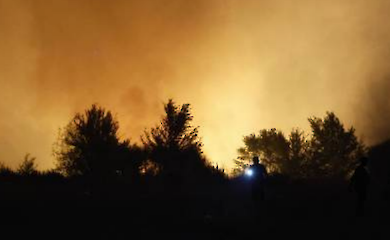
Fires are raging in the south of Europe. The situation for tourists is getting more complicated


The upper level of the Eiffel Tower in Paris is closed due to the abnormal heat wave

Popular news
Orban announces "results" of Hungarian mission on Druzhba oil pipeline

Will maternity leave be shortened in Ukraine? Changes for workers with children


Zelensky said that Russia was preparing a new offensive and pointed out the direction of it


Kellogg named the ceasefire condition today and compared Putin to Nicholas II

News about war
Orban announces "results" of Hungarian mission on Druzhba oil pipeline
Kellogg named the ceasefire condition today and compared Putin to Nicholas II
Zelensky said that Russia was preparing a new offensive and pointed out the direction of it
Russia is destroying Ukraine twice as fast as at the start of the war - international report