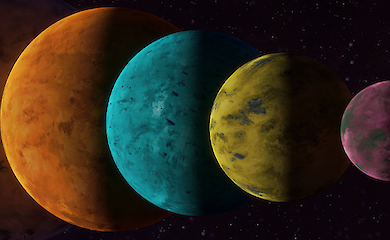
How rainbows help search for life on other planets


If you've ever noticed rainbow circles around the Moon, bright lights on the sides of the Sun, or pillars of light in freezing weather - you've witnessed atmospheric optical phenomena.
These rare and mesmerising effects are caused by the interaction of light with ice crystals or water droplets in the atmosphere. And, as scientists suggest, similar phenomena may occur on other planets outside the solar system, The Conversation reports.
On Earth, phenomena such as halos, parhelia (or "solar dogs"), glories and rainbows are well-studied. For example, rainbows only occur in the presence of spherical liquid droplets - ordinary rain. And "sun dogs" appear because of light refraction in horizontally orientated hexagonal ice crystals high in the atmosphere.
Scientists note that each of these forms of light indicates certain physical parameters of the atmosphere: composition, shape and orientation of particles, temperature and even the presence of electric or magnetic fields.
The atmospheres of other planets, including exoplanets, also contain crystalline aerosols. For example, on Io (a satellite of Jupiter) it is sodium chloride, and on Mars it is carbon dioxide crystals. These particles can form similar optical effects, especially when winds, magnetic fields and radiation pressure are involved.
The study suggests that on giant planets with dense and active atmospheres, like so-called hot Jupiters, crystals are lined up by winds of up to 18,000 kilometres per hour, like sailboats under a squall. This orientation of the crystals could theoretically create stable optical phenomena.
Scientists have already detected quartz crystals in the atmosphere of exoplanet WASP-17 b using the James Webb Telescope. These elongated particles are particularly sensitive to wind flow, making visual effects possible.
Although the human eye cannot see such phenomena on other planets, JWST instruments make it possible to record their spectral traces. For example, using glorius observations, scientists have detected persistent clouds on the exoplanet WASP-76 b despite the extreme heat - on one side of the planet, the temperature is hot enough to melt iron.
Mykola Potyka has a wide range of knowledge and skills in several fields. Mykola writes interestingly about things that interest him.
Related news
A scientist has proposed a way to preserve life on Earth after the Sun’s demise


Scientists have explored the glacier on the summit of Mount Ararat for the first time
Astronomers have determined just how large the Universe’s largest galaxy is
A new crater is set to form on the Moon – scientists will be watching it come into being
Popular news

Ukrainian security services have been recognised as among the best intelligence services in Europe – L'Express



Irina Levchenko, the abducted Ukrainian journalist, has been transferred to the Donetsk remand centre: what is known


Evidence has been found in Australia of an unusual ritual that has been practised for thousands of generations

News about war

The UN has reported a sharp rise in the number of Ukrainian civilians killed as a result of the war


3 July has been declared a day of mourning in Kyiv. The number of dead and injured is rising