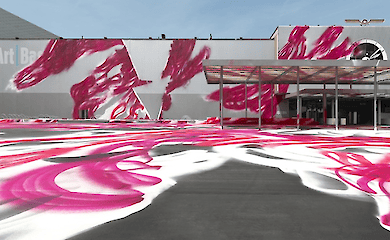


An unusual experiment has been launched in France: in the palace and park ensemble of Versailles you can now communicate... with statues.
One of Europe's most famous architectural monuments has implemented artificial intelligence to make tours of the grounds more immersive and personalised.
According to museum officials, Versailles has partnered with US company OpenAI and French startup Ask Mona. Together, they have developed a system that allows visitors to ask questions of the 20 sculptures housed in Versailles' gardens and receive live answers - in French, English or Spanish.
"Versailles is now testing an artificial intelligence that, thanks to its enormous capabilities, will greatly enrich the visitor experience," said Christophe Leribault, head of the museum.
To enter into a dialogue with the AI statue, it is enough to scan a QR code near the work of art. From this moment the user starts an interactive conversation, during which he can ask the statue about its origin, about the epoch of Louis XIV or about the life at the court.
The project says it is the first initiative of this scale where artificial intelligence is used not to improve efficiency but to deepen the cultural experience.
"Usually when we talk about AI, we think of it as a productivity tool. Here, however, AI becomes a lever for arousing curiosity," explained Marjon Carré, president of startup Ask Mona.
Each of the virtual "talking" statues is prepared with historical sources in mind and adapted to different types of questions. They can answer not only standard queries, but also unexpected ones: for example, about their creator, their place in the royal garden or the symbolism of the image.
"Whether you're an art historian, a museum curator or just visiting Versailles for the first time, this discovery is suitable for everyone," commented Julie Lave, Head of European Partnerships at OpenAI.
For OpenAI and Ask Mona, the project has become a landmark project: each year Versailles welcomes around eight million visitors, making it an ideal platform to showcase the power of AI in the cultural sector.
The project is still in the testing phase, but has already generated a lot of interest from the public and the cultural community. If the experience proves successful, similar technologies could be implemented in other museums in Europe in the future.
Maria Grynevych, project manager, journalist, co-author of Guidebook Sacred Mountains of the Dnieper Region, Lecture Course: Cult Topography of the Middle Dnieper Region.
Related news

Scientists have discovered a hidden mechanism behind the choice of friends


From The Day After Tomorrow to Mad Max: How cinema helps us understand science

Popular news

Ukrainian security services have been recognised as among the best intelligence services in Europe – L'Express

Irina Levchenko, the abducted Ukrainian journalist, has been transferred to the Donetsk remand centre: what is known

Scientists have put forward an explanation as to why there were no tiny dinosaurs


Russia has attacked Lviv with drones and missiles: dozens of residential buildings have been damaged and there are casualties
News about war

The UN has reported a sharp rise in the number of Ukrainian civilians killed as a result of the war


3 July has been declared a day of mourning in Kyiv. The number of dead and injured is rising