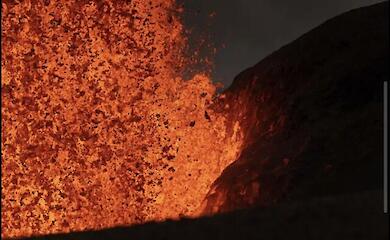

Something has been found on Mars that shouldn’t have been there. Now scientists know why


In 2024, the Curiosity rover made a completely chance discovery. Its wheel split open a rock, revealing bright yellow crystals of pure sulphur inside.
This discovery immediately baffled the scientists. On Mars, sulphur is usually found as part of minerals, rather than as individual crystals. Researchers now believe that the answer may lie in an event that took place millions of years ago.
The study has been published in the journal *Icarus*.
Why the discovery was so unusual
On Earth, deposits of pure sulphur are often associated with volcanoes or hot springs.
But in Gale Crater, where Curiosity is operating, there are no signs of such processes. Therefore, the presence of pure sulphur here seemed virtually inexplicable.
What’s more, near the first discovery, the rover also found other rocks containing sulphur.
Suspicion fell on an ancient asteroid
The researchers turned their attention to a small, eroded crater about 390 metres in diameter, situated higher up the slope.
They hypothesised that an asteroid had once struck this spot.
Computer modelling showed that the impact could have melted the sulphur-rich rocks. The resulting molten sulphur flowed down the slope, then cooled and turned into the very crystals that Curiosity happened to discover millions of years later.
Why sulphur could flow like water
At temperatures above 115 °C, molten sulphur becomes very fluid — almost like water.
Therefore, following the asteroid impact, it could well have spread across the surface until it gradually solidified.
Calculations have shown that this mechanism could explain the formation of deposits of pure sulphur, provided the original rock contained very large quantities of this element.
The authors emphasise that this is still a hypothesis, not a proven fact.
The model is based on computer simulations and has a number of limitations. For example, scientists are not yet able to accurately model the behaviour of sulphur under the extremely high pressures generated by asteroid impacts.
Curiosity itself will be able to test the hypothesis. In the near future, the rover is due to explore the area where the ancient impact is thought to have taken place.
If sulphur-rich rocks are indeed found there, the asteroid theory will receive strong support.
Why this is important
Pure sulphur has become one of Curiosity’s most unexpected discoveries in recent years.
If the hypothesis is confirmed, scientists will gain a new explanation for how unusual deposits of chemical elements form on Mars following cosmic collisions. This will also help to better understand the geological history of the Red Planet.
Background
The Curiosity rover has been exploring Gale Crater since 2012. Its main objective is to determine whether conditions suitable for life existed on ancient Mars.
Crystals of pure sulphur were discovered in the summer of 2024 after one of the rover’s wheels accidentally split a rock.
Source
Luca Maggioni et al. Impact-induced melting of materials with sparse thermodynamic data: The case of native sulphur on Mars. Icarus (2026).
Mykola Potyka has a wide range of knowledge and skills in several fields. Mykola writes interestingly about things that interest him.
Related news
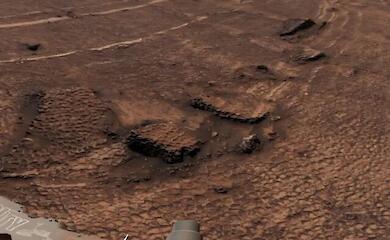
Curiosity has discovered a ‘sea’ of mysterious polygons on Mars — scientists do not know how they came to be


The robot was supposed to save NASA’s telescope from destruction — but the mission failed

A piece of a SpaceX rocket left an 18-metre-wide crater on the Moon
Astronomers have discovered a new type of astrophysical object – a ‘star with a black hole’
Popular news

Russia has received new weapons from North Korea: which regions of Ukraine could be at risk


Henry VIII’s long-lost castle has been found inside another castle


Bones of ancient humans found on the seabed of the Taiwan Strait suggest they were up to 190 cm tall

News about war

An expert explains how Russia is changing its tactics for strikes on Kyiv


The UN has reported a sharp rise in the number of Ukrainian civilians killed as a result of the war