

Russia blows up the Kakhovka HPP: what will be the consequences
- Home
- Frontline
- Terrorist attack
- Russia blows up the Kakhovka HPP: what will be the consequences

The region's flora and fauna will suffer, and some 400,000 people will not be able to engage in irrigation.
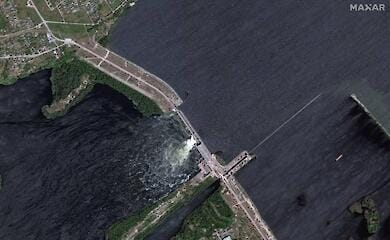
On the night of 6 June, Russia blew up the Kakhovska hydroelectric station in Kherson Oblast. The water level in the region began to rise sharply.
Experts and scientists are already speculating on the consequences of this terrorist act for Ukraine.
Journalists of Suspіlne turned to scientists of the Department of Water Bioresources and Aquaculture of the Kherson State Agrarian-Economic University for a comment. Particularly the senior researcher of the university Evgeniy Korzhov informed that the area of flooding as a result of the Kakhovka dam explosion by the Russian troops will be about 100 square kilometres, from Novaya Kakhovka to Kizomys.
However, according to preliminary calculations, the maximum water level will rise by 1.6 metres in the upper parts of the lower Dnieper (Novaya Kakhovka, Dnipryane, up to the settlement of Lvovsky). Below that, the level will rise to a metre of height from the current level and further on will be half a metre to 0.3 in the area of Kizomys. For the lower Dnipro this situation is not dangerous, because the level rise will be short-lived, not more than a week. And what are the consequences: the water from the Kakhovka reservoir will flush all the low-lying areas of the Dnieper's downstream banks and flow on.


However, according to the scientist, there will be more negative consequences after the reservoir is drained.
According to Korzhov, this may lead to water contamination and all flora and fauna that live in the sludge accumulations of the Kakhovskaya HPP will suffer.
Also, the water level in the Kakhovka reservoir could drop below the 12.7-meter mark of the Baltic system.
What would happen if the water in the reservoir dropped below the mark of 12.7 metres
Earlier, the Ministry of Environmental Protection and Natural Resources informed about the consequences of a drop in the water level of the Kakhovska hydroelectric power station.
In particular, when the water level reaches 13.2 metres, the cooling of the Zaporizhzhya plant's reactors may be stopped. This threatens a nuclear catastrophe.
If the water level drops below 13.1 m. - about 1 million people may be left without drinking water supply, mass mortality of fish and birds will start. This would threaten the epidemiological situation in the Black Sea region.
Below 12.7 m - potential shallowing of the reservoir, which will lead to the destruction of biodiversity not only of the Kakhovka reservoir, but also of the adjacent areas.

Agrarian consequences
In April 2023, journalists of the Centre for Investigative Journalism spoke to Ihor Pilipenko, a professor at Kherson State University.
He said that more than 400,000 hectares of land in Kherson and Zaporizhzhya regions will be left without irrigation. About 400-450 thousand people will have no access to drinking water, will be unable to engage in irrigation and, consequently, will have no work.
Because of this it will not be possible to grow high-value agricultural crops.
I would put all of these factors on the last place, because first of all it will be a disaster for the people who live there. The nature will survive such things. Yes, it will be different, strange, unusual after that, but the south will not have advantages in cultivation of high-yield crops anymore. So, approximately 400-450 thousand people in this area will not have access to drinking water, will not be able to do irrigation and therefore, will not have jobs
Artur Zayonts specialises in news from the frontline. A historian by education, Arthur has always sought to bring depth and context to his journalistic work.
Related news


Germany has urged its citizens to avoid travelling to Ukraine ahead of Independence Day


Why Ukrainians may not return home after the war: it's not just about security

An expert explains how Russia is changing its tactics for strikes on Kyiv

Popular news

How to cook sweetcorn properly so that it’s juicy and sweet: the best method revealed

Archaeologists have discovered who actually built Colombia’s ancient canals


Scientists have put forward an explanation as to why there were no tiny dinosaurs

An expert explains how Russia is changing its tactics for strikes on Kyiv
News about war
An expert explains how Russia is changing its tactics for strikes on Kyiv

The UN has reported a sharp rise in the number of Ukrainian civilians killed as a result of the war

