


Chinese probe reaches asteroid after a 1 billion-kilometre chase


The Chinese space probe Tianwen-2 has reached the asteroid 2016 HO3 after a journey of around 1 billion km.
The spacecraft approached the object to within a distance of approximately 20 km and began scientific observations, according to the China National Space Administration (CNSA), as reported by Phys.org.
This is China’s first mission to retrieve samples from an asteroid. If all goes according to plan, the probe is set to collect material from the surface of 2016 HO3, send a sample return capsule back to Earth, and then continue its journey to another object — the main-belt comet 311P.
For China, this is an important step in the exploration of deep space. Previously, samples from asteroids had already been returned by the Japanese Hayabusa and Hayabusa 2 missions, as well as the American OSIRIS-REx mission. Now Beijing is seeking to join the same exclusive club of nations capable not only of reaching a small body in the Solar System, but also of returning its material to laboratories on Earth.
Details
Tianwen-2 was launched in May 2025 from the Xichang Space Centre on a Long March 3B rocket. Following launch, the spacecraft entered a flight path towards the asteroid 2016 HO3, also known as Kamoʻoalewa.
According to the CNSA, the journey to its destination took around 400 days. On 2 July 2026, the spacecraft took a photograph of the asteroid from a distance of about 20 km: the image shows a small, grey, rocky object against the black backdrop of space.
The probe will now gradually carry out more detailed observations. Scientists are interested in the asteroid’s shape, its composition and its internal structure. This data is needed not only for scientific purposes, but also for a practical task: to select a safe location and method for collecting samples.
After collecting the samples, Tianwen-2 is due to jettison the return module, which will deliver the samples to Earth. The CNSA has previously stated that the capsule is expected to return in late 2027. After that, the main spacecraft will continue its journey to 311P — an object in the main asteroid belt that shows signs of cometary activity.
What is this asteroid?
2016 HO3 is a small near-Earth asteroid, often referred to as a quasi-satellite of Earth. It is not a real moon: the object does not orbit the Earth like the Moon, but orbits the Sun in a path close to Earth’s orbit. Because of this, from our perspective, it appears to be accompanying the planet. NASA JPL has described 2016 HO3 as one of the most stable examples of such an ‘almost-satellite’ of Earth.
It is precisely this characteristic that makes it a convenient and interesting target. It is relatively easier to reach than many other small bodies, yet it may hold information about the early history of the Solar System. Chinese experts have also noted that 2016 HO3 may contain ancient material that is important for studying the composition and evolution of the Solar System.
There is an additional element of intrigue: the origin of Kamoʻoalewa is still a matter of debate. Some studies have suggested that the object may be linked to lunar material – that is, a fragment knocked off the Moon’s surface by an ancient impact. However, only direct measurements and laboratory analysis of samples can provide a definitive answer.
Why this is important
Asteroids are remnants of the material from which the planets formed. Unlike Earth, where rocks are constantly changing due to geology, the atmosphere and water, small bodies can preserve the Solar System’s more ancient chemical ‘memory’.
This is precisely why sample-return missions are so valuable. Spectrometers and cameras on board the probe provide important data, but a laboratory on Earth allows the material to be studied much more precisely: its minerals, isotopic composition, and traces of water and organic compounds.
For China, Tianwen-2 is also a technological test. The spacecraft must operate near a very small body with almost no gravity, orient itself autonomously, approach the surface safely, collect a sample and send the capsule back. The CNSA explicitly states that the mission’s objectives include testing technologies for collecting samples from bodies with low gravity and for high-precision autonomous navigation.
Background
China has already carried out successful missions to retrieve extraterrestrial material: the Chang’e lunar landers have delivered samples from the Moon. However, an asteroid mission is more challenging in another respect: the target is much smaller, exerts a weaker gravitational pull on the spacecraft and is less well understood prior to the probe’s arrival.
Such missions remain rare worldwide. Japan’s Hayabusa2 collected samples from the asteroid Ryugu and returned the capsule to Earth in December 2020. The US’s OSIRIS-REx returned samples from the asteroid Bennu in September 2023.
Tianwen-2 is set to demonstrate whether China can accomplish a similar task with a different type of target — a small near-Earth object. If the mission is successful, scientists will obtain rare material from an object that could reveal a great deal about the origin of near-Earth objects.
Mykola Potyka has a wide range of knowledge and skills in several fields. Mykola writes interestingly about things that interest him.
Related news

Scientists have observed tiny vortices on the Sun’s surface for the first time


A scientist has proposed a way to preserve life on Earth after the Sun’s demise
Astronomers have determined just how large the Universe’s largest galaxy is
Popular news

How to cook sweetcorn properly so that it’s juicy and sweet: the best method revealed

Archaeologists have discovered who actually built Colombia’s ancient canals

Scientists have put forward an explanation as to why there were no tiny dinosaurs

Scientists have discovered how snakes lived during the age of the dinosaurs
News about war

An expert explains how Russia is changing its tactics for strikes on Kyiv


The UN has reported a sharp rise in the number of Ukrainian civilians killed as a result of the war


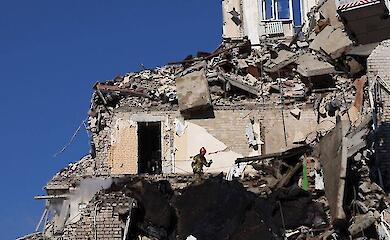
3 July has been declared a day of mourning in Kyiv. The number of dead and injured is rising