

Can monkeys write a masterpiece? Scientists have tested an old hypothesis


Last week, scientists challenged a long-standing thought experiment that monkeys randomly typing on a keyboard would sooner or later create the works of Shakespeare.
Monkeys and Shakespeare: myth debunked
Researchers from the University of Technology Sydney in Australia have analysed the probability that a single monkey typing one character per second on a keyboard with 30 keys will accidentally type the works of Shakespeare over the lifetime of the universe. The results showed that this is virtually impossible. Even the probability of a monkey typing the word "bananas" in its lifetime is only 5 per cent. Thus, the idea that monkeys can accidentally create complex literary works, refuted.
Recall, earlier researchers reported on the world's second-tiniest toad, which won silver in the Brachycephalus competition.
Also chemists from the University of California disproved the 100-year rule of organic chemistry.
The rule, known as Bredt's rule, has been proven wrong, and scientists believe it's time to rewrite textbooks.
Bredt's rule, formulated in 1924, stated that in bridged bicyclic molecules there can be no double bonds between carbon atoms in the bridging position (the so-called "bridgehead position"). It was thought that such molecules would be too unstable due to geometric distortions and stresses in the structure.
However, a team at UCLA has shown that it is possible to synthesise such molecules, called anti-Bredt olefins (ABO), and use them in practical reactions. They developed a method in which silyl(pseudo)halide molecules undergo an elimination reaction to form unstable ABOs. These unstable molecules are then "captured" by other reagents, yielding stable products suitable for further use.
In addition, physicists have established a link between dark energy and the number of black holes in the universe, and biologists have discovered that Antarctic Weddell seals plan their dives, Phys.org reported.
Dark energy and black holes: a new insight
Physicists at the University of Michigan have used data from the DESI instrument to study the connection between dark energy and black holes. Dark energy is the mysterious force causing the accelerated expansion of the universe. The researchers hypothesised thatblack holes may contain dark energy, influencing this expansion. By comparing data on the number of black holes and the level of dark energy, they found a correspondence: an increase in the number of black holes coincides with an increase in dark energy.
Professor Steve Ahlen said: 'This is an excellent mechanism to explain dark energy.
This discovery could shed light on one of cosmology's biggest mysteries.
Weddell seals: mastery of diving behaviour
Scientists have studied the behaviour of Weddell seals, the southernmost mammals. These seals can dive to depths of up to 900 metres and spend up to 90 minutes underwater. However, such extreme dives require long recovery times. The study found that seals avoid deep dives in the middle of the day. Instead, they make them in the early morning so that they can recover by midday, when the light underwater is optimal for hunting. This allows them to use their time and energy efficiently, maximising hunting success while minimising costs.
Maria Grynevych, project manager, journalist, co-author of Guidebook Sacred Mountains of the Dnieper Region, Lecture Course: Cult Topography of the Middle Dnieper Region.
Related news

Traces of inbreeding have been found in the bones of sabre-toothed tigers

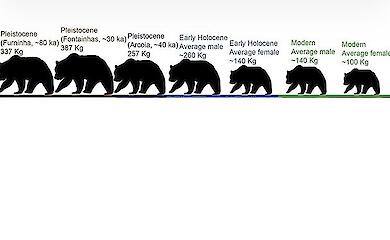
Why did Portugal’s giant bears gradually shrink to almost half their original size?

Scientists have uncovered the secret behind the dominance of female hyenas
Popular news

An antidote to one of the most potent marine venoms has been found in frogs

Traces of water heated to 300 degrees have been found near the “Lost City”

A gold tiara found in a woman’s tomb has astonished archaeologists

News about war

The UN has reported a sharp rise in the number of Ukrainian civilians killed as a result of the war


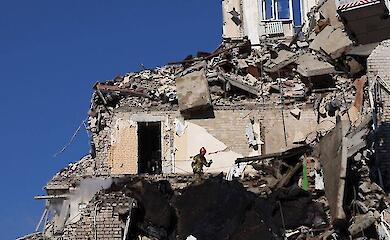
3 July has been declared a day of mourning in Kyiv. The number of dead and injured is rising