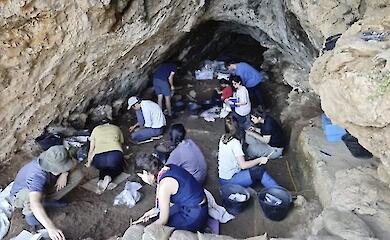

Archaeologists have discovered soft tissue from an animal that lived before the dinosaurs


Scientists have discovered an extremely rare fossil: it preserves the soft tissues of an animal that lived around 452 million years ago — long before the appearance of dinosaurs. The fossil in question is that of the ancient crinoid Dendrocrinus simcoensis — a marine animal resembling a flower on a stem, but related to starfish and sea urchins.
To be more precise, it was not archaeologists but palaeontologists who made the discovery: archaeology studies human history, whereas this concerns an ancient animal. But the story itself does indeed sound like an archaeological mystery: the stone has preserved something that almost never survives for millions of years.
Most importantly, the scientists did not find bones or a shell, but rather tubular legs — soft structures that such animals used to feed and interact with the water. For crinoids, this is only the second known instance of soft tissue preservation and the oldest to date.
Details
Crinoids are often called ‘sea lilies’. They do indeed look like plants: a stem, a calyx, and arms radiating out like ‘petals’. But they are animals belonging to the Echinodermata phylum — the same major group to which starfish and sea urchins belong.
Usually, only the hard parts of such ancient organisms remain in the fossils. Soft tissues — skin, internal structures, tentacles, and tube feet — are the first to decay. Palaeontologist Lena Cole from the University of Oklahoma has therefore compared these preservation conditions to a ‘natural fridge’ or ‘vacuum-sealed packaging’.
The new study focuses on the crinoid Dendrocrinus simcoensis from the Late Ordovician Neuville Lagerstätte site in Quebec, Canada. The find is around 452 million years old. The tubular stalks have been preserved as thin films of pyrite — a mineral sometimes referred to as ‘fool’s gold’.
Important: this is not the ‘flesh’ or DNA of the ancient animal. It is a mineral trace of soft tissues that managed to be preserved before they disappeared completely.
What exactly was found
In modern echinoderms, tube feet help them to move, capture food, breathe and sense their surroundings. In crinoids, they are particularly important for feeding: the animal filters small food particles from the water, and the tube feet help to capture them.
Scientists have discovered that the ancient tube feet of Dendrocrinus simcoensis are generally similar to those of modern crinoids, but their length and the spacing between them do not match those observed in living species. This may mean that the ancient animal fed differently: it may have held its arms in a wider, multidirectional or cone-shaped position.
Put simply, the discovery reveals more than just ‘what the ancient animal looked like’. It helps us understand how it lived and fed.
Why this is rare
Crinoids are known for their vast number of fossils. Their fossil record spans hundreds of millions of years, but almost always only the hard skeleton is preserved. According to the authors, in the approximately 485 million years of the crinoid fossil record, only one previous case of preserved tubular legs had been described.
This is precisely why the researchers describe the find as a ‘one-in-a-million’ discovery. Millions of crinoids have been preserved in the rock, but their soft tissues almost never reach palaeontologists.
What this changes
Before this discovery, scientists could say a great deal about the body shape of crinoids, but far less about the soft parts responsible for feeding and interacting with the environment. Now they have a rare, direct example.
This is important for understanding early marine ecosystems. 452 million years ago, there were no dinosaurs, mammals or flowering plants on Earth. Life developed mainly in the ocean, and crinoids were part of ancient marine communities. Such a discovery shows how these animals may have occupied their ecological niches and adapted to currents and available food.
Background
Interestingly, the discovery was not made during a new expedition, but thanks to a museum collection. The specimen was housed at the Musée de paléontologie et de l’évolution in Montreal. Its significance became clear when crinoid specialists examined the find closely.
This is a common story in palaeontology: important discoveries can lie in collections for years until scientists develop new methods, gain experience or are prompted by a specific research question. Museum collections are not merely warehouses for ancient bones, but archives of life, where undescribed finds still remain.
Source
Study: Selina R. Cole, David F. Wright, William I. Ausich, Marcel E. Cournoyer, “Exceptional soft-tissue preservation reveals the oldest evidence for tube feet and their ecological significance in crinoids”, Royal Society Open Science, 2026.
Mykola Potyka has a wide range of knowledge and skills in several fields. Mykola writes interestingly about things that interest him.
Related news
Human brain cells survived for years in a petri dish — and continued to develop on schedule

Scientists have discovered how cockroaches recognise ‘their own’


Scientists have explored the glacier on the summit of Mount Ararat for the first time
Popular news

Archaeologists have discovered who actually built Colombia’s ancient canals


Russia has received new weapons from North Korea: which regions of Ukraine could be at risk


Henry VIII’s long-lost castle has been found inside another castle
Bones of ancient humans found on the seabed of the Taiwan Strait suggest they were up to 190 cm tall
News about war

An expert explains how Russia is changing its tactics for strikes on Kyiv


The UN has reported a sharp rise in the number of Ukrainian civilians killed as a result of the war