
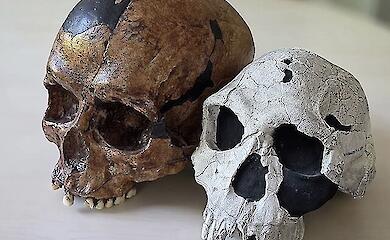

Shells from an ancient cave have revealed an unexpected link between Neanderthals and modern humans


In an ancient cave in southern Turkey, archaeologists have discovered an unexpected link between Neanderthals and Homo sapiens. This is not just a matter of stone tools or food remains, but of seashells, which had almost no practical use. It appears that both groups of people collected them.
New research on the Üçağızlı II cave suggests that Neanderthals and modern humans may not only have lived in the same region at different times, but may also have maintained similar cultural practices for over 20,000 years.
The study has been published in the *Proceedings of the National Academy of Sciences*.
This does not mean that scientists have proven the existence of a ‘shared civilisation’ between Neanderthals and Homo sapiens. However, the discovery complicates our picture of the ancient world: relations between different groups of people may have involved not only competition and chance encounters, but also the exchange of customs, technologies and, possibly, symbolic preferences.
Details
The Üçağızlı II cave is located in southern Turkey, in a region that served as an important corridor between Africa, the Levant, Anatolia and Eurasia. It was through such territories that ancient migrations of Homo sapiens took place beyond the borders of Africa, whilst Neanderthals were already living in various parts of Eurasia.
For several years, researchers carried out excavations literally millimetre by millimetre. In the cave’s strata, they found evidence of the presence of various human groups, including Neanderthals and Homo sapiens. Of particular importance are the modern human remains, dating back approximately 50–60 thousand years — a period close to the key stage of Homo sapiens’ dispersal beyond Africa.
But the main intrigue lies not only in the bones. Scientists have discovered that, at different periods, the cave’s inhabitants used similar stone-tool technologies, obtained food in similar ways and selected the same type of seashells.
Why are the shells so important?
Stone tools can be explained by practical necessity: if people live in a similar environment, hunt similar animals and face similar challenges, they may make similar tools. But with the shells, the story is more nuanced.
Sea shells were found in the cave that had almost no nutritional value. In other words, they were probably not collected because they were important as food. Such objects could have been used as jewellery, status symbols, items of exchange, or simply as objects of aesthetic and symbolic significance.
This is precisely why the shells became the key to interpretation. If different groups of people chose the same ‘impractical’ object, this may indicate a deeper cultural continuity than simply shared survival strategies.
What this tells us about Neanderthals
For a long time, Neanderthals were often portrayed as more ‘simple’ and isolated relatives of Homo sapiens. But in recent years, this picture has changed significantly. Genetic data show that Neanderthals and modern humans came into contact on multiple occasions, and most people of non-African descent still carry some Neanderthal DNA. According to studies of ancient genomes, one of the key periods of interbreeding began around 50,500 years ago and lasted for approximately 7,000 years.
Archaeology, too, is increasingly showing that different groups of ancient humans may have interacted, exchanged technologies and lived in a far more interconnected world than previously thought. For example, studies of other Levantine sites have also highlighted similarities in the behaviour of different Homo groups, including technologies, hunting methods and symbolic practices.
Against this backdrop, the finds from Üçağızlı II are significant in that they provide archaeological evidence of a long continuity specifically in the northern Levant — a region where different human lineages may have intermingled.
Why this is important
This discovery challenges the conventional narrative. Previously, the story was often described simply: Neanderthals lived in Eurasia, then Homo sapiens arrived, displaced them and brought a new culture. But the data from the Üçağızlı II cave reveal a more complex scenario.
It is possible that in some regions there was no sharp cultural break. New groups may have arrived into an already existing world of contact, cultural borrowing and shared practices. And Neanderthals may not have been a ‘dead-end branch’, completely separate from us, but rather participants in the shared human landscape of the late Pleistocene.
This is also important for understanding ourselves. If early Homo sapiens evolved not in isolation but in contact with other human groups, then the history of our species is not a story of solitary triumph, but a story of encounters, intermingling and exchange.
Background
The Levant – the eastern Mediterranean – has long been regarded as one of the key regions for studying contacts between Homo sapiens and Neanderthals. It forms a geographical bridge between Africa and Eurasia, across which various waves of migration may have passed.
The Üçağızlı II cave is significant precisely because it is situated in the northern part of this corridor. Earlier studies indicated that the site dates from approximately 75,000 to 42,000 years ago and contains Middle Palaeolithic artefacts, including stone tools and mollusc remains.
The new study adds a particularly interesting layer to this picture: not only who lived in the cave, but also what customs may have been shared between different groups of ancient people.
Source
Study: İsmail Baykara et al., “Long-term cultural continuity across the Neanderthal–modern human sequence at Üçağızlı II Cave, northern Levant”, Proceedings of the National Academy of Sciences, 2026.
An independent researcher, interested in archaeology and sacred geography. He researches them and writes about them.
Related news

For 30 years, archaeologists thought these bones were from cows — it turned out they were from a bear and a wild boar

Snakes were part of the ancient people’s diet for 3,000 years — scientists have found evidence of them being butchered
Why is childbirth so difficult for humans? The Neanderthal pelvis provided an unexpected answer
Popular news

How to cook sweetcorn properly so that it’s juicy and sweet: the best method revealed

Archaeologists have discovered who actually built Colombia’s ancient canals

Russia has received new weapons from North Korea: which regions of Ukraine could be at risk

Scientists have uncovered the ‘true curse of the mummy’—and it turns out it’s not mystical at all
News about war

An expert explains how Russia is changing its tactics for strikes on Kyiv


The UN has reported a sharp rise in the number of Ukrainian civilians killed as a result of the war

