
Unique objects in Ukraine's passport: experts told about cultural heritage

The Ukrainian passport in 2022 has acquired additional meaning. For many Ukrainians who are temporarily abroad, it reminds them of their connection to home.
Ukraine's passport is decorated with images of architectural and artistic objects from all country regions. The project of the Union of Archaeologists of Ukraine, "United by History: Ukraine's cultural heritage on the Pages of the Passport"(Facebook and YouTube channel of the Union of Archaeologists of Ukraine), will tell about the value of endangered objects as well as remind about the history of Ukraine's passport, which began its history in the early twentieth century, reports Socportal.
The passport pages depict slag heaps of Donbas and Dneproges, Kyiv shrines and picturesque towers of Kamyanets-Podolsk fortress. Unfortunately, some of this cultural heritage is now threatened or has already been partially damaged by the Russian Federation's war against Ukraine.
Passport of the UNR and ZUNR as a marker of national identity


In the Ivan Franko Museum, there is a passport of his son, aviator Peter Franko. It was issued on 4 October 1919 in Vienna and has 24 pages. The photo shows a sample of the first Ukrainian passport of citizens of the UNR and ZUNR. The passport of the UNR has all the attributes of the then document for Ukrainians who had to leave for other countries.
On the first page in the upper left corner there is a handwritten number of the document, in the centre - the coat of arms (a lion with a crown), below it is printed: "PASSPORT OF THE UKRAINIAN NATIONAL REPUBLIC". On the second page there are Peter Franko's data: place and year of birth, occupation (centurion of the Ukrainian army), the document was issued for the purpose of free movement across the territories "for the purpose of travelling and living in Yugo-Slavia (Ljubljana and Zagreb) and back," the description says.
In addition, the document has visas and stamps for countries whose borders Franco crossed. There is no photo in the document—records are in Ukrainian, French, and German.
Passports of the UNR and ZUNR were issued by the Ministry of Internal Affairs and the Ministry of Foreign Affairs of the UNR. Abroad, passports were issued by Ukrainian diplomatic missions, consulates, and passport departments for the representation of the UNR and ZUNR. They were mostly printed at the Globus printing house in Budapest. They were valid from half a year to 1-2 years. They were mostly 24 or 16 pages long. They often contained a photo, a description of the person: height, face, colour of hair, eyes, lips, nose, special features.
Researchers note that thanks to the passports of the UNR, natives of Ukraine were perceived abroad as representatives of a certain territory, representing Ukrainians in the world. Ukrainian emigrants could also obtain a UNR passport, and it was not only a document that certified their identity but also outlined their state-national belonging.
Design of a modern Ukrainian passport - memos from all corners of the country
Independent Ukraine had passports of several designs. It started with a "dark cherry book" with a small Coat of Arms; later, in 1997, the passport received a blue cover with Trident.
In 2015, the design of a new biometric passport - in addition to the small State Coat of Arms of Ukraine added an image in the form of wavy lines and the words "UKRAINE UKRAINE". The pages of the document were decorated with images of important cultural heritage objects symbolising almost every region of Ukraine.
The developers of the passport used this format to promote Ukraine's material and cultural heritage.
Since the beginning of Russia's war against Ukraine and the annexation of Crimea in 2014, some of the objects presented in the passport are under serious threat. In particular, we are talking about the fortress city of Scythian Naples, the Cumans' stone mounds and Scythian burial mounds, the ancient Chersonese Tauride in Sevastopol, the Belgorod-Dnestrovsky fortress, the pearl of Odesa's architectural appearance - the Opera and Ballet Theatre and the Dnieper Hydroelectric Power Plant in Zaporizhzhya.
These objects are part of Ukraine's cultural heritage. Their presence in your passport reminds you once again that Ukraine is united by its unique centuries-old culture.
By the way, the Ukrainian passport in 2023 rose by 4 more steps in the rating of the most influential passports in the world. Therefore, illustrations symbolising the indivisible Ukraine and reminding of monuments under threat acquire even more significance and symbolism.
Monuments under threat on the pages of a passport


Chersonesos Tauride and Scythian Naples are symbols of statehood that the Russian Federation is trying to "rewrite."
Two iconic objects from the pages of the passport since 2014 are in the temporarily occupied territories of Crimea. The occupants are trying to "fit" the history of Scythian Naples and Chersonesos of Tauris to the partly fictitious Russian historiography.
Denis Yashnyi, PhD in History, tells about it. He emphasises that both Scythian Naples and Chersonesos Tavrichesky are very important for the history of Crimea and Ukraine, as well as for European history in general.
These two monuments are almost the same age. Chersonesos Tauric appears in the 5th century BC. And Naples of Scythia two centuries later gets the status of the capital of the so-called Little Scythia. Both sites are important. Naples is actually the embodiment of the history of Scythia on the territory of Ukraine, precisely in Crimea. And Chersonesos-Tavrichesky is the first democratic formation on the territory of Ukraine. Thanks to them we can trace the continuous development of different statehoods on the territory of Ukraine - Greek settlers, and then the local population, which was subordinated to the Scythian administration, - says Denis Yashny.
According to the scientist, it is this continuity of statehood on the territory of Crimea that Russia is now trying to deny in every possible way. After all, it goes against the "great-power" Russian historiography, which tries to create the illusion that before Russia, there were no more or less stable state formations in Crimea.
Everything that existed before the Russian annexation in 1783 was either adjusted to the convenient framework of Russian historiography or forgotten. For example, many Crimean Tatar monuments have gone into oblivion," says Denis Yashny.
During the XIX century, the objects that are present in the Ukrainian passport received due attention; research was conducted there. But at the same time, part of their history even then began to be destroyed. Thus, the very name "Naples" (New City), which the monument at that time received, was dictated in a certain fashion to give special importance to the Greek period in the history of Crimea. Although scholars often identify the monument with the ancient settlement of Kermenchik.
The fate of these objects was different. If Chersonesos received a lot of attention in the XIX century, then Naples - during the construction of the new city of Simferopol, on the site of Akmestzhit, the capital of Kalga-Sultan, which was then used as a source of stone. And very many things were dismantled. And it is also important to talk about it, - notes the scientist.
Now the Scythian Naples Reserve, which was created back in 2011, has the appearance of a pseudo-reconstruction. According to Denis Yashny, this echoes the principles of Russian historiography - to fit everything to their ideas about history.
And this is a very negative trend. When some objects, monuments are out of this narrative, they are simply forgotten. And if Chersonesos managed to fit in.... But again we must understand that Russia is not writing into its historiography the ancient Chersonesos, but the Byzantine one, linking it, first of all, with the so-called Baptism of Vladimir the Great. That Naples looks like a screen for many not quite historical things, presenting a very arrogant interpretation of the history of Scythia. The very site of the Scythian settlement of Naples has turned into a pseudo-historical reconstruction with cow and horse skulls hanging on fences," the scientist says.
He adds that now it is necessary to draw attention to the threatened sites from the pages of the passport because it is, in particular, to reveal Ukraine as an operator of the world heritage.
Ukraine as a country with a part of valuable European heritage has not been much talked about outside official circles. And this heritage, although it is on the occupied territory of Ukraine, these are the monuments of Ukraine. And the fact that they are in the passport confirms that cultural heritage is an important part of Ukrainian identity. These are not just our monuments, because they are located on our territory, but also because we were engaged in them, because we researched them - Chersonesos in particular in co-operation with European scientists. And that, unlike Russia, which locked these monuments inside occupied Crimea - Ukraine opened the doors - it made these monuments accessible to the whole world," Denis Yashnyy emphasises.

Dneproges is a unique industrial facility and a symbol of scientific research.
The image of the Dnieper dam in a passport began to resonate strongly in the hearts of many Ukrainians in the summer of 2023 when the occupiers destroyed the dam of the Kakhovskaya hydroelectric power station. In August 1941, the Dnieper dam was destroyed by order of the Soviet authorities. Officially - so that the German troops could not cross the Dnieper. During the destruction of the Dnieper dam, the civilian population and the ecosystem were also affected.
Anna Yanenko, PhD in history, told this association with the image of Dneproges (or Dneprostroy). She added that the photo of an industrial object simultaneously draws attention to Ukraine's industrial heritage under threat, which suffers not only from the terrorist actions of the aggressor country, Russia but also because it is insufficiently protected by law.
For example, in Poland, the state protects their industrial heritage, which is huge ports, factories - protest movements against the Soviet Union and for an independent Poland are directly related to it. In Ukraine, industrial heritage is often ignored. For example, the brewery of M. Richert on Podol was neglected for a long time. Our legislation on such heritage is imperfect, and many questions arise on revitalisation of these objects. Public interest has started to emerge only in recent years, now there are already a number of important studies on entrepreneurs and Ukrainian businesses of the XIX - early XX century, - says Anna Yanenko.
The image of Dneproges is interesting not only because it draws attention to the problems of protecting industrial sites, the scholar adds. In the context of identity, Dneproges symbolises the invaluable protective archaeological research that was carried out during its construction.
In 1927-1932, the Dnieperges Expedition of the People's Commissariat of Education of the Ukrainian SSR (Dneprolstan/Dneprelbud/Dneproges) operated, whose work was carried out, among others, by the All-Ukrainian Academy of Sciences. The main task of the expedition was to preserve tangible and intangible historical and cultural heritage and information about the natural landscape.
The construction of any hydroelectric power station, as well as its destruction, leads to a colossal change in the water level, both downstream and upstream of the river. When on 6 June 2023 Russian terrorists destroyed the dam of Kakhovskaya HPP, - downstream there was flooding and destruction of all settlements, all archaeological monuments that are in the ground. Above - on the contrary, the water level dropped critically and artefacts began to appear at the bottom of the Kakhovka reservoir. A similar situation was when Dneprostan was being built. A complex expedition of a conservation nature tried to maximally explore the territory that was to be flooded, to save everything that would become inaccessible, - says Anna Yanenko.
The expedition, which worked on the territories where the Dnieper was built, gathered a huge number of specialists; it was headed by a famous historian, archaeologist, researcher of Ukrainian Cossacks, researcher of Ukrainian archaeology, museum worker, founder of collections Dmytro Yavornitsky. It also included Ukrainian archaeologists-intellectuals, most of whom later fell into the millstones of the Soviet punitive system.
Famous archaeological monuments of the Neolithic and Bronze Age were discovered at that time. In particular, they discovered a valuable monument - the so-called "Voznesensky hoard"- which is now kept in fragments in different museums but has been partially lost. The Dniepergesov expedition also studied the so-called Chumatsky trade because, after the construction of the dam, the traditional crafts directly related to the natural landscape were significantly changed or completely disappeared. The materials of the expedition's work, particularly the valuable photo archive, have survived to this day.
Ukrainian archaeologists, despite the fact that at that time they were forced to work under totalitarianism, did their best to preserve the historical and cultural heritage. They tried to be present at any large-scale excavations as much as possible," says Anna Yanenko.
The construction of the Nikopol South Pipe Plant, which now suffers from enemy shelling, allowed scientists to discover valuable archaeological monuments. The territory where the plant was erected was the centre of ancient Scythian burial mounds. As well as the construction of separate objects of "Azovstal" in Mariupol was accompanied by extraordinary studies of Mariupol Mogilnik. Nikolai Makarenko conducted these archaeological studios. Subsequently, the scientist was repressed on the instructions of the Soviet authorities. Therefore, the image of Dneproges is not only about the hydroelectric power plant but also about the continuity of history, says Anna Yanenko.
Behind this seemingly ordinary picture is the history of both the construction and all the people who researched the historical and cultural heritage during and before the flooding of the territory, their fates. Most of the intellectuals concerned with the history of Dneprolstan were in one way or another repressed or physically destroyed - if not in 1933-34, then in 1937-38. This is a story about incredibly interesting exhibits and monuments that are still in our museums. And at the same time it is such an allusion to the contemporary crimes of the Russian Federation - the destruction of the Kakhovskaya HPP," Anna Yanenko summarises.

Belgorod-Dnistrovsky fortress - an example of European architecture
The Belgorod-Dnestrovsky fortress has been studied for 11 years by Ukrainian scientist, Doctor of Historical Sciences Svetlana Bilyaeva.

The fortress is unique, built in the "Moldavian time" - in the 15th century - and has signs of elegant European architecture. Then it was completed by the Turks, but the general outline of the fortress, the main courtyards - all this was built until 1484. And only at the beginning of the XVIII century the bastions that we see in the images were completed there", - says the scientist.
The unique monument has four ancient courtyards: commandant's, garrison, civil and port (sometimes called "lower"; some craft functions of the courtyard are also recorded). The exact time of the erection of the oldest elements was partly determined by Turkish scientists who participated in the monument's research.
Turkish specialists found documents about the construction of the lower courtyard in the XV century on the bank of the estuary. There was a built-in barbican - such were typical for this period of European culture. Therefore, the fortress was erected as the best examples of the pan-European type. Its citadel itself is a castellum of the Eastern Byzantine model. And already external belts of fortifications - the fortress of Constantinople type - triangular - was constructed at once from a stone. This is how we see the transition of Eastern European fortresses to stone fortresses," says Svetlana Bilyaeva.
The fortress belongs to the "tower-type" structures and has 34 towers, of which about 30 have been preserved. Such a monument should have been protected by UNESCO long ago. According to her, the fortress, which is in danger because of the war, is also being destroyed without restoration.
Firstly, we do not know where it will land. For example, the Russians destroyed the fortress of Tyaginj, which I have been digging for 6 years. They smashed it and are still smashing it without end. God forbid that Belgorod-Dnestrovskaya should be preserved. Secondly, the fortress itself is being destroyed. It needs a good restoration, but there is no school of architectural restoration in Ukraine now. And after the war many monuments will have to be restored - in Odessa, which was already under UNESCO protection, in Kharkiv. The fortress also needs restoration, but there are no specialists," says Svetlana Bilyaeva.

Polovtsian and Scythian babas - "memory steles" of the Ukrainian South and the Left Bank
The image of historical stone babas in the Ukrainian passport has acquired new associations, in particular after the destruction of sculptures near the town of Izium, in the Kharkiv region. At that time, some of the valuable objects suffered due to vandalism by Russians. Now, they are protected by special constructions. The same constructions "decorate" the exhibits in the city of Dnipro.
The image of Scythian women in the passport as models were taken, those that are in the National Historical Museum in Kyiv. Now, they are, fortunately, in relative safety. But most of the valuable exhibits are under threat. This was reported by Eugene Sinitsa, Ph.D. in history.
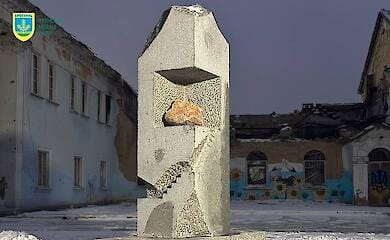
The very culture of anthropomorphic stelae is very ancient, it is not less than 5 thousand years old. "Babas" were characteristic of the inhabitants of our southern Ukrainian steppe - as part of the so-called Eurasian steppe corridor, which stretched from Mongolia to Ukraine. That is, "babas" are a typical element of the landscape, historical landscape, such a marker of the southern territories, the Left Bank and Slobozhanshchina. They were installed on the mounds. If you look at Shevchenko's etchings - and there they are present - so they were a recognisable element of the landscape even in the XIX century. "Baba" is in any large museum in the Dnieper region, Left Bank", - says the scientist.
Most stelae are tombstones. Scythian babas, often with portrait features, Cumans, were created during the developed Middle Ages in the XII-XIII centuries. - can be without a clear depiction of faces but with a detailed depiction of clothes and hairstyles.
That is, it was probably a depiction of a particular buried person or buried woman, which, in principle, later turned into an element of the ancestor cult," says Eugene Sinitsa.
He emphasises that the cult is connected rather with specific places and inhabitants of the Ukrainian steppe, and they have no direct connection with the inhabitants of modern Ukraine - it is part of the steppe culture.
We are talking about the fact that this is our historical landscape, this is a piece of our history embodied in artefacts. It is a part of Ukrainian identity," says Yevhen Sinitsa.
The scientist emphasises that each of the preserved "babas" is valuable and is a work of art. Each specimen, even ancient, "rough" at first glance - unique. If we are talking about Polovtsian babas, there are hundreds of copies of them, but it is still not enough. Each one has both scientific and artistic value," the scientist notes.
He stresses that the sculptures, made mainly of sandstone, have great endurance and are well preserved in lapidaries (an exposition of the remains of sculptures and buildings, most often presented in places of archaeological excavations. - ed.), outdoors. However, in times of full-scale war, artefacts are not safe. It is noted that "babas" in a war zone can suffer not only from a direct hit but also from the effects of a shock wave.
Part of the lapidary sculpture, belonging to the Museum Fund of Ukraine, has remained since 2014 in the temporarily occupied territories. The fate of the objects is still unknown. Periodically, in the network, there is information about the removal of valuable objects for exhibitions in Russia.
For example, Crimean building slabs from the Old Crimea were taken to an exhibition in the Russian Federation and, it seems, never returned. There are questions about the Stone Grave Reserve near Melitopol. There is no information from there. They also had a rather large lapidarium. In autumn in the network slipped information that the museum of the Stone Grave was actively preparing for evacuation. Then some of the things from the Stone Grave flashed in Crimea at an exhibition. This is a habitual practice for Russians: appropriated objects are taken to the exhibition, and then they simply do not return, - says Yevgeny Sinitsa.
He adds that the fate of such monuments becomes known only because concerned Ukrainians post photos and videos online, as was the case with the exhibits of the Kherson Art Museum, which "flashed" in Crimea.
About the project
The grant project "United by History: Cultural Heritage of Ukraine on the pages of a Passport" was initiated by the Union of Archaeologists of Ukraine. It is aimed at popularising the material and cultural heritage of Ukraine among a wide audience.
Culture has the potential to overcome the conflict of values and form national identity. Value models are formed and produced in the space of culture and disseminated by its means. This is how they enter the everyday life of a person. Tangible cultural heritage (as part of our cultural space) is a component of historical memory, the basis for the formation of national spirituality, and the consolidation of national identity. Therefore, the issues of preservation, utilisation and development of the worldview and value potential of cultural heritage are topical," say the authors of the project.
It is noted that for a long time, no necessary attention was paid to the care, preservation and popularisation of our cultural heritage, and its significance and potential were underestimated. Unfortunately, it is Russia's large-scale war against Ukraine and, in particular, the enemy's deliberate destruction and theft of objects and artefacts of Ukraine's tangible cultural heritage that has brought these issues into the public consciousness.
Being extremely ignorant of our own cultural heritage, we are unable to effectively and adequately resist the aggressive Russian policy, which is aimed at appropriating our heritage, levelling and/or silencing the material evidence actually available, and rewriting history. However, it is time for the intellectual communities of Ukraine to use the promotion of their tangible and intangible heritage as one of the powerful elements of cultural diplomacy," the researchers write.
The project provides for the creation of video content, in which explanatory texts in Ukrainian and English accompany the objects and artefacts that illustrate the pages of Ukraine's passport. The information will be presented in an accessible popular science format.
People who have never even heard anything about these or those objects/artifacts from the pages of the passport, having familiarised themselves with the brief information provided, will be able to get interested and remember it, - the authors of the project note.
Also, the aim of the project is to encourage the audience to learn more - to visit museums or objects (real or virtual). It is assumed that each video will contain links, with the help of which the user will be able to go to more detailed information.
Hanna Shchokan creates long-form reports on social and medical issues for Sozportal.
Related news
Archaeologists have found children's fingerprints in 15,000-year-old clay

Traces of an "ancient machine gun" have been found in Pompeii
100 years ago, the first rocket was launched - this was the beginning of the space age

Popular news
Orban announces "results" of Hungarian mission on Druzhba oil pipeline


Will maternity leave be shortened in Ukraine? Changes for workers with children


Zelensky said that Russia was preparing a new offensive and pointed out the direction of it


Kellogg named the ceasefire condition today and compared Putin to Nicholas II

News about war
Orban announces "results" of Hungarian mission on Druzhba oil pipeline
Kellogg named the ceasefire condition today and compared Putin to Nicholas II
Zelensky said that Russia was preparing a new offensive and pointed out the direction of it
Russia is destroying Ukraine twice as fast as at the start of the war - international report