


The jaw of an ancient "cousin" of man has been found in Taiwan


A mysterious ancient jaw lifted from the seabed off the coast of Taiwan has turned out to be the trace of extinct human relatives - Denisovans. This important discovery expands the known range of their habitat and raises new questions for scientists.
Read more: Takumi Tsutaya et al, A male Denisovan mandible from Pleistocene Taiwan, Science (2025). DOI: 10.1126/science.ads3888. www.science.org/doi/10.1126/science.ads3888
A jawbone fragment discovered by fishermen in Penghu Strait ended up in an antique shop, where it was spotted and purchased by a collector in 2008. He later donated the find to the National Museum of Natural History of Taiwan.
The age of the jaw was determined by marine organisms stuck to the bone - it dates back to the Pleistocene (2.6 million - 11.7 thousand years ago). However, for a long time it was unclear to whom it belonged: there are very few remains of Denisovans. Until now, they were known only from jaw fragments, teeth and a finger bone found in Siberia and Tibet.
The breakthrough came when an international team from Taiwan, Japan and Denmark managed to extract protein chains from the fossilised bone. Although the DNA in the bone was not preserved, a comparison of the proteins showed similarities to Denisovans from Denisova Cave in Siberia.
"This may change our understanding of where the Denisovans lived," said one of the study's authors, Takumi Tsutaya of the University of Advanced Studies in Japan. Until now, Denisovans were thought to have lived in northern and central Asia, possibly Laos. Now Taiwan appears to have been added to that list.
The study is published in the journal Science. However, not all experts are rushing to judgement. The head of the project on human origins of the Smithsonian Institution Rick Potts noted that for final certainty needs more data. Nevertheless, he called the work "a fantastic attempt at protein extraction."
The scientific significance of the finding cannot be overstated. Several species of human ancestors - Homo sapiens, Neanderthals and Denisovans - co-existed in Eurasia, sometimes interbreeding with each other. Traces of their DNA are still found in modern humans, especially in some inhabitants of Asia and Oceania.
Now the Taiwanese jaw may be adding to those traces. It becomes another piece in the mosaic that helps us understand who we are and where we came from.
🔍 Who are the Denisovans?
TheDenisovans are an extinct group of ancient humans closely related to Neanderthals and Homo sapiens. Their existence was first established in 2010 by analysing DNA from a finger phalanx found in the Denisova Cave in the Altai Mountains. Since then, remains of Denisovans have also been found in Tibet and, presumably, Laos
Genetic studies have shown that Denisovans interbred with other species of humans. For example, modern inhabitants of Papua New Guinea and Australia have up to 5% of Denisov DNA. Also known case of hybrid Denisovian and Neanderthal - a girl who lived about 90 thousand years ago
🧬 What did the Denisovans look like?
The appearance of the Denisovans has been reconstructed using DNA analysis and proteomics techniques. According to the research, they had the following features
- Wide face: wider than modern humans and Neanderthals
- Massive jaws: with large teeth
- Dark pigmentation: probably had dark skin, hair and eyes

An independent researcher, interested in archaeology and sacred geography. He researches them and writes about them.
Related news
Archaeologists have found children's fingerprints in 15,000-year-old clay

Traces of an "ancient machine gun" have been found in Pompeii
100 years ago, the first rocket was launched - this was the beginning of the space age

Scientists have found a huge bone from a possible ancestor of T. rex
Popular news
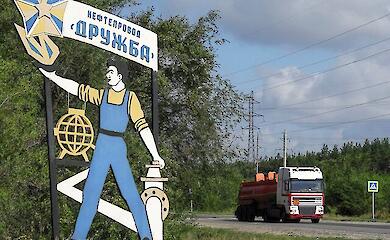
Orban announces "results" of Hungarian mission on Druzhba oil pipeline


Will maternity leave be shortened in Ukraine? Changes for workers with children


Zelensky said that Russia was preparing a new offensive and pointed out the direction of it


Kellogg named the ceasefire condition today and compared Putin to Nicholas II

News about war
Orban announces "results" of Hungarian mission on Druzhba oil pipeline
Kellogg named the ceasefire condition today and compared Putin to Nicholas II
Zelensky said that Russia was preparing a new offensive and pointed out the direction of it
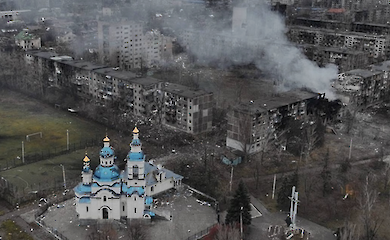
Russia is destroying Ukraine twice as fast as at the start of the war - international report