“Want extra pay? Go to the trenches." Why Ukrainian medical staff in frontline areas are not receiving the promised payments
- Home
- Society
- Health care
- “Want extra pay? Go to the trenches." Why Ukrainian medical staff in frontline areas are not receiving the promised payments


Ukrainian medical staff working in areas where hostilities may occur or are currently taking place are entitled to higher pay. However, the figures set out in the government decree remain merely on paper unless the management of healthcare facilities shows goodwill.
This is stated in the study "Debt to Medical Workers: What's Wrong with the 'Frontline Supplements' System" by the Medical Movement "Be like We Are" and NGO "Sotsialnyi Rukh".
Why do medical staff not receive the promised additional payments?
"I asked our acting director. He always answered condescendingly, laughing: 'And what extra pay should you get? You are not at the front here. If you want, go to the trenches there and earn money," said a nurse at a hospital located in the area of possible hostilities in eastern Ukraine.
Since May 2023, medical staff have been entitled to increased pay. At first, the additional payments were relatively small, for example, 2 thousand hryvnia (≈40 €) for a nurse and 3 thousand hryvnia (≈50 €) for doctors in the zone of possible hostilities, and 4.5 thousand hryvnia (≈ 90€) and 8 thousand hryvnia (≈150 €), respectively, in the active zone. From September 2025, the payment was significantly increased - for the zone of active hostilities, salaries actually doubled. However, the figures voiced in the government decree remain on paper, unless there is goodwill on the part of the administration of medical institutions.

Thus, according to the position of the National Health Service of Ukraine (NHSU), even if hospitals have appropriate funding for "frontline supplements": "labour remuneration issues are determined by the collective agreement, which establishes the forms and systems of labour remuneration, labour standards, conditions for introduction and introduction of additional payments". The same opinion is voiced by the Minister of Health, Viktor Lyashko.
That is, the resolution on additional payments should be duplicated in the collective agreement; a document that should be in all state and municipal medical centres and should coordinate the interests of employers, employees, and trade unions. Otherwise, "frontline supplements" for staff will not be fully guaranteed. The only participant in the study who reported that her hospital got full payments was a trade union leader and an active participant in the creation of the collective agreement.
"We wrote our collective agreement ourselves. Our new collective agreement provides a lot of opportunities for nurses and orderlies too," this nurse from a hospital in the praying territory of the fighting in southern Ukraine revealed.
However, in many cases, staff, especially mid-level and junior staff, have little influence or are not even aware of the document. Therefore, "frontline additional payments" can be cancelled if the medic was on sick leave or holiday. Or medics in the territories of active hostilities are paid the amounts prescribed for the territories of possible. Or payments to certain departments, for example, polyclinics, are halved.
"I cannot understand this either. Why are we in different conditions? We work in the same hospital, but with such different additional payments," said a nurse from a hospital in the territory of possible hostilities from the central region.
That is, medical institutions can use the proceeds of the "frontline" packages at their discretion. Problems arise even in the issue of informing staff whether they are entitled to additional payments. In turn, the NHSU and the Ministry of Health (MOH) appeal to the prudence of hospital administrations and the need for staff to participate in collective bargaining.
What conditions do frontline medical staff work in?
But do medical staff working in frontline areas have opportunities for such activity? When asked about working in dangerous conditions, medics talked about cases when they received seriously wounded people, although such cases were not their speciality.
"Two wounds are very serious. Shrapnel wounds. They brought in people who were not our speciality. Thanks to our doctors and those who were there, [they were saved]. Three surgeons just didn't unbend for a day and a half," said a nurse from a hospital in an area of possible fighting in the south.
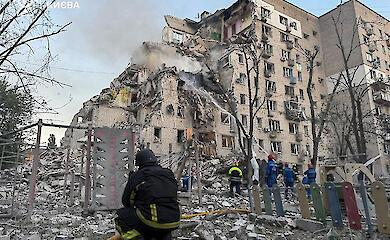
Medical professionals also cited examples of medical facilities themselves coming under attack and their colleagues being injured.
"On our hospital grounds, ambulance drivers were injured, drones came," said a nurse from a hospital in the possible fighting territory in the east.
"The nurse got PTSD - and she still can't get out of it. She still has work to do - she's 45 years old - but she's done everything. "I'm already burnt out, I can't do it." She's been on antidepressants for a year," said a doctor at a hospital in the area of possible hostilities in the south.

As for the shelters, the medical staff mostly noted that they are available, but it is impossible to stay there all the time and continue full-fledged work. Therefore, according to one of the nurses, "when there is some direct attack, we can go down to the shelter, but mostly we are at our workplaces". In some wards, patients cannot interrupt their treatment, so the nurses stay with them despite the alarm.
"This is the ward where people's kidneys don't work: people are hooked up to machines, artificial ones. And they lie down for four hours. And we have to watch them for these four hours," said a nurse at a hospital in the territory of possible hostilities in the central region.
Now, according to medical staff, because of the activation of Russian drones, one of the most dangerous moments has become the road between work and home.
"Getting to work - drones. True, where the net is now being pulled. Drones sentries, shoot at minibuses, trolleybuses, non-truck cars. You can walk from a bus stop. We've had a lot of people hit by gunfire. Thank God, they managed to hide, to run somewhere," said a nurse in Lycana and the area of active hostilities in the south.
Another nurse from eastern Ukraine says that because of drone agro, they no longer have transport, so she walks an hour to the hospital every time.
According to the head of the WHO office in Ukraine, as of early 2026, Russian troops have launched 2,900 attacks on Ukraine's health care system during the full-scale invasion, killing 239 medical staff and patients.
When asked why medical staff continue to work in such dangerous conditions, most spoke of a sense of duty to patients and their own family members who cannot be evacuated, the involvement of other family members in critical infrastructure or defence forces, and love of home.
"And my wife is in the military in the air defence forces, 80 kilometres away. That's it. She comes home once a fortnight for two days. That's the situation," said an emergency paramedic from an active combat zone in the south.
The medical staff are aware that their sense of duty or affection is now being exploited rather than being fairly rewarded for risks and over-exertion. When asked about how medical staff in the frontline areas should be treated, they spoke primarily about the universality of supplementary payments.

Everyone should be paid. Because everyone works the same way, everyone risks their lives the same way. They go to work during the alarm, during shelling. While our hospital was bombed with cassettes, everyone was at work equally. All people take risks during working hours, so everyone needs to be paid," says a hospital doctor from the territory of possible hostilities in the central region.
Why the state "owes" medical staff
In addition to incomplete or non-transparent accruals, "frontline supplements" could not be paid at all. For example, in 2023, 126 hospitals had a package of NHSU No. 57 "Preparedness and provision of medical care to the population located on the territory where hostilities are conducted". However, by the summer of 2025, there were only 57 such hospitals. Funding was reduced despite the expansion of the territories of possible hostilities - last year, seven districts of the Odesa region received this status. But in the summer of 2025, only one medical centre there had a package for "frontline supplements".
Therefore, in the middle of last year, less than a quarter of doctors from the frontline territories worked in hospitals that had funding for additional payments.
The cuts were made under various pretexts. Thus, thanks to the appeal of a nurse of the KNP "Kherson Regional Institution for Mental Health Care" to "Be like We Are" it became known that in 2025 the medical institution stopped paying "frontline supplements" because the NHSU did not renew their package No. 57. The service referred to the Cabinet of Ministers' resolution No. 1503 of 24.12.2024, according to which specialised medical institutions, which includes psychiatry, are no longer entitled to this package. The hospital administration appealed to the Ombudsman, who supported their position. Therefore, the Cabinet added to the decree that facilities that provide facilities that provide facilities that provide facilities that provide facilities that provide facilities that provide facilities that provide facilities that provide facilities that provide facilities that provide facilities that provide facilities that provide facilities that provide facilities that provide facilities that provide facilities that provide facilities that provide facilities. "Frontline" packages of hospitals have been updated.
This selective approach was probably not isolated and created inequalities that the Ombudsman drew attention to. As there is hardly any difference in the level of danger of working in specialised and general medical institutions in the frontline areas.
Other reasons for refusing to fund the "frontline" package are that the legal address of the medical centre is not registered in the community that belongs to the frontline area. Even if the medical centre is located very close by, or even if its individual units or branches do work there. An illustrative example - an ambulance medic works 10 km from the front line, but the legal address of his medical facility is in the oblast centre.
"Emergency medical assistance should receive additional payment for combat operations in the combat zone and possible hostilities, [...] a coefficient of 6.01 to the basic rate. And we're currently getting 1.25[...]. We were told that you are not in this decree," says an ambulance paramedic from an active combat zone in the south.
An identical example is the blood transfusion centre, which is located in the territory of active hostilities in the central region, but is subordinate to the oblast centre.
"We have a border zone. We have a territory where hostilities are taking place. Thank God, it's 35 km away from us, but the fact is that our department works from the regional blood centre. [ ] Our administration is all in [name of city], and we asked in a veiled way about [extra pay], and we were told no," a nurse told the centre.
There is also the opposite case, when the legal address of the hospital is registered in the oblast centre in the territory of possible hostilities. But one of its branches is located in the suburbs without the appropriate status, so the administration denies its staff "frontline supplements".
However, there is a positive example of change - the medical institution was actually located in the oblast centre, which is a territory of possible hostilities, but formally belongs to another community. After the activity of the trade union and constant appeals to the local authorities, MOH, and NHSU, they were finally provided with a "frontline" package.
This happened in the autumn of 2025, when the government announced an increase in "front-of-house supplementary payments". Additional funds were likely saved or received by the government at that time. At that time, package No. 49 "Ensuring the preservation of human resources for the provision of medical care to the population located in the territories of combat operations" was also added to package No. 57. And by the end of 2025, 180 hospitals from areas of possible or active hostilities received "frontline" packages - compared to 126 in 2023 and 57 in the summer of 2025.

However, the austerity and retrenchment practices that have developed over the years may continue to prevent medics from receiving full and proper payments. The funding of "frontline supplements" follows the logic of medical reform, which involves distancing the MOH and the NHSU from the regulation of staff working conditions. And the active participation of medics themselves in collective bargaining. However, now, in conditions of exhaustion and constant danger, medics need to have a universal and guaranteed right to adequate supplementary payments.
In addition, medics can demand compensation for the period when they were without proper additional payments, through an appeal to the State Labour Service or to the court. There is relevant case law on civil servants, who are also entitled to "frontline supplements".
Expert on women's rights, persons with disabilities, motherhood in the modern context, health care reform, education and social welfare.
Related news

A hidden source of resistance to the latest antibiotics has been discovered in Australia


Why migration policy in Ukraine is becoming a matter of rebuilding the country


Ukrainians have to help wounded during Russian shelling on their own


“A nurse is a person on whom everything depends”: three stories about work in a hospital, school, and on the front

Popular news
Ukrainian security services have been recognised as among the best intelligence services in Europe – L'Express

Irina Levchenko, the abducted Ukrainian journalist, has been transferred to the Donetsk remand centre: what is known
Evidence has been found in Australia of an unusual ritual that has been practised for thousands of generations

News about war

The UN has reported a sharp rise in the number of Ukrainian civilians killed as a result of the war

3 July has been declared a day of mourning in Kyiv. The number of dead and injured is rising