

Contemporary Ukrainian literature and cinema instead of a museum: what objects from the Ukrainian passport appear in pop culture


Continuation of the material about how symbols of Ukraine are depicted in contemporary art and what new shades they acquire.
The 2015 Ukrainian passport is a symbol of visa-free border crossing and a symbolic guide to all regions of the country. The pages of the document are decorated with cultural heritage objects symbolising different parts of Ukraine. The Crimean Chersonese, the walls of Lutsk fortress, the oldest churches of Kyiv and the slag heaps of Donbas. The design of the document became especially symbolic after the outbreak of full-scale war in Ukraine - it reminds us that the entire territory of our state - from the West to the East - is indivisible and Ukrainian.
Some of the objects from the passport are now under threat and have suffered from the large-scale invasion of Russia. A number of important objects- such as symbols- have been actualised in pop culture and artistic projects. They are present in films, modern books, plays, music videos, and even pseudonyms of performers.
Socportal continues to explore how symbols of Ukraine are portrayed in contemporary art and what new shades they acquire.
In the first part of the article we talked about modern comics with Cossacks and mysticism of Lviv, and in this part, we will talk about monuments of the South and East of Ukraine.


Odessa National Opera and Ballet Theatre
The Odessa Opera House, embodied in the Viennese Baroque style, is considered one of the most beautiful in the world. In 2008, Forbes magazine included it among the 17 most interesting monuments in Eastern Europe. The opera is featured in the Cambridge edition of Buildings for Music.
The building was erected in 1887 by architects Ferdinand Fellner and Hermann Helmer. The work was supervised by local architects under the direction of Alexander Bernardatsi. The facade is decorated with figures of heroes and heroines of Greek mythology; of course, the main place is given to the Muses, the patronesses of genres.
The ground part of the theatre consists of three floors - five more technical rooms underground. The hall has unique acoustics - even a whisper from the stage can be heard at either end. World-famous stars such as Enrico Caruso, Solomiya Krushelnitskaya, and Giuseppe Anselmi once performed onstage. Odessa Opera is present in the cinema, in numerous paintings of artists, in books and photos.
How Odessa sounds. The sound of Odessa, particularly the Opera, in the realities of a full-scale war, was recorded by composer Evgeny Filatov. He dedicated the second episode of his musical travel show "How Ukraine Sounds" to Odesa. The episode about the new sound of Odessa appeared on the channel "UkrYouTubeProject" in February 2023.
I thought it would be easy to draw a musical portrait of Odessa. But the city has changed. Now the Black Sea is at war. And in order to convey this musically, I have brought a unique musical instrument - the yuphon. It sounds something in the middle of an organ and a vibraphone. In order to play it, you have to keep your fingers wet," composer and show host Yevgeny Filatov told me at the time.
Films ranging from world-famous classics to modern festival winners. The film "Enthusiasm. Symphony of Donbas", which was shot in 1930, is considered a masterpiece. It occupies the 28th position in the list of 100 best films in the history of Ukrainian cinema. The tape was the first film in which real industrial and everyday sounds served to create a musical image, not just illustrate the visuals. "I never imagined that these industrial sounds could be organised in a way that made them seem beautiful. I consider 'Enthusiasm' to be one of the most moving symphonies I have ever heard. Mr Dziga Vertov is a musician. Professors should learn from him, not argue with him," Charlie Chaplin said of the film.
Taras Tomenko's contemporary film "Terrykony" tells the story of children who live in Donbas amid the war with Russia and has won several awards at Ukrainian and international festivals. 2023, it was on the short list of candidates for the Academy Award from Ukraine.
So, the constructions and symbols of different parts of Ukraine, which are present in the passport, are present in the classics and continue to inspire artists who create contemporary art. Of particular importance are those objects that symbolise the territories temporarily occupied by the enemy - because, at a time when there is a full-scale war in Ukraine, it is important to remember that every corner of our state is part of a large and indivisible Ukraine. And every cultural monument is our national treasure.
A film about the creation of the performance. Odessa Opera House becomes the location and direct participant of the documentary film "Katerina. Art under fire". The film shows the process of creating a modern production of Alexander Rodin's "Katerina", which has already become a landmark. The film showed footage from Odessa before the full-scale invasion and then the Odessa military, which was surrounded by barricades. The premiere of "Catherine" took place in September 2022. It combined symbolism, tradition, rituals and mysticism. Almost a thousand exclusive costumes and authentic musical instruments were made for the production, which included time travel and involved more than a hundred performers.
Image of the Small Coat of Arms of the Ukrainian People's Republic (UNR)
The central figure of the coat of arms of the UNR is the Trident of Prince Vladimir. The coat of arms was one of the three official symbols of the state, along with the flag and the anthem. It was used by the UNR and by the UNR government in exile.
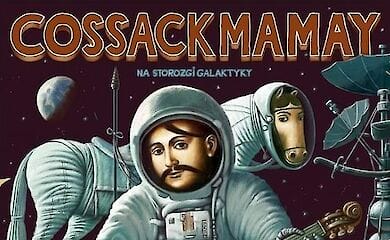
Steampunk about the Ukrainian State. The most original popularisation of Ukrainian history of the UNR period can safely be called Comics "Volya", which began to be released in 2017. Ukrainian steampunk, which is called "quality thrash" and then cool, thoughtful popularisation, has five issues for now. Depicts an alternate reality with recognisable characters - there are cyborg Maxim Krivonos, academician Vernadsky, who overcomes demons, Father Makhno, Simon Petliura and, of course, Mikhail Hrushevsky alongside. But the enemies of Ukrainian statehood are bloody zombies with "red symbols".

The central figure of the coat of arms of the UNR is the Trident of Prince Vladimir. The coat of arms was one of the three official symbols of the state, along with the flag and the anthem. It was used by the UNR and by the UNR government in exile.
Steampunk about the Ukrainian State. The most original popularisation of Ukrainian history of the UNR period can safely be called Comics "Volya", which began to be released 2017. Ukrainian steampunk, which is called then "quality thrash", then cool thoughtful popularisation - for now has 5 issues. Depicts an alternate reality with recognisable characters - there are cyborg Maxim Krivonos, academician Vernadsky, who overcomes demons, Father Makhno, Simon Petliura and, of course, Mikhail Hrushevsky alongside. But the enemies of Ukrainian statehood are bloody zombies with "red symbols".
A special operation for Father Makhno. The history of the liberation struggle in Slobozhanshchina is also trying to be explored in the theatre. 2019 Capital Wild Theatre presented the play "Red, Black and Red Again" based on the authors' work "The Pirate Bay". In the centre of "CHCH" - an interesting and ambiguous theme of Makhnovshchina. Confessors of the philosophy of Gulyaypol show contradictory and colourful characters, and the plot is almost detective - Makhno's father must deliver a velvet box with valuable cargo - but on the way, he gets lost. This is where real madness begins, with historical facts, humour, and symbolism, which are typical of Wild Theatre productions.
Films about Petliura and Kruty. New Ukrainian films are dedicated to the period of the Ukrainian Revolution. Thus, "The Secret Diary of Simon Petliura" by Oles Yanchuk covers the Parisian period of the life of the main ataman of the troops and leader of the Directory of the UNR Simon Petliura. The diary format takes the viewer from Petliura's life in exile to the events and actors of the UNR period, when Ukraine gained but unfortunately could not retain its independence. The film also shows the murder of Simon Petliura at the hands of Samuel Shvartsbard.
Historical figures from the UNR period and recognisable Kyiv locations, such as Sophia of Kyiv, also appear in the film "Kruty 1918" by Alexey Shaparev By Alexei Shaparev. Depict the story of military cadets who became the defence of the UNR and heroically died near Kruty on 29 January 1918. The battle scenes were filmed in Kievshchyna - because, in fact, in Kruty, there is a memorial dedicated to the tragedy, and it would indicate a temporal discrepancy.
Image of the Zenit rocket launcher and a fragment of the Dnieper hydroelectric power station in Zaporizhzhia city
The Dnieper dam was featured both in the classic film "The Eleventh" (1927) by the legendary Dziga Vertov and in recent film productions - it was used as a backdrop for the series "Cossacks. Absolutely False History". Now, these landscapes are inextricably linked with shots of the Kakhovskaya HPP, which was destroyed by the Russians in the summer of 2023. The connection has direct associations - after the terrorist attack on the Russian Federation - the Dnieper in the area of the Dneproges significantly shallowed, also historical parallels - during World War II, the dam of the Dneproges was destroyed by the Soviet troops, which caused terrible consequences for the territories - part of it was flooded, part of it - catastrophically shallowed.
GAIA-24 - opera about environmental disasters of mankind. The tragedy at the Kakhovskaya HPP will soon find its symbolic reflection in a modern opera by composers Ilya Razumeiko and Roman Grigoriev, which will be called GAIA-24 and will see the light of day in May. The article will talk about ecological catastrophes and their impact on human beings through images and symbols.
The idea was born after the Kakhovka catastrophe. This is the biggest ecological tragedy in Europe since Chernobyl, which had such an impact on the landscape change. This place is a hot spot where you can observe the struggle between nature and man," Ilya Razumeiko commented for Socialportal.

The Dnieper dam was featured both in the classic film "The Eleventh" (1927) by the legendary Dziga Vertov, and in recent film productions - it was the backdrop for the series "The Cossacks. Absolutely False History". Now these landscapes are inextricably linked with shots of the Kakhovskaya HPP, which was destroyed by the Russians in the summer of 2023. The connection has direct associations - after the terrorist attack of the Russian Federation - the Dnieper in the area of the Dneproges significantly shallowed, also historical parallels - during World War II the dam of the Dneproges was destroyed by the Soviet troops, which caused terrible consequences for the territories - part of it was flooded, part of it - catastrophically shallowed.
GAIA-24 - opera about environmental disasters of mankind. The tragedy at the Kakhovskaya HPP will soon find its symbolic reflection in a modern opera by composers Ilya Razumeiko and Roman Grigoriev, which will be called GAIA-24 and will see the light of day in May. Through images and symbols it will tell about ecological catastrophes and their impact on human beings.
The idea was born after the Kakhovka catastrophe. This is the biggest ecological tragedy in Europe since Chernobyl, which had such an impact on the landscape change. This place is a hot spot where you can observe the struggle between nature and man," Ilya Razumeiko commented for Socialportal.
Before the tragedy of 2023, the authors of the opera had shot images of the Kakhovka Reservoir in their previous work, the archaeological opera Chernobyldorf. While working on the work, the team conducted expeditions to industrial and post-industrial areas - in particular, to the Exclusion Zone, the bank of the Dnieper River, opposite Energodar, and the southern part of the Kryvyi Rih iron ore basin.
It so happened that the territories filmed in the opera all became the theatre of war, victims of the Russian invasion. The Palace of Culture in Vyshchetarasovka, Nikopol district, where we shot one of the baroque novellas, was recently destroyed by an enemy missile. The very territory of the Dnieper River near the former Kakhovka reservoir, which we also used as a landscape in the opera, has turned into a front line and a territory of military operations. Now research there is impossible. But we continue to work with these landscapes and the theme of Kakhovka in GAIA-24, - said the composer.
Image of terricones and a miner's copter
The passport also features symbols of Donbas - slag heaps formed from waste rock and a miner's copter - a structure above a mine shaft. These symbols of Donbas appear in Serhiy Zhadan's poetry, fiction, and works of fiction, in particularly in the popular book "I Will Mix Your Blood with Coal" by journalist and writer Alexander Mikhed. In addition, Donbas' iconic symbols and buildings appear in cinema, theatre, and contemporary art.

A play-musical about miners. 2021 at the capital's Stage 6 staged a play-musical about miners "Anthracite. Day of Fortitude". The project was realised by the NGO "Point of Contact", Grand Duke Films Limited and Wild Theatre.
In the story, Alexey, a miner, loses a close friend during an accident in the mine. He is tormented by remorse, feels guilty. Subsequently, a mystical event takes Alexei into the past and allows him to change the course of events not only his life, but also the Ukrainian history. "Anthracite" was directed by Ukrainian Pavlo Yurov and British Vicky Thornton, who worked together on the big project "The House of Miners". In the play they used documentary footage shot in Donetsk region. We paid attention to the pro-Ukrainian strikes in Donbass.
I am interested in showing the audience the Donbass they don't know yet - not a place of war - but the Donbass of community, of real human connection, of joy, warmth and hope. And I believe that the concrete experience of a living person is of great value," Pavel Yurov said at the time.

Terricons in luthy art. The Terrichons of Donbass in February 2024 became the topic of a social media challenge #luteart by @bavovna.help. Participants had to combine a symbolic image of the Terrykons with the Carpathians.
Terrykons are close to me, because Donetschina is the region where I spent my childhood. And for me they are like the tip of the iceberg of what is extracted deep in the ground, - Valeria Pavlenko wrote.
Artists whose works are popular online, such as Sasha Danylenko, also took part in the challenge.
Thus, the buildings and symbols of different parts of Ukraine that are present in the passport continue to inspire artists who create contemporary art. Of particular importance are those objects that symbolise the territories temporarily occupied by the enemy - because, at a time when a full-scale war is going on in Ukraine, it is extremely important to remember that every corner of our country is part of a large and indivisible Ukraine. And every cultural monument is our national treasure.
Hanna Shchokan creates long-form reports on social and medical issues for Sozportal.
Related news
Archaeologists have found children's fingerprints in 15,000-year-old clay

Traces of an "ancient machine gun" have been found in Pompeii
100 years ago, the first rocket was launched - this was the beginning of the space age


Popular news
Orban announces "results" of Hungarian mission on Druzhba oil pipeline


Will maternity leave be shortened in Ukraine? Changes for workers with children

Zelensky said that Russia was preparing a new offensive and pointed out the direction of it


Kellogg named the ceasefire condition today and compared Putin to Nicholas II

News about war
Orban announces "results" of Hungarian mission on Druzhba oil pipeline
Kellogg named the ceasefire condition today and compared Putin to Nicholas II
Zelensky said that Russia was preparing a new offensive and pointed out the direction of it
Russia is destroying Ukraine twice as fast as at the start of the war - international report