

A child's disability doesn't put an end to a mum's career. Three stories that motivate

The participants of the project "Mum, work!" shared with Socialportal their stories about the challenges on the way to professional fulfilment and the motivation that participation in the project gave them.
Mums are the foundation of the well-being of families of children with disabilities. It is the mother who constantly makes decisions about treatment, socialisation and other aspects of life.
Approximately 80 per cent of women raise children with disabilities on their own and often lack the means to live a decent life," says Niya Nikel, a Kyiv-based activist, entrepreneur and PR manager with 12 years of experience.

As part of Patients Ukraine, Nia lobbied for people with epilepsy and the legalisation of medical cannabis. This was in relation to her daughter Eva, who suffers from the rare Yamoir syndrome, which affects only 35 people in the world and is not treated by traditional medicine.
With the full-scale invasion underway, Niya focused on helping children with epilepsy who were left in Ukraine without access to medication. She later started the "Mum, Work!" project for women raising children or people with disabilities across Ukraine.
It is quite possible to change the vector of your life and become financially independent, even while raising a child in need of palliative care. Our experts have developed this course to support women in self-development and striving to be economically free," says Nia.
According to Nia, the "Mum, Work!" project aims to unlock the professional potential of mums and give them the opportunity to self-actualise and be economically independent, including from the state.
We are very pleased with the project and proud of each participant. It was a sincere learning experience, sometimes with tears from the traumas experienced, but always with a smile and mutual gratitude at the end. We are proud that the mums saw their talents, strengths and found new friends, creating a real community of mutual support and communication," says the founder of the project.
The participants of the project "Mum, work!" shared with Socialportal their stories about the challenges on the way to professional fulfilment and the motivation that participation in the project gave them.
Kharkiv woman about the war, her daughter's illness and the search for motivation: how I found a new meaning in life

Ekaterina, a resident of Kharkiv, shared her story of life during the war and her daughter's struggle with diabetes.
Kateryna was born in Kharkiv, but spent most of her childhood in the village of Lukyantsy, which fell under occupation after the start of the full-scale invasion. During the first shelling of Kharkiv, she and her husband and daughter decided to leave for Kharkiv Oblast.
According to Ekaterina, their greatest concern was the safety of their child, so despite the fear and uncertainty, they took the risk of travelling to strangers to avoid danger. However, after a short period away from home, the family returned back to Kharkiv.
Ekaterina emphasised that even during the war it was important for her to stay close to her relatives. Despite the possibility of evacuation abroad, she could not imagine life apart from her family. Severe disease on the background of stress In addition to the difficulties of the war, Ekaterina faced the diagnosis of her daughter - diabetes mellitus.
She believes that the disease developed due to constant stress. Her daughter began to experience typical symptoms: intense thirst and frequent urination. When they went to the doctor, tests showed extremely high sugar levels, which already threatened the child's life.
Three months flew by like a blur," Ekaterina recalls.
She admits that in the first days after her daughter's hospitalisation, she could not eat and did not understand how to move on.
However, she gradually learnt to cope with the situation and find the strength to fight again.
Her daughter needs an insulin pump to make it easier to control her sugar levels, but due to queues and lack of medical resources it is difficult to get one. Catherine has launched a collection for an insulin pump for her daughter. You can support the collection here.

"Mum, work!" - project that gave a new breath
After her diagnosis and difficult months of struggle, Ekaterina lost her motivation to live, feeling that her strength was running out. But by chance she came across the project for mothers of children with illnesses "Mum, work!".
Already after the first online session she felt part of a big family where everyone supports each other. The project helped Ekaterina to believe in her own strength and start dreaming again. She completed the first task - she wrote 30 wishes and was surprised to see that some of them started to come true.
"It was a new breath of life," says Ekaterina.
She has started to engage in self-development, exploring opportunities to create her own business. She is passionate about photography, children's clothing and SMM, and wants to find herself in these areas. Challenges and future plans Despite the challenges, Ekaterina does not lose hope.
She sees her future in her own business and hopes to create an online shop or other project that will help her family regain stability. However, for now she cannot fully concentrate on her work because of the need to care for her daughter.
Kateryna dreams of a better future for all children with diabetes in Ukraine and is even thinking of creating a fund to support such families so that other mums do not go through such difficulties alone. "I hope I will succeed," she summarises.
How the project "Mum, work!" helped me find strength for a new career: the story of a mum of a child with disabilities

Alice, a mum of a 10-year-old daughter with a disability, talks about her struggles, the "Mum, work!" project and finding a balance between childcare and professional fulfilment.
Alice is 32 years old and has been caring for her daughter with a disability for ten years. Alice initially worked as an accountant, but due to her daughter's epilepsy and constant hospital visits, she had to leave her job.
When you find out you have a sick child, it's like society shuts you out," she recalls.
Alice faced many obstacles trying to return to work after the birth of her baby.
I had problems both getting the baby into day care and finding a job," she says.
However, when she heard about the "Mum, Work!" project for mums, her hope for self-fulfilment was revived.
It was a breath of fresh air," Alisa shares.
Living with a disability and finding balance
Despite the challenges, Alice has been able to find a balance between caring for her child and her own needs.
It was hard at first, but after 10 years you learn to cope," she says.
Now Alice knows how to organise her time so that she can leave a few hours for self-development and work.
Her main dream is a job that will allow her to realise her potential and help others. She doesn't want to go back to accounting because of the stress, but sees herself in the role of a client manager or a support line operator.
I want to work with people and help them solve problems," Alisa shares.
Thanks to the project "Mum, work!" Alisa created her first CV and is now actively looking for vacancies.
She is interested in modern professions related to information technology and dreams of training in this field.
I want to start from scratch and find a job that will inspire me," she says.
Alisa is also considering applying to government retraining programmes, as she has learned that she is eligible.
According to Alisa, Ukraine does not have enough programmes to support mothers of children with disabilities.
We are not informed about our rights, and the meagre payments that are available do not cover the needs," she says.
One of the main challenges for such families is the lack of psychological support.
The state should provide more psychological support for mums so that we don't feel lonely," says Alice.
Proud of my achievements
Despite all the difficulties, Alisa is proud of what she has managed to do for her daughter. She has put a lot of effort into her development despite the scepticism of those around her.
When people told me that my child was a vegetable and that it was not worth wasting time on her, I did not give up," Alice recalls.
Thanks to her persistence, her daughter attended kindergarten and now studies at a specialised school. Alice also dreams that the state should create more opportunities for socialisation of children with autism and other developmental disabilities.
My child has the right to interact with other children, even if it is an inclusive environment," she emphasises.
Alice continues to seek a balance between caring for her daughter and professional development. She believes that she will find a job that will not only bring her an income, but also allow her to fulfil herself as a person. At the same time, she continues to fight for a better future for her daughter and other children with disabilities.
I have already done a lot for my child, and it inspires me to go further," Alice summarises.
Life after 18: how Victoria Panasiuk fights for the future of her disabled son
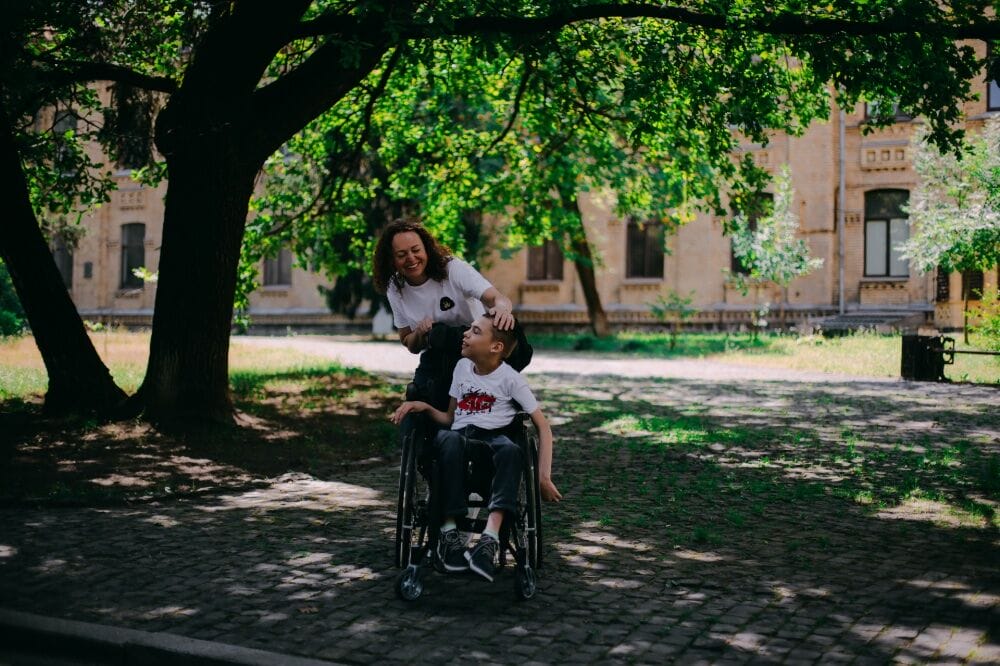
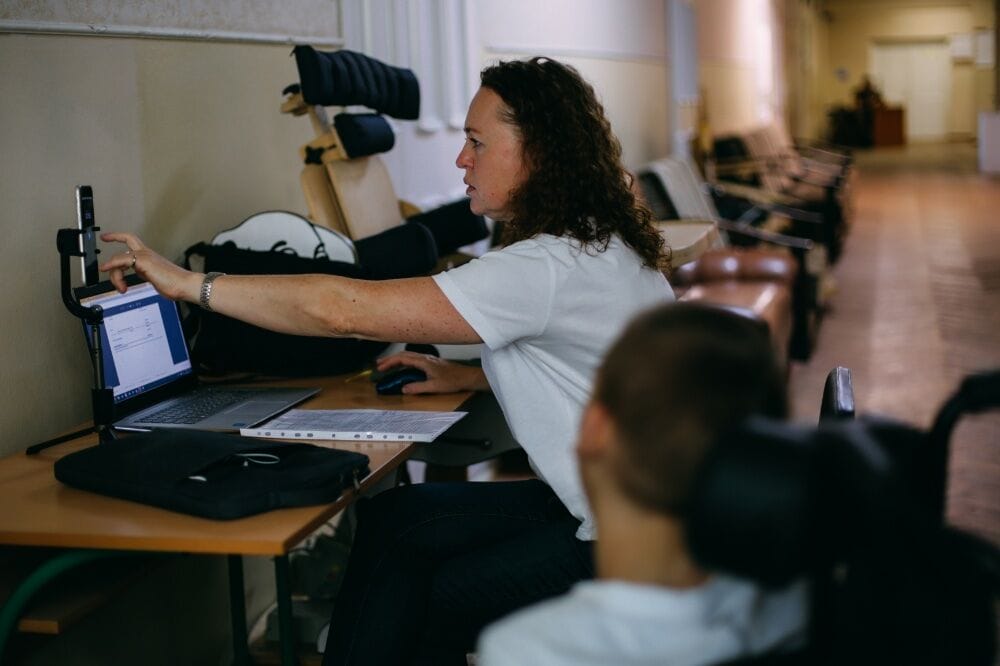
Victoria Panasiuk is a trainer, financial counsellor and mother of an 18-year-old son with a disability. She not only fights for a decent life for her son, but also helps other families through social activism. Victoria spoke about her path to self-realisation, support for families raising children with disabilities and the importance of socialisation.
My son Egor was born in 2006, and a year later he was diagnosed with cerebral palsy - infantile cerebral palsy. Since then, our lives have changed dramatically. I worked as a marketing manager in a construction company, but after Egor's birth I had to leave my job because the child needed all my time, energy and resources. The daily work of recovery, training and rehabilitation began and it continues to this day. My husband and I have come a long way from despair to acceptance, but our son is worth all our love," says Victoria.
Today Egor is studying at the special school "Nadezhda", and despite his physical limitations, he was able to transfer to the general education programme. This is a real achievement for Victoria:
At first it was very hard, teaching my son literally everything: breathing, swallowing, chewing. We worked for five years so that he could blow out a candle. School gave, of course, a lot, for the development of Egor and the formation of him as a person.
Egor and I travelled abroad a lot for rehabilitation. In Europe I saw a completely different approach to people with disabilities. For example, in Germany, adults with disabilities work in special centres. They have the opportunity to lead a full life, including work and rehabilitation. In Ukraine, however, everything is just beginning to be built, and the process is very slow," says Victoria.
She is actively fighting for the reform of the residential care system in Ukraine.
My goal is not to put children in orphanages, but to keep them in families. The system should support families who raise children with disabilities so that the child can grow up surrounded by loved ones," she says.
Social project "Special" and support for other families
Victoria not only takes care of her son, but also created the social project "Special", which supports more than 500 families raising children with disabilities. The main focus of the project is socialisation.
Socialisation is the first thing such children need. It is important not only to teach a child to solve maths problems, but also to communicate and be active in society," Victoria explains.
The project helps children and their parents to participate in various activities: sports classes, art therapy, and educational programmes. Thanks to this, children can interact with their peers and develop social skills.
Victoria actively studies international experience. She tells about Hungary, where the state has created a full cycle of support for people with disabilities from 0 to 99 years old; about Germany, where even adults with the most complex forms of disability can work and live independently.
Egor does not walk, sit independently, or talk, but in Germany such people after the age of 18 can live in flats with supported living. They have their own individual rehabilitation plan, they work in special centres, come home in the evening, and on weekends go to visit their parents," she says.
In Victoria's opinion, reforms in Ukraine are very slow. She believes that instead of residential institutions, which "eat up the budget", it would be better to support specific families raising children with disabilities.
The state should create the basic conditions, while charitable organisations and volunteers can and should be involved when necessary," Victoria believes.
Support system after the age of 18 - at the initial level
After Yegor reached the age of 18, new challenges arose.
In Ukraine, the support system for people with disabilities after the age of 18 is almost non-existent. Rehabilitation services, health vouchers - all this becomes inaccessible, because adults with disabilities get in the same queue with all other adults. We stand in a common queue together with the military, pensioners and other people in need of social assistance," Victoria emphasises.
One of the biggest challenges for families is the lack of helpers for adults with disabilities.
We have social workers for the elderly, but adults with disabilities, like my Egor, have to stay at home because they are often denied further education or the opportunity to work precisely because of the lack of accessibility and helpers," she adds.
One of the biggest challenges for Victoria is to find a way for Yegor to fulfil himself professionally. She talks about the success of her son, who, despite his limitations, participates in filming videos about inclusion and earns money.
He was on the film with other children and this gave him the opportunity to earn his own money. It is important that people with disabilities can also be realised and express themselves in society," Victoria notes.
"Mum, work!" and new opportunities for mums In addition to her activism, Victoria joined the "Mum, work!" project, which helps mums of children with disabilities to find a job. Victoria says that this project has helped her to look at her career from a new perspective: "I had been volunteering for a long time, but it was time to find a way to earn a living. Thanks to the project, I realised that I could combine social activism with financial counselling. This is not only helping others, but also an opportunity to secure my future." Victoria also helps other mums from the project to learn financial literacy:
Mums of children with disabilities are often left destitute. I help them find ways of financial stability, teach them how to manage family finances, and for some it is also an opportunity for a new profession - financial counsellor.
Victoria believes that every child with a disability has the right to a decent life. Her dream is to create a system that allows adults with disabilities to live independently and be socially active.
I want our children with disabilities to not be left at home without support after the age of 18. We must create an environment where they can work, study and be a full part of society. This is important not only for them, but for all of us," she summarises.
Conclusions from the project "Mum, work!" from Nii Nickel
Fear of lack of experience. Many mums fear that they don't have professional experience, but we all started from scratch at some point. In addition to experience, we have skills. Mums of children with disabilities have a multitude of skills: they can handle the kind of stress and workload that many people don't even realise they have. They know how to be systematic, attentive, and emotionally sensitive to others. We wanted the female participants to be able to dream more, experiment and gain more experience. That's why we asked Comfy to present the mums with UAH 5000 certificates. They used this money to buy lighting devices for TikTok shoots or curling irons, which added to their self-confidence.
Low self-esteem. Due to isolation and constant challenges, mums often lose community support and self-belief. From the first session though, we saw what strong and interesting individuals they are. Gaining their confidence back was not easy. Many found their dream jobs already during the course. These are extraordinary and inspiring women. In addition, we raffled off 10 beauty boxes from Eva.ua and received a lot of feedback that now they feel like queens and are ready for the coveted job interviews.
Fear of making a mistake. Fear of answering incorrectly at a job interview or making a mistake is the third common fear. To overcome it, we invited representatives of Oschadbank, LUN and Velaskes beauty studio to conduct mock interviews. This helped to break the last barrier, and the participants gained invaluable experience.
Maria Grynevych, project manager, journalist, co-author of Guidebook Sacred Mountains of the Dnieper Region, Lecture Course: Cult Topography of the Middle Dnieper Region.
Related news
Archaeologists have found children's fingerprints in 15,000-year-old clay


Scientists have discovered how a father's health affects his child before conception


100,000 net outings in the autumn: what happened after the borders opened up for 18-22 year old men

Stress over studying at 15 linked to depressive symptoms at 22 - study
Popular news
Orban announces "results" of Hungarian mission on Druzhba oil pipeline


Will maternity leave be shortened in Ukraine? Changes for workers with children


Zelensky said that Russia was preparing a new offensive and pointed out the direction of it

Kellogg named the ceasefire condition today and compared Putin to Nicholas II

News about war
Orban announces "results" of Hungarian mission on Druzhba oil pipeline
Kellogg named the ceasefire condition today and compared Putin to Nicholas II
Zelensky said that Russia was preparing a new offensive and pointed out the direction of it

Russia is destroying Ukraine twice as fast as at the start of the war - international report