




Today, parents are increasingly faced with a paradox: their children literally do not let their smartphone out of their hands, but they do not answer the phone.
This behaviour is annoying and alarming to adults, but it actually reflects a profound change in the digital habits of today's youth, The Conversation writes.
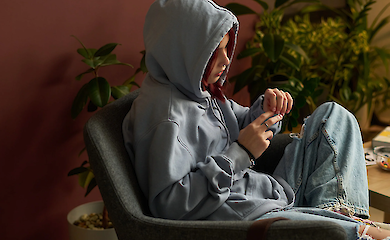
For teenagers, the phone has long ceased to be a device for voice conversations. Calls are used only in emergencies or to communicate with the closest people - for example, mum or best friends. Everything else teens prefer to discuss via text messages, voice recordings or social media chats.
The reason is not laziness or ill-manneredness, but a desire to control communication. Written communication gives time to think, allows you to edit your words and express emotions in a way that is convenient for the interlocutor. A voice call requires an immediate response and is often perceived as stressful or a violation of personal boundaries.
"I always only answer my mum or if it's something urgent. In all other cases, it's easier to text," confesses 15-year-old Lea. Her peer Mehdi, 16, adds: "When I see 'Dad' on the screen, I just don't pick up the phone. I'll write later when I'm in the mood."
Such behaviour does not mean indifference. Teenagers make their own rules: who can contact them, when and how. Not answering the phone is a way to protect personal space and avoid information overload.
What's more, today, silence in response to a call is becoming a new form of digital etiquette. For many teens, it is not a sign of rudeness, but a conscious choice, a way to maintain a balance between communication and personal time. Waiting for a prior message is a common practice: first, a friend or girlfriend asks in chat if it's convenient to talk, and only after agreeing to do so, makes a call.
Adults should realise that modern teenagers do not refuse contact with their loved ones, but simply choose other, more convenient ways of communication. For them, not only speed is important, but also the ability to manage their time and emotions. And if parents want to be heard, it is important not to impose the usual schemes, but to agree on the rules of communication.
For example, agreeing in advance on a time to call or using messages and emoji to convey information and emotions. Even a small change in habits - such as a short message instead of an unexpected call - can help reduce tension and maintain contact between generations.
Rather than rebuking them for being "rude," it's worth considering teens' new communication habits as part of the evolution of digital politeness. The world of communication is changing - and with it, the forms of care and ways of expressing feelings.
Maria Grynevych, project manager, journalist, co-author of Guidebook Sacred Mountains of the Dnieper Region, Lecture Course: Cult Topography of the Middle Dnieper Region.
Related news




These microbes survive boiling water and acid - and could help save the Earth

Anxiety and depression rise sharply in young people after pandemic - study finds

Popular news

Orban announces "results" of Hungarian mission on Druzhba oil pipeline

Will maternity leave be shortened in Ukraine? Changes for workers with children


Zelensky said that Russia was preparing a new offensive and pointed out the direction of it

Kellogg named the ceasefire condition today and compared Putin to Nicholas II

News about war
Orban announces "results" of Hungarian mission on Druzhba oil pipeline
Kellogg named the ceasefire condition today and compared Putin to Nicholas II
Zelensky said that Russia was preparing a new offensive and pointed out the direction of it

Russia is destroying Ukraine twice as fast as at the start of the war - international report