

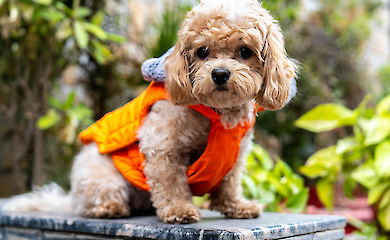
Why people make the mistake of "reading" their dogs' emotions


We misunderstand dogs' emotions - and the cause may be our mood.
Humans and dogs have lived side by side for thousands of years, and we seem to understand our pets' emotions perfectly. However, a new study shows that we are often wrong in interpreting dogs' feelings - and our own emotional state is to blame.
The work of scientists from Arizona State University is published in the scientific journal PeerJ. The study suggests that people's perception of dogs' emotions may be distorted depending on their current mood - and not in the way the researchers themselves expected.
How mood affects what we "see" in a dog
Science has previously established the so-called emotional matching effect: when a person is in a good mood, he tends to see positive emotions in others, and in a bad mood - negative. Scientists have suggested that the same mechanism may work in the perception of emotions of animals.
To test the hypothesis, the researchers conducted two experiments involving students.
The first experiment: unexpected lack of effect
In the first stage, participants were deliberately put into a positive, negative or neutral mood using images of people and landscapes. They were then shown videos of three dogs in a positive, negative or neutral emotional state.
Volunteers rated how happy, sad, calm or excited the dogs looked. To the scientists' surprise, the people's moods had no effect on their evaluations.
The second experiment produced the opposite result
In the second experiment, the mood of the participants was formed already with the help of images of the dogs themselves - happy, sad or neutral. After that, the subjects watched the same videos and again evaluated the emotions of the animals.
This time the effect appeared - but in the opposite direction.
People in a good mood were more likely to perceive the dogs as sadder.
Participants in a bad mood, on the other hand, rated the dogs as happier.
The authors say the results challenge traditional ideas about how emotional matching works when perceiving emotions in other species.
Dogs improve people's moods - even when they look sad
The researchers found another curious effect: watching videos of dogs boosted people's moods, even when the animals displayed neutral or negative emotional states.
This may explain why socialising with dogs is often used for therapeutic purposes - and why we sometimes overestimate our own ability to 'read' their emotions.
Why this is important for animal welfare
The authors emphasise: the results cannot yet be considered definitive. The study involved only students, used videos of three dogs and a limited number of clips. Nevertheless, the work raises an important question - how accurately people understand the emotional state of dogs.
Errors in interpretation can affect the quality of care, training and overall animal welfare. A better understanding of how we perceive pets' emotions will help improve human-dog interactions.
Maria Grynevych, project manager, journalist, co-author of Guidebook Sacred Mountains of the Dnieper Region, Lecture Course: Cult Topography of the Middle Dnieper Region.
Related news

More than 50,000 seals killed by bird flu - scientists sound the alarm



Popular news
Orban announces "results" of Hungarian mission on Druzhba oil pipeline


Will maternity leave be shortened in Ukraine? Changes for workers with children


Zelensky said that Russia was preparing a new offensive and pointed out the direction of it


Kellogg named the ceasefire condition today and compared Putin to Nicholas II

News about war
Orban announces "results" of Hungarian mission on Druzhba oil pipeline
Kellogg named the ceasefire condition today and compared Putin to Nicholas II
Zelensky said that Russia was preparing a new offensive and pointed out the direction of it

Russia is destroying Ukraine twice as fast as at the start of the war - international report