

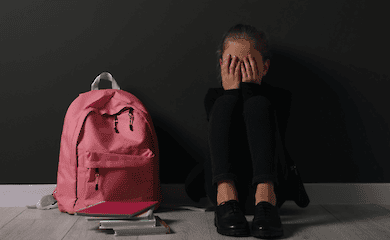
Why do we get angry and lose patience? What kind of people are more patient?
- Home
- Life
- Healthy lifestyle
- Why do we get angry and lose patience? What kind of people are more patient?


American psychologist Kate Sweeney of UC Riverside wondered why patience is sometimes called a virtue, but most people admit to being "impatient"
To figure it out, Sweeney decided to clarify what patience and impatience even are, and what factors govern them.
Source: University of California, Riverside
She conducted three experiments involving more than 1,200 people. The result: impatience is what people feel when they encounter a situation they consider inappropriate or unfair: for example, a traffic jam when it's no longer rush hour, a protracted work meeting, or a long wait for test results because the lab lost your sample. Patience, on the other hand, is a set of strategies to help you deal with such irritation.
The findings are published in two articles in Personality and Social Psychology Bulletin and Personality and Social Psychology Review. Sweeney calls patience "emotion regulation" - that is, the ability to manage negative feelings and not let them take over.
What causes impatience?
The experiments asked participants to imagine various unpleasant situations, from a traffic jam to a long wait in a waiting room. Test subjects described how nervous they would be and then indicated what ways (such as distracting themselves, taking deep breaths or looking for positivity) would help them calm down.
Sweeney identified three main factors that create the "perfect storm" of impatience:
- High importance: for example, a traffic jam that puts you at risk of missing your favourite band's concert.
- Negative waiting conditions: standing in a queue without a chair or entertainment, and even in a stuffy room.
- The obvious fault of another: for example, when tests are not ready due to a laboratory error.
And the length of the delay (short or long) was less influential than the discrepancy with the actual wait (time seems to drag on longer than it "should").
Which people are more patient?
The results showed that people who are more comfortable with uncertainty and who are more emotionally balanced (i.e., they have low levels of nervousness and don't have a strong need to "shut down" a situation) are less likely to get impatient. And those who manage their emotions well (the skill of "self-regulation") and have a high level of empathy, even when irritation arises, find ways to "not get further heated".
These observations only begin to reveal how patience works, but it's already clear that our hypotheses are being confirmed," Sweeney says. - If we can learn to better manage impatience, perhaps we can become more patient in our daily lives.
Maria Grynevych, project manager, journalist, co-author of Guidebook Sacred Mountains of the Dnieper Region, Lecture Course: Cult Topography of the Middle Dnieper Region.
Related news


Toxic people in your environment may accelerate ageing, study shows


Scientists show: working with childhood memories helps you fear failure less

Sometimes the brain itself is looking for something to distract itself with - scientists have explained why
Popular news
Orban announces "results" of Hungarian mission on Druzhba oil pipeline

Will maternity leave be shortened in Ukraine? Changes for workers with children


Zelensky said that Russia was preparing a new offensive and pointed out the direction of it

Kellogg named the ceasefire condition today and compared Putin to Nicholas II

News about war
Orban announces "results" of Hungarian mission on Druzhba oil pipeline
Kellogg named the ceasefire condition today and compared Putin to Nicholas II
Zelensky said that Russia was preparing a new offensive and pointed out the direction of it
Russia is destroying Ukraine twice as fast as at the start of the war - international report