
Why do Russians need Ukrainian children? Interview with the "Save Ukraine" organization, which returns kids to their homeland
- Home
- Frontline
- War in Ukraine. The storybook
- Why do Russians need Ukrainian children? Interview with the "Save Ukraine" organization, which returns kids to their homeland


In 2023, the International Criminal Court in The Hague issued an arrest warrant for Vladimir Putin and the Russian Commissioner for Children's Rights, Maria Lvova-Belova, who are suspected of the illegal forced transfer of Ukrainian children to the Russian Federation.
In the same year, six children who managed to escape from the occupants provided the court with evidence of how they were forcibly taken to the Russian Federation after losing their relatives.
Such actions are considered by international law as a sign of genocide, i.e. an attempt to exterminate the people. According to the Ukrainian law enforcers, the Russians took out about 20,000 children. However, it is difficult to give an exact figure. The Save Ukraine charity organisation is working on their return home.
Thesocial portal asked its founder and director Mykola Kuleba to tell us how Ukrainian children are being saved.
Why do Russians need our children? Does it fit into their general policy of traditionalism, restriction of abortion, ban on adoption by non-citizens?
The Russians' goal is the destruction of the Ukrainian nation. And a huge place in their strategy is taken by the upbringing of children. That is why all children are immediately passported and forced to go to Russian kindergartens and schools. This is a strategy of indoctrination through educational institutions. To take a child to school, parents have to get a Russian passport and provide the child with a Russian passport. Schools are also being trained, Ukrainian books are destroyed there, and it is forbidden to speak the Ukrainian language. School days are accompanied by the daily playing of the Russian anthem, lessons of political information, "talks about important things" and, above all, the militarisation of children.
Parents in the occupied territories testify that online learning in Ukrainian schools is now impossible: all children must have passports and physically attend a Russian school. Because this is part of the indoctrination model. Most parents are afraid to send their child to school because it is dangerous, and where the school is far away from home, they are not sure the child will come home.
Children told us that these Russian schools are like military facilities. Parents and relatives cannot enter the school grounds because the military are armed there.
If children speak Ukrainian, the military come and take them away for "special processing". This means psychological violence and punishment.
Teaching is in Russian, and there are weekly talks based on Russian propaganda. New children's books for 2023 are out, and history is already being rewritten, erasing Ukrainian identity.
Children who are sent to live with Russian families or institutions often have limited or no contact with their Ukrainian families, speaking to them only under supervision, and are denied normal childhood activities. And the risk of being forcibly transferred to Russia increases significantly for them.
The Russian military pays special attention to children aged 16-18. And in the summer, children are placed in mandatory junior military camps, where they are filled with propaganda and broken Ukrainian spirit. As a result, many children become pro-Russian.
Why did this become a valid argument for The Hague? How is this framed legally, what arguments or evidence is pointed to? Are any historical parallels drawn?
It has recently been a year since the PACE recognised the deportation of Ukrainian children to the Russian Federation as genocide. This is the first official document to mention the term "genocide" as an international war crime in relation to the actions of the Russian Federation.
The resolution also states that under international law, forced deportation is a direct sign of genocide, so the abduction of every child must be properly investigated, every word must be documented, and everyone involved must be held accountable.
We tirelessly say this every day on international platforms around the world. Putin, Lviv-Belov and everyone involved in the abduction of Ukrainian children must be punished. And this list must be expanded, because every Russian who took a Ukrainian child to his or her home must be held personally responsible. Every driver of a bus with children, every educator or director of "camps" - all of them must be held responsible. The return of children, their rehabilitation and the creation of conditions for family reunification to preserve the identity of Ukrainian children should be a priority for the member states of the Council of Europe.
How many children were taken out? Where did this data come from?
The abduction of children from the temporarily occupied territories of Ukraine is one of many war crimes committed by the Russians during the war. The exact number of children divorced from their families and taken to the Russian Federation is unknown. At the same time, the Russians themselves said that they had "evacuated" more than 324,000 children.
So far, only a few hundred have been returned. The abduction is clearly planned and takes place according to several scenarios. The "Children of War" portal records 19,546 deported or forcibly displaced children. And according to the National Information Bureau, 744,000 children have been deported.
How does this predominantly happen?
Often, children are deported under the guise of "evacuation", "recuperation", "treatment". In reality, this is not the case. We often hear stories that children were sent for "recuperation" to a camp for 2-3 weeks, and then our organisation took these children out of Crimea after half a year of deportation.
Very often Russians forcibly move children whose parents were killed in the temporarily occupied territories. Children are also removed from their families, depriving their parents of parental rights under the "laws" of the occupation authorities.
At checkpoints, parents are often divorced from their children during filtration, as well as creating uninhabitable conditions and as a result are offered to hand over their children for "recuperation" under duress.
The worst scenarios, unfortunately, await the children of 24-hour institutions, as they are taken to the Russian Federation almost entirely and their paths are often lost.
Have there been cases when Russians forcibly separated children from their parents?
Yes, and there are many such stories. One of them is mdash; the story of a family from Kherson, which has been occupied by the Russians since the beginning of the full-scale invasion. Four children, except for five-year-old Matthew, went to a Russian school. But at the same time, the family lived in an atmosphere of fear and uncertainty.
Because of the shelling, dad and mum were worried about the children's safety. When the school teachers suggested a holiday camp in Crimea, the parents agreed to send the children there for safety reasons. The mother hesitated for a long time, but when the children heard that the whole class and their friends were going, they convinced the mother to agree.
The children were sent to the camp in Crimea, ostensibly for 2 weeks, but in fact they stayed there for almost half a year.
When the parents and their children found themselves on different front lines, the mother lost 10kg of weight due to her worries. The Russians said that the children would not be returned, but would be transferred to Skadovsk or Genichesk. Or they offered parents to pick up their children themselves.
In the camp, the youngest son, who is 10 years old, was moved to a mental hospital for bad behaviour and crying, where he stayed for almost a month.
During this period, the child was given injections and some medication. The child was also placed in isolation because the occupants considered his behaviour unacceptable.
After six months of separation, our organisation was able to remove all the children and return them to their parents. After the de-occupation of Kherson, the family was able to rebuild their lives. However, just a few weeks later, when the family was at the market, a shell hit their house. The family lost their home and are now living in our Hope and Recovery Centre in Kiev, trying to recover from the horror they experienced.
What are the possibilities for the return of the children?
We currently have two main areas of work: helping families and children from the temporarily occupied territories and returning to Ukraine children illegally taken to the Russian Federation.
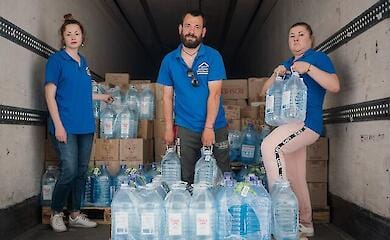
You can contact the organisation via social media or by calling the hotline 0 800 33 31 29. The hotline receives about 300 calls a day.
The hotline can be contacted for legal or psychological assistance or with a request for evacuation. Of course, the region of residence does not matter, we help Ukrainians who find themselves in a difficult situation.
For security reasons, we cannot disclose the process of returning deported children. But the process of evacuating families from temporarily occupied territories is not much easier.
A family can apply for help both through our channels and through the authorities, police, etc. After receiving the application, we analyse what kind of assistance is in question. We also find out about the family's whereabouts and availability of documents. We then draw up a specific rescue plan for each family.
Please tell us examples of successful return of children to Ukraine
One of the stories that truly amazes us. We admire the resilience and courage of this young boy. Rostislav was 17 when the Russians occupied his village in the Kherson region. After the full-scale invasion began, his grandmother's heart failed and she passed away. Later, the Russians came and took his mother to the hospital, she had been suffering from mental disorders for a long time. The boy was left alone.
The next four months Rostislav lived by himself in the occupation. There was little money, so neighbours brought him food. After the 9th class the guy found a part-time job - he helped his friends in the vegetable garden.
When the occupiers realised after four months that Rostislav was left at home by himself, Russian troops came to his house with weapons and threats. Two days later, Russian soldiers wearing balaclavas and carrying guns took him to Kherson.
There Rostislav was assigned to the Kherson Technical College and settled in a dormitory. There he was immediately told that he had to get a Russian passport. They also promised him a certificate, 100 thousand roubles and a house. Rostislav rejected these offers.
At that time, Rostislav's mother, who was in a state of mental disorder, was taken to a hospital in Crimea and was issued a Russian passport. Later the guy learnt that he had been issued a Russian birth certificate. He tore it up. Then the teachers hid his Ukrainian birth certificate and produced another Russian one, but did not show it to the guy. He was closed in the isolation centre because of disobedience to the Russians and forced to forget about the Ukrainian language. But he did not give up and dreamed of returning home.
After almost half a year, the mother of one of Rostislav's Ukrainian friends, with whom he was rooming, found the Save Ukraine organisation and went to pick up her son and another Ukrainian guy. Rostislav hoped he could leave with them and packed his belongings. But his teachers wouldn't let him go home with his friends because the Russians wanted to relieve his sick mother of her parental rights at that time.
Instead, he was sent to a rehabilitation centre for the summer holidays because the hostel was closed for the summer. For two months at the rehabilitation centre, all children were forbidden to use the telephone. It was given out for only half an hour a day and taken back.
Eventually Rostislav decided to flee Kerch. We cannot disclose the details of the operation for security reasons.
Now Rostislav lives in the Hope and Healing Centre from the Save Ukraine Foundation in Kiev and is studying at school. He intends to take photography courses. He dreams of travelling and finally forgetting all the horrors he has experienced.
Expert on women's rights, persons with disabilities, motherhood in the modern context, health care reform, education and social welfare.
Related news
Archaeologists have found children's fingerprints in 15,000-year-old clay

The loss of the middle class: what a new study on Ukrainian refugees showed

Scientists have discovered how a father's health affects his child before conception


Kellogg named the ceasefire condition today and compared Putin to Nicholas II

Popular news

Orban announces "results" of Hungarian mission on Druzhba oil pipeline


Will maternity leave be shortened in Ukraine? Changes for workers with children


Zelensky said that Russia was preparing a new offensive and pointed out the direction of it
Kellogg named the ceasefire condition today and compared Putin to Nicholas II
News about war
Orban announces "results" of Hungarian mission on Druzhba oil pipeline
Kellogg named the ceasefire condition today and compared Putin to Nicholas II
Zelensky said that Russia was preparing a new offensive and pointed out the direction of it

Russia is destroying Ukraine twice as fast as at the start of the war - international report