
Why cats are ginger: scientists have solved the genetic mystery of the colouring


Until recently, scientists did not know why some cats have red hair, although in other animals the mechanism for the appearance of such shades was understood long ago.
Thanks to the work of two research groups in the US and Japan, the mystery of ginger cats has finally been solved.
It turns out that there are only two types of pigment in mammals: eumelanin (dark brown or almost black) and pheomelanin (yellowish-orange or red).
In red-haired people, pheomelanin colours the hair, while eumelanin predominates in dark-haired people. Normally, the MC1R receptor is responsible for switching between these pigments in different species. If it is active, a dark pigment is formed; if it is blocked, a lighter or reddish shade appears.
In cats, however, things work differently. Their "ginger gene" is not linked to MC1R. Two new studies presented on the BioRxiv server have shown that a section of DNA called the "orangelocus" is responsible for theorangehue in cats. It contains the gene Arhgap36. If a cat carries the "O" (capital letter) variant, it shows orange colour (pheomelanin), and if it carries the "o" (small letter) variant, the coat remains dark (eumelanin).
The peculiarity is that this gene is located on the X chromosome.
Female cats (XX) can have both "O" and "o" variants at the same time. Due to random inactivation of one of the X chromosomes in different cells, one part of their coat can be red, the other black. If you add white spots due to other genetic traits, you get the famous tri-coloured (calico) cats. Each of them is unique, as the distribution of spots is formed randomly during development.
Male (XY) cats cannot be tri-coloured as they have only one X chromosome. They are usually either orange or dark. The rare exception is males with an extra X chromosome - an analogue of Klinefelter syndrome in humans.
Maria Grynevych, project manager, journalist, co-author of Guidebook Sacred Mountains of the Dnieper Region, Lecture Course: Cult Topography of the Middle Dnieper Region.
Related news
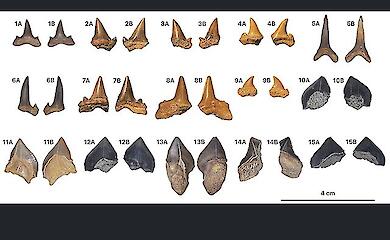
A ‘shark graveyard’ dating back some 80 million years has been discovered in the Egyptian desert



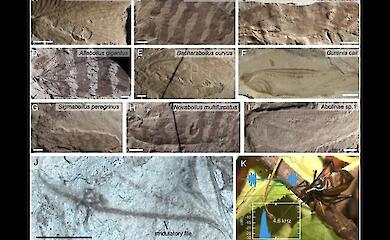
165 million years ago, the forests were already filled with ultrasound — scientists have discovered who was producing it


Turtles capable of crossing the ocean have unexpectedly turned out to be “homebodies”
Popular news

Russia has received new weapons from North Korea: which regions of Ukraine could be at risk


Henry VIII’s long-lost castle has been found inside another castle

Bones of ancient humans found on the seabed of the Taiwan Strait suggest they were up to 190 cm tall

News about war


An expert explains how Russia is changing its tactics for strikes on Kyiv


The UN has reported a sharp rise in the number of Ukrainian civilians killed as a result of the war