


Ukrainians in Germany: women explain why they cannot return home
- Home
- Overseas
- Refugees. How to survive
- Ukrainians in Germany: women explain why they cannot return home


Many who left at the beginning of the war believed they were not leaving home for long.
Germany has received since the end of February 2022 more than one million Ukrainian citizens who fled their country due to the Russian Federation invasion. The country ranks second in the EU by this indicator after Poland. Almost 80 per cent of those who arrived during this time are women. About half of them - came with young children. Almost 70 per cent of Ukrainian refugees in Germany have higher education.
The war continues and the hope of many of those who came to Germany to return to their homeland soon has been destroyed, just like the homes of many refugees.
The longer the war conflict in Ukraine continues, the harder it is to return. Many of those who found shelter in Germany had to socialise and it was not a painless process. They were looking for a kindergarten or school for their children, housing, work, support. in the end they overcame many difficulties to find a doctor for their child and to learn a previously unknown language.
On Monday, 07.08.2023, the national cultural radio station "DLF Kultur" broadcast a programme about the situation of Ukrainians in Germany. It was devoted to the issue of the return of refugees to Ukraine. In the programme three Ukrainian refugee women told whether they plan to return home. Blanka Weber spoke to the Ukrainian women from Leipzig.
Valeria, 23 years old
During the interview, Valeria told Blanka that she had recently turned 23. Before coming to Germany she studied gymnastics and English in Ukraine. The girl planned to work as a translator. When she got to the FRG, she was sent to Erfurt, the administrative centre of the federal state of Thuringia. There Valeria went to university to study Public Policy. During this time, she made friends and her children socialised in their new environment. She said that it is easier for her than for the elderly, because it is hard for them to settle in.
Older people miss their homeland, their home and everything they have worked hard to earn during their lives. They want to go home, but they can't, because the danger is still great there," she explained.
According to Blanka Weber, about 37 thousand Ukrainians live in Thuringia today. For many of them the province has already become home. They have found a job, a social environment. At the same time, the journalist noted that according to the data of the volunteer organisation "Leipzig helps Ukraine e.V." every second person who found asylum here plans to stay in Germany.
The reasons for this are varied: it can be a destroyed house or a destroyed apartment block. It may be a decision not to uproot a child brought here from a stable environment (to which the child has finally got used to). The reason could also be that people feel comfortable, as Leipzig is perceived as a very beautiful, progressive and friendly city," Mario Bauer, who represents Leipzig helps Ukraine e.V., told the journalist
Weber noted that this organisation made a lot of efforts to make the Ukrainians feel comfortable in their new home. In particular, they were in touch day and night, helped with translations, accommodation, places in kindergartens, went to hospitals with Ukrainians. Now in Germany they have come to realise that the war will not end soon, which means that people need to build a life in the new territories.
The journalist said that there are about 56,500 Ukrainian refugees in Saxony (the eastern part of Germany). They have access to the social system and can work.
Tatyana, 44 years old
Tatiana Denisova used to work in Ukraine as a choirmaster in Kharkov and had her own music studio. Now the woman works in an international centre with children. For a long time Tatiana expected to return home. However, this spring she made a difficult decision to stay. Her children go to school and classes, she has arranged accommodation and passed the first stage of socialisation.
Olga, 40 years old
It is not easy for a woman. She came to Germany with her husband, two sons and her mother. The youngest son has already learnt the language. Other family members find it more difficult, especially the older son at school. Olga herself misses home a lot, but decided not to return until the end of the war.
We would like to add that at the beginning of 2023, the average net household income of Ukrainian refugees is just under 850 euros per month. At the same time, according to the Federal Statistical Office, the average net household income in Germany in 2021 was about 3,800 euros per month.
Eugenia Ruban writes about political and economic news. She looks at large-scale phenomena in Ukrainian politics and economics from the perspective of how they will affect ordinary Ukrainians.
Related news
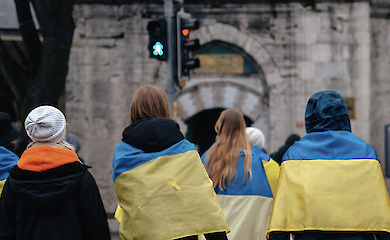
The loss of the middle class: what a new study on Ukrainian refugees showed


Berlin suggested that Ukraine reduce the number of men leaving the country for the EU


An EU country has announced its intention to stop accepting military conscripted men of conscription age
Popular news

Orban announces "results" of Hungarian mission on Druzhba oil pipeline


Will maternity leave be shortened in Ukraine? Changes for workers with children


Zelensky said that Russia was preparing a new offensive and pointed out the direction of it

Kellogg named the ceasefire condition today and compared Putin to Nicholas II

News about war
Orban announces "results" of Hungarian mission on Druzhba oil pipeline
Kellogg named the ceasefire condition today and compared Putin to Nicholas II
Zelensky said that Russia was preparing a new offensive and pointed out the direction of it

Russia is destroying Ukraine twice as fast as at the start of the war - international report