
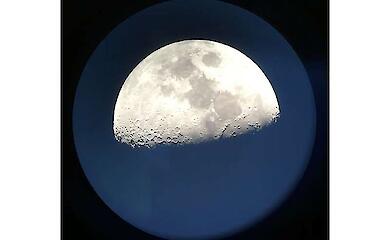
The solar system is travelling three times faster than scientists had thought


Scientists from the University of Bielefeld have reported results that call into question the current picture of the structure of the universe.
An analysis of the distribution of distant radio galaxies has revealed that the Solar System is moving through space more than three times faster than the standard cosmological model predicts. The work is published in the journal Physical Review Letters
"Our analysis shows that the solar system is moving more than three times faster than current models predict," said the study's lead author, astrophysicist Lukas Böhme. - This result clearly contradicts the expectations of standard cosmology and forces us to rethink previous assumptions."
To determine the motion of the solar system, the team studied the distribution of so-called radio galaxies - distant galaxies that emit particularly powerful radio waves. Unlike visible light, radio waves pass easily through dust and gas, so radio telescopes can "see" objects invisible to optical instruments.
If the Solar System is moving in any direction, there is a subtle "counter-flow" in the sky: slightly more of these sources will be observed in the direction of motion. The effect is extremely weak and requires very sensitive measurements.
The researchers used data from the European low-frequency radio interferometer LOFAR (Low Frequency Array), as well as two other radio observations. This allowed them to count radio galaxies across the sky so accurately for the first time. The scientists used a new statistical technique that takes into account that many radio galaxies are made up of multiple components, and so a simple "object count" can be skewed. This approach yielded a more realistic estimate of the errors.
Even accounting for the increased, more honest errors, the combined data from the three radio telescopes showed a deviation of more than five sigma - a level of statistical significance that in physics is considered a very reliable sign of a real effect.
The measurements revealed a dipole anisotropy - a difference in the number of radio galaxies in different directions - that is 3.7 times stronger than predicted by the Standard Model of the Universe. This model describes the birth and evolution of the cosmos since the Big Bang and assumes that, on large scales, matter is mostly homogeneously distributed.
"If our solar system is really moving so fast, we have to question fundamental ideas about the large-scale structure of the Universe," explains co-author of the paper, cosmologist Professor Dominik J. Schwartz. - Either the distribution of radio galaxies is much less homogeneous than we thought. Either way, our models have been severely challenged."
The new results are consistent with earlier observations of quasars - the extremely bright nuclei of distant galaxies where supermassive black holes absorb matter and release enormous energy. There, a similar unusual effect was found in the infrared data, making it less likely that this is a simple measurement error rather than a feature of the Universe itself.
Mykola Potyka has a wide range of knowledge and skills in several fields. Mykola writes interestingly about things that interest him.
Related news

Lost satellite 'brought back to life' after a month - scientists talk of a miracle




Popular news
Orban announces "results" of Hungarian mission on Druzhba oil pipeline

Will maternity leave be shortened in Ukraine? Changes for workers with children


Zelensky said that Russia was preparing a new offensive and pointed out the direction of it


Kellogg named the ceasefire condition today and compared Putin to Nicholas II

News about war
Orban announces "results" of Hungarian mission on Druzhba oil pipeline
Kellogg named the ceasefire condition today and compared Putin to Nicholas II
Zelensky said that Russia was preparing a new offensive and pointed out the direction of it

Russia is destroying Ukraine twice as fast as at the start of the war - international report