
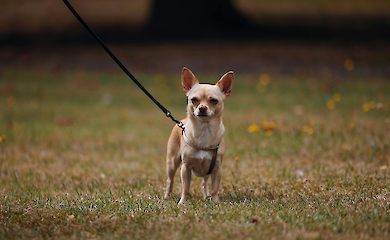

Stone Age "pet" wolves found on an island in the Baltic Sea


Ancient humans may have kept wolves in settlements - an unexpected discovery on a Baltic island.
Scientists have discovered the remains of 3,000- to 5,000-year-old wolves in a cave on a small, isolated island in the Baltic Sea - a place these predators could not have travelled to on their own. The discovery points to a much more complex relationship between humans and wolves in the prehistoric era than previously thought.
The study was published in the journal Proceedings of the National Academy of Sciences by scientists from the Francis Crick Institute, Stockholm University, the University of Aberdeen and the University of East Anglia.
The bones were found in the Stora Förvar cave on the Swedish island of Stora Karlsø. The island is only about 2.5 km² in size and has no native land mammals: any large animal could only have ended up here with the help of humans. In the Neolithic and Bronze Age, the cave was actively used by seal hunters and fishermen.
Genetic analysis has revealed
the remains belong to grey wolves, not dogs;
there is no evidence of canine admixture in the genome;
they are common Eurasian wolves, not a separate "domestic" lineage.
Nevertheless, the behaviour and life of these animals, judging by the analyses, were clearly related to humans.
Isotopic analyses of bones showed that the diet of ancient wolves was rich in marine protein - seals and fish - meaning they ate roughly the same food as humans on the island. Such a diet is unusual for a typical wild wolf, especially in a confined environment. It suggests that:
the animals were probably fed by humans,
or that they lived near human campsites and used rubbish.
In addition, the wolves were smaller in size than normal mainland wolves. One was found to have very low genetic diversity, which is typical of isolated or managed (partially "bred") populations.
"To find wolves on a remote island that could only be reached by boat is quite unexpected," says Linus Girdlund-Flink from the University of Aberdeen.
"They lived side by side with humans, ate the same food, and yet were not different in origin from other Eurasian wolves. This paints a much more complex picture of the relationship between humans and wolves in the past."
For a long time, human-wolf interactions in prehistory were viewed at two extremes: hunting wolves or gradual domestication, which resulted in dogs. The new data do not fit into either simple scheme.
The authors emphasise:
it is not yet known whether these wolves were domesticated, kept in semi-domesticated conditions or otherwise controlled;
but their presence on an isolated, human-populated island and their dietary and genetic characteristics clearly indicate a deliberate and prolonged form of interaction.
One of the Bronze Age wolves also had a serious bone pathology of a limb that should have limited mobility and the ability to hunt. Yet it survived to adulthood - which could mean that:
either he was cared for by humans,
or he lived in an environment where he didn't need to hunt large prey to survive.
"Combining the osteological and genetic data has yielded something that neither approach separately would have shown," notes Professor of Osteoarchaeology Jan Storo of Stockholm University.
"We have gained completely new and unexpected perspectives on human-animal interactions in the Stone and Bronze Ages, especially in relation to wolves and dogs."
Senior author of the paper Pontus Skoglund admits that the team expected to see a dog, not a wolf:
"This is a provocative case showing that under certain conditions people could keep wolves in their settlements and found favour in doing so."
Co-author Anders Bergström adds that one of the animals recorded a level of genetic diversity lower than any other ancient wolf, which resembles the pattern in artificially restricted or domesticated populations.
The authors stipulate: natural causes of low diversity cannot be completely ruled out. But the totality of facts - island, diet, size, genetics and pathologies - very convincingly suggests that humans consciously and unusually densely interacted with wolves, without turning them into the dogs we are accustomed to.
The study shows that in prehistoric Scandinavia, the relationship between humans and wolves could have been much more varied - from enemy and hunted object to "camp neighbour" and possibly companion-guardian or helper - without these animals having evolved to full-fledged domestication.
An independent researcher, interested in archaeology and sacred geography. He researches them and writes about them.
Related news
More than 50,000 seals killed by bird flu - scientists sound the alarm


Archaeologists have found children's fingerprints in 15,000-year-old clay

Traces of an "ancient machine gun" have been found in Pompeii
Popular news

Orban announces "results" of Hungarian mission on Druzhba oil pipeline


Will maternity leave be shortened in Ukraine? Changes for workers with children


Zelensky said that Russia was preparing a new offensive and pointed out the direction of it


Kellogg named the ceasefire condition today and compared Putin to Nicholas II

News about war
Orban announces "results" of Hungarian mission on Druzhba oil pipeline
Kellogg named the ceasefire condition today and compared Putin to Nicholas II
Zelensky said that Russia was preparing a new offensive and pointed out the direction of it

Russia is destroying Ukraine twice as fast as at the start of the war - international report