
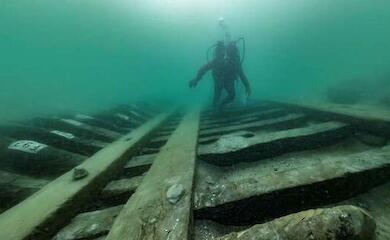

Scientists have 'uncovered' 1.4bn year old air bubbles


A "time capsule" with air before the dinosaurs was found in the salt.
Crystals of ordinary rock salt have suddenly become an "archive" of Earth's atmosphere that existed long before the dinosaurs.
A team led by RPI PhD student Justin Park and Professor Morgan Schaller has studied liquid and gas inclusions in a halite about 1.4 billion years old from northern Ontario - and in doing so has pushed direct measurements of the composition of ancient air back a giant amount of time.
As the researchers explain, in the Mesoproterozoic, there was a shallow basin in what is now Canada that resembled modern-day hypersaline depressions like Death Valley: water evaporated, salt crystals precipitated out, and microscopic "pockets" of brine and air bubbles were sealed inside them. These capsules turned out to be almost perfect repositories - the crystals were then buried by the sediment and remained isolated from the outside environment for hundreds of millions of years.
The main challenge was not to find the inclusions, but to "read" them correctly: both gas and brine are present in the crystal at the same time, and oxygen and carbon dioxide behave differently in water than in air. According to RPI, Park was helped by specially assembled laboratory facilities and a technique that allows him to take into account the distribution of gases between the water and gas phases and obtain more accurate estimates of the ancient atmosphere.
The results were unexpected. Firstly, oxygen levels, according to the measurements, reached about 3.7 per cent of today's levels - higher than many expected for an era sometimes ironically referred to by geologists as the "boring billion". Second, CO₂ was about 10 times higher than today's, which could have supported a climate comparable to today's, despite the dimmer ancient Sun.
This raises an intriguing question: if there was enough oxygen to theoretically "pull" complex multicellular life, why did animals appear so much later? The authors emphasise that their sample is only a snapshot of geological time: it may have recorded a short-term spike in oxygen, rather than a stable norm for the entire epoch.
The scientists also attribute the relatively elevated oxygen to evolutionary changes in the algal world: red algae appeared around this time and could have had a significant impact on oxygen production on a global scale.
Mykola Potyka has a wide range of knowledge and skills in several fields. Mykola writes interestingly about things that interest him.
Related news


These microbes survive boiling water and acid - and could help save the Earth

100 years ago, the first rocket was launched - this was the beginning of the space age

Popular news

Orban announces "results" of Hungarian mission on Druzhba oil pipeline

Will maternity leave be shortened in Ukraine? Changes for workers with children


Zelensky said that Russia was preparing a new offensive and pointed out the direction of it


Kellogg named the ceasefire condition today and compared Putin to Nicholas II

News about war
Orban announces "results" of Hungarian mission on Druzhba oil pipeline
Kellogg named the ceasefire condition today and compared Putin to Nicholas II
Zelensky said that Russia was preparing a new offensive and pointed out the direction of it

Russia is destroying Ukraine twice as fast as at the start of the war - international report