


Scientists have figured out how to stay motivated - and it has nothing to do with money
- Home
- Life
- Healthy lifestyle
- Scientists have figured out how to stay motivated - and it has nothing to do with money


When our efforts don't yield the expected results - whether it's losing weight, assembling furniture, or failing on a New Year's promise - it's easy to get discouraged.
However, as researchers from Binghamton University found out, in order not to lose motivation, it is worth focusing not on the money spent, but on the time invested. This is reported by Binghamton University.
Time is the strongest motivator
A new study published in the Journal of Consumer Marketing shows: reminding yourself of the time you've spent promotes greater perseverance than thinking about financial losses. This is because time is perceived as a personal contribution to development and growth, whereas money spent often causes a sense of waste in the event of failure.
One of the authors of the paper, Professor Subimal Chatterjee, explains:
"You can buy books, enrol in courses or purchase training videos. But when you invest money and don't get results, motivation drops dramatically. If, on the other hand, you've invested not money but time - and you see it as a contribution to yourself, you're more likely to keep trying."
How the study was conducted
The researchers conducted three experiments:
The first involved 600 working professionals,
The second involved 75 students at a Taiwanese university.
Participants were asked to focus on either the time or money spent on a goal. They then analysed how much difference their emotions and desire to continue after one or two unsuccessful attempts made.
Key findings
Time reduces the frustration of failure
When people thought about the time spent preparing (e.g. for an exam), they tolerated failure more easily than those who emphasised the financial cost.Money increases the feeling of being in control of external circumstances
Losing money makes the outcome feel dependent on external forces - and failure is perceived as a wasted resource.Repeated failures only hit persistence in the money paradigm
After two failures, motivation declined sharply for "monetary" participants, while it remained stable for "temporal" participants.
Interestingly, after three or more attempts, the difference between the two groups levelled out - people learned to keep their spirits up and gained experience either way.
Why this is important for business and marketing
The authors of the study believe that these findings can also be used in product promotion, especially for DIY products, online courses and skill development services.
"If a person perceives their actions as a path to growth, they are more likely to value the process and the outcome rather than be frustrated by the money spent," notes study co-author Debjit Gupta. - "Your advertising or training should emphasise the acquisition of experience, skills and personal contribution."
Employers and HR departments can also take this data into account. It turns out that employees with more freedom in time management show higher job satisfaction, experience setbacks more easily, and regain motivation more quickly.
Practical advice
If you are disappointed after a failure - remember how much time you have already spent and how it enriched you with new knowledge.
Marketers should emphasise competence development, personal growth and not just 'quick success for your money'.
It's important for businesses to support customers in moments of failure by offering additional resources, encouraging retries and emphasising autonomy in decision-making.
"It's all about intrinsic motivation," Chatterjee emphasises. - "When you choose your own development path, it's not the money that becomes more important, but the time and experience gained."
The next time a goal seems out of reach or something doesn't work the first time round - think not about how much money you've spent, but how much time you've invested in your progress. This will help you stay persistent and reduce frustration, and your efforts will definitely not go to waste.
Maria Grynevych, project manager, journalist, co-author of Guidebook Sacred Mountains of the Dnieper Region, Lecture Course: Cult Topography of the Middle Dnieper Region.
Related news


Toxic people in your environment may accelerate ageing, study shows


Scientists show: working with childhood memories helps you fear failure less


Sometimes the brain itself is looking for something to distract itself with - scientists have explained why
Popular news

Orban announces "results" of Hungarian mission on Druzhba oil pipeline


Will maternity leave be shortened in Ukraine? Changes for workers with children


Zelensky said that Russia was preparing a new offensive and pointed out the direction of it

Kellogg named the ceasefire condition today and compared Putin to Nicholas II

News about war
Orban announces "results" of Hungarian mission on Druzhba oil pipeline
Kellogg named the ceasefire condition today and compared Putin to Nicholas II
Zelensky said that Russia was preparing a new offensive and pointed out the direction of it
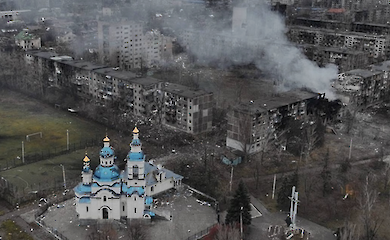
Russia is destroying Ukraine twice as fast as at the start of the war - international report