
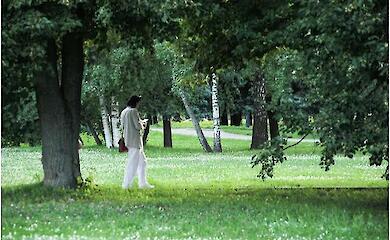

Scientists have explained how memory shapes a person's personality


Memory plays a key role in who we feel we are, but it is organised in a much more complex way than is commonly thought.
Modern research shows: different types of memory are involved in shaping personality, self-perception and life experiences in different ways
Many people think they have a "bad memory" if they can't remember the plot of a film or the cake at a previous birthday party. At the same time, the same people have no trouble reproducing abstract facts - for example, the temperature of the Sun's surface. This is due to the fact that human memory is heterogeneous and consists of several systems, writes The Conversation.
Psychologists distinguish between declarative and non-declarative memory. Non-declarative memory is responsible for skills and habits - for example, the ability to type or ride a bicycle - and does not require conscious effort. Declarative memory, on the other hand, is concerned with what we can meaningfully recall: our name, the current year, or the contents of the fridge.
Declarative memory is divided into two key types - semantic and episodic memory. Semantic memory stores general knowledge about the world: for example, that cats belong to mammals. Episodic memory relates to personal experience and includes the context of 'what', 'where' and 'when'. It is the one that allows one to mentally revisit events in one's own life and creates a sense of personal involvement in the past.
Studies of patients with amnesia in the mid-20th century helped scientists to clearly distinguish between these systems. People with damage to certain areas of the brain could lose memories of their own lives, but retain extensive knowledge of the world. In the opposite cases - in semantic dementia - it is the general knowledge that suffers, while personal memories may remain relatively intact.
Age also affects memory performance. In children, semantic memory develops earlier, while episodic memory is formed more slowly and is usually fully manifested only by 3-4 years. This explains why most people have almost no memories of early childhood. In old age, episodic memory, on the contrary, deteriorates faster than semantic memory - especially in dementia.
Neuroimaging studies show that both types of memory involve overlapping areas of the brain. More and more scientists believe that semantic and episodic memory should not be considered as separate systems, but as a continuum. In real life, they interact constantly.
A prime example is autobiographical memory. When a person thinks he or she is a "good swimmer," this seems like an abstract fact. However, behind it, there are almost always concrete memories of personal experiences. Over time, such episodes are 'compressed' into stable representations of the self - a process known as semanticisation.
In the end, memory turns out to be not just an archive of the past, but an active mechanism that constantly recycles experiences and shapes our identity. How we remember directly affects who we think we are.
Elena Rasenko writes about science, healthy living and psychology news, and shares her work-life balance tips and tricks.
Related news

'If you have kidney stones, you need to drink more water'. Scientists have tested a well-known myth





Scientists have discovered how a father's health affects his child before conception
Popular news
Orban announces "results" of Hungarian mission on Druzhba oil pipeline


Will maternity leave be shortened in Ukraine? Changes for workers with children


Zelensky said that Russia was preparing a new offensive and pointed out the direction of it

Kellogg named the ceasefire condition today and compared Putin to Nicholas II

News about war
Orban announces "results" of Hungarian mission on Druzhba oil pipeline
Kellogg named the ceasefire condition today and compared Putin to Nicholas II
Zelensky said that Russia was preparing a new offensive and pointed out the direction of it
Russia is destroying Ukraine twice as fast as at the start of the war - international report