


Mars was a planet of rivers, scientists claim


It has long been known that rivers once flowed on Mars.
But until now, scientists have had little idea how large and organised these water systems were. A new study published in the journal Proceedings of the National Academy of Sciences (PNAS), for the first time, maps in detail the large watersheds of ancient Mars and estimates how much precipitation these rivers carried.
The work was done by a team from the University of Texas at Austin (UT Austin). The study helps to better understand how much water there was on Mars in the past, how it moved across the surface, and offers new methods for mapping ancient river systems - not just on Mars, but on other planets as well.
How ancient Martian rivers were mapped
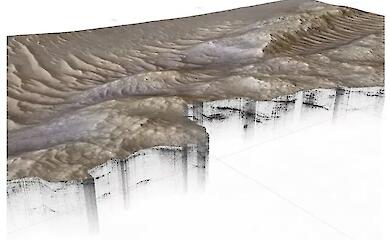
The scientists analysed data from the Mars Orbiter Laser Altimeter (MOLA), which operated aboard NASA's Mars Global Surveyor from 1997 to 2006, and images from the Mars Reconnaissance Orbiter's Context Camera (CTX). CTX is distinctive in that it provides nearly complete coverage of the surface of Mars.
Professional mapping software ArcGIS Pro, used for both terrestrial and planetary data, was used to delineate and mark river systems. The goal was to identify and map major drainage systems - where they begin, how they drain, and where they discharge water. Basins larger than 10⁵ km² were considered - a threshold the authors describe as typical for large catchments on Earth.
The final map includes river systems associated with:
areas of sediment accumulation,
channel canyons at the outlet,
ancient lakes,
a network of valleys.
Sixteen giant basins and half of the sediments
As a result, the team identified 16 major drainage systems. The authors estimate that they collectively transported about 28,000 km³ of sediment - that's about 42% of the total sediment volume moved by ancient rivers on Mars.
Separately, it was estimated that canyons at the outlet of the basins yielded about 24% of the global volume of river sediment.
"We've known for a long time that Mars had rivers," said paper co-author Timothy Goudge, assistant professor of Earth and planetary sciences at UT Austin. - But until now, we didn't know the extent to which these rivers were integrated into large, planet-wide catchment systems."
Mars' water history
Mars is thought to have formed about 4.5bn years ago, at the same time as the rest of the solar system. There is still no consensus in the scientific community about how long liquid water has existed on its surface, with some researchers talking about a series of episodic "wet" periods and others about longer phases. Work from 2022, for example, indicates that liquid water could have persisted on Mars as long as 2 billion years ago.
Signs of ancient water on Mars, in addition to the runoff systems, lakes and valleys described in the new paper, include:
deltas,
powerful channelised flow channels,
gullies,
terraces that look like coastlines.
Mineralogical "marker" features include clays, sulfate minerals, carbonates, and hematite nodules ("blueberries") first discovered by NASA's Opportunity rover in 2004.
Why the water disappeared
Scientists suggest several main reasons for Mars' loss of surface liquid water:
loss of the magnetic field,
climatic collapse,
burial of water in the interior.
As on Earth, Mars' magnetic field was once generated by its core. But the planet's smaller size led to faster cooling of the core and gradual decay of the magnetic field. This left the surface unprotected from harsh solar and cosmic radiation. Atmosphere and water began to actively leak out into space.
Part of the water, according to the models, could either go deep down - becoming groundwater - or be fixed in the form of ice at the poles. The exact proportions between "escaped" and "hidden" water are still a matter of research.
The new study shows that the ancient water system of Mars was not a collection of random channels, but a large and organised network of catchments that carried huge volumes of precipitation. This is another argument in favour of the Red Planet once being much wetter - and potentially more habitable.
Mykola Potyka has a wide range of knowledge and skills in several fields. Mykola writes interestingly about things that interest him.
Related news

Lost satellite 'brought back to life' after a month - scientists talk of a miracle




Popular news

Orban announces "results" of Hungarian mission on Druzhba oil pipeline

Will maternity leave be shortened in Ukraine? Changes for workers with children


Zelensky said that Russia was preparing a new offensive and pointed out the direction of it


Kellogg named the ceasefire condition today and compared Putin to Nicholas II

News about war
Orban announces "results" of Hungarian mission on Druzhba oil pipeline
Kellogg named the ceasefire condition today and compared Putin to Nicholas II
Zelensky said that Russia was preparing a new offensive and pointed out the direction of it

Russia is destroying Ukraine twice as fast as at the start of the war - international report