

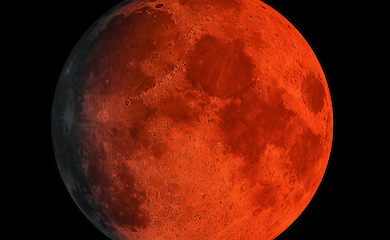
Life on Mars could have existed 4 billion years ago


Last year, NASA made a sensational announcement: the Perseverance rover on Mars had discovered possible signs of ancient life.
The technical details have now been published in the journal Nature, and despite the cautious wording, it could be one of the most significant scientific discoveries in history, according to The Conversation.
The rock in question is called Cheyava Falls, a fragment of ancient mudstone (mudstone) formed by water some 4 billion years ago. Unlike most Martian rocks, the red colour of this rock is not due to dust, but to oxidised iron in its composition. But what's more interesting is that the rock is mottled with small light-coloured spots surrounded by dark phosphorus-containing minerals. Organic compounds have also been found in the rock.
On Earth, all living organisms use redox reactions (redox reactions) to produce energy. In animals, for example, mitochondria transfer electrons from glucose to oxygen. But some bacteria use other compounds, including oxidised iron.
When such iron (ferric) is converted to a reduced form (ferrous), it becomes soluble and can be leached by water or reacted with to form lighter-coloured minerals. As a result, such "reduction spots" are often found in red sedimentary rocks on Earth. Similar formations were found Perseverance in Cheyava Falls and even more pronounced - on the site Serpentine Rapids, but there the rover did not have time to collect samples.
The new Nature publication confirms: light spots contain reduced iron, sulfur (in the form of sulfides) and organic compounds. The researchers believe that the redox reactions occurred inside the rock after its formation, which led to local discolouration.
Remarkably, such reactions - especially those involving the reduction of sulfates - do not usually occur at low temperatures, as they do on Mars. But they are quite possible with the involvement of microbes. In addition, such microbes may produce phosphates - and these are also found in the rock.
There is no definite answer. Without bringing the samples back to Earth, it is impossible to carry out all the necessary laboratory analyses. So far, the Mars Sample Return mission, a joint project between NASA and ESA, is facing financial difficulties, but it is the mission that could provide the final answer.
As the authors of the paper emphasise, no fully convincing non-biological explanation for all the observations has yet been found. But in astrobiology, this is not considered proof of life - it's just the beginning of the journey. The history of science shows that if there is no explanation today, it does not mean that it will not be found tomorrow.
Scientists will have to investigate which redox reactions involving iron, sulphur and organics are possible without life. And space agencies have to be brave enough to complete a sample return mission. Yes, it's expensive - but the stakes are incredibly high: we may be on the verge of discovering extraterrestrial life.
Mykola Potyka has a wide range of knowledge and skills in several fields. Mykola writes interestingly about things that interest him.
Related news

Lost satellite 'brought back to life' after a month - scientists talk of a miracle

These microbes survive boiling water and acid - and could help save the Earth

Astronomers have discovered a mysterious source of signals in space
Popular news

Orban announces "results" of Hungarian mission on Druzhba oil pipeline

Will maternity leave be shortened in Ukraine? Changes for workers with children


Zelensky said that Russia was preparing a new offensive and pointed out the direction of it


Kellogg named the ceasefire condition today and compared Putin to Nicholas II

News about war
Orban announces "results" of Hungarian mission on Druzhba oil pipeline
Kellogg named the ceasefire condition today and compared Putin to Nicholas II
Zelensky said that Russia was preparing a new offensive and pointed out the direction of it

Russia is destroying Ukraine twice as fast as at the start of the war - international report