

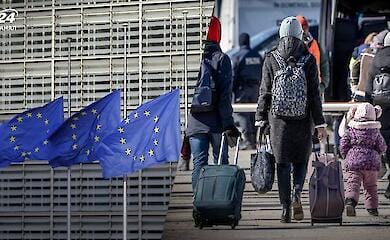
In Estonia, payments to Ukrainian refugees for rent are stopped
- Home
- Overseas
- Refugees. How to survive
- In Estonia, payments to Ukrainian refugees for rent are stopped

From May 2025, the support system for Ukrainian refugees in Estonia will change.
From May, Tallinn will stop the programme under which Ukrainian refugees who received temporary protection were reimbursed for housing and translation services. This is reported by Estonian TV channel ERR.
Previously, Ukrainian refugees in Estonia could receive one-off compensation to cover the costs of renting accommodation while they were looking for a permanent place to live.
Now, however, the support is becoming more targeted and stable," explained Lijs Paloots, head of the migration section of the Social Insurance Board.
According to her, Estonia is gradually returning to the previous order, whereby assistance is provided first to those who apply for international or temporary protection, have no support in the country and temporarily reside in state accommodation centres.
Estonia is also considering ending similar arrangements with other local communities to ensure a uniform approach to payments across the country.
This will help ensure that support does not depend on where you live, but only on your need for assistance in moving out of the accommodation centre," Paloots added.
From the start of the programme in June 2022 until April 2025, almost 11,000 Ukrainian families received compensation, including 1,710 households in 2024, of which 62% used the assistance in Tallinn. The maximum amount of compensation was up to 1,200 euros per family.
As of 28 February 2025, over 4.3 million non-EU citizens who fled Ukraine as a result of the Russian invasion have been granted temporary protection in an EU state. As of 31 January, Ukrainian nationals accounted for over 98.4% of temporary protection beneficiaries in the EU. Of these, women accounted for almost half (44.8 per cent), children for about a third (31.8 per cent), and men for less than a quarter (23.4 per cent) of the total number.

Journalist and editor of informational and analytical programs.
Related news
The loss of the middle class: what a new study on Ukrainian refugees showed


Berlin suggested that Ukraine reduce the number of men leaving the country for the EU

An EU country has announced its intention to stop accepting military conscripted men of conscription age

After temporary defences: how the EU and Ukraine can avoid chaos in 2027
Popular news
Orban announces "results" of Hungarian mission on Druzhba oil pipeline


Will maternity leave be shortened in Ukraine? Changes for workers with children


Zelensky said that Russia was preparing a new offensive and pointed out the direction of it

Kellogg named the ceasefire condition today and compared Putin to Nicholas II

News about war
Orban announces "results" of Hungarian mission on Druzhba oil pipeline
Kellogg named the ceasefire condition today and compared Putin to Nicholas II
Zelensky said that Russia was preparing a new offensive and pointed out the direction of it
Russia is destroying Ukraine twice as fast as at the start of the war - international report