

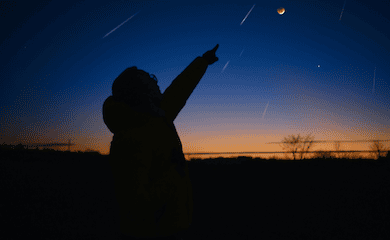
How to see the parade of planets in January 2025


In January, six planets come together in the evening sky at once - astronomers call this the "parade of the planets".
Most of them are quite visible to the naked eye, reports Phys.org.
A planet parade occurs when several planets cluster on the same side of the Sun and appear to be lined up behind each other in the night sky. According to Hannah Sparks, a member of the planetarium staff at the Bishop Museum of Science and Nature (Florida), the objects don't actually form a perfect straight line, but are roughly in the same sector relative to the Sun.
Astronomers note that such scenes happen at least once a year, but can be more frequent - it all depends on which planets are involved. Last June there was a similar phenomenon, but without the help of telescopes and binoculars then it was realistic to see only two planets.
Visible planets
This time Mars, Jupiter, Saturn and Venus will be visible without special instruments, but Uranus and Neptune will still have to be found with binoculars or telescopes. Mars is shining particularly brightly now, as it is opposite the Sun (a position astronomers call "opposition").
One of the most interesting scenes unfolds on 24 and 25 January (Friday and Saturday), when Venus and Saturn come so close together that there are only about two degrees between them in the sky. If the weather is cloudless, this rare convergence will be visible to the naked eye.
How to observe
To enjoy the parade of planets, it is recommended to go outside a couple of hours after sunset and look towards the south (or southwest). Venus and Saturn will be low on the southwestern horizon, Jupiter will be in the southern sector, and Mars will be closer to the east or southeast. You should look for bright 'dots' in the sky: stars tend to twinkle, while planets shine more evenly; Mars is easily recognisable by its red-orange hue.
For additional help, you can install an astronomy app on your smartphone. It will indicate the exact GPS position of objects and allow you to "catch" planets in the eyepiece faster.
Bonus: Mercury
By the end of February, Mercury will also join this cosmic "team", becoming the seventh planet of the parade. However, in the spring, the show's participants will begin to "disperse" one by one, returning to their orbits.
The planet parade makes us feel like we're part of the larger solar system," said Kevin Williams, director of the planetarium at the State University of New York at Buffalo. - Moments like this remind us how amazing our cosmic home is.
Mykola Potyka has a wide range of knowledge and skills in several fields. Mykola writes interestingly about things that interest him.
Related news
Lost satellite 'brought back to life' after a month - scientists talk of a miracle

These microbes survive boiling water and acid - and could help save the Earth
Astronomers have discovered a mysterious source of signals in space
Popular news

Orban announces "results" of Hungarian mission on Druzhba oil pipeline

Will maternity leave be shortened in Ukraine? Changes for workers with children


Zelensky said that Russia was preparing a new offensive and pointed out the direction of it


Kellogg named the ceasefire condition today and compared Putin to Nicholas II

News about war
Orban announces "results" of Hungarian mission on Druzhba oil pipeline
Kellogg named the ceasefire condition today and compared Putin to Nicholas II
Zelensky said that Russia was preparing a new offensive and pointed out the direction of it

Russia is destroying Ukraine twice as fast as at the start of the war - international report