
How does the Red Cross help Ukraine and how does it respond to criticism
- Home
- Frontline
- War in Ukraine. The storybook
- How does the Red Cross help Ukraine and how does it respond to criticism


The Red Cross is an organization with almost two hundred years of history, which was the first to systematically begin to help the victims of the war.
It is also, in fact, the guarantor of the Geneva Convention and is represented in all hot spots of the world. The Red Cross has been active in Ukraine since 2014, but after the full-scale invasion of the Russian Federation, several scandals erupted around the organization. Among the reproaches are self-elimination in the first weeks of the war, the transfer of Ukrainians from the combat zone to the territory of the Russian Federation, and inactivity in Olenovka, where Ukrainian prisoners of war died.
Socportal asked the representative of the International Committee of the Red Cross in Ukraine, Oleksandr Vlasenko, to answer several questions about the organization's activities.
What are the main tasks facing the Red Cross in Ukraine?
In any armed conflict, the International Committee of the Red Cross works according to its mandate, which is recognized by the entire world community. We work in armed conflicts and other violent situations to protect the life and dignity of the victims of armed conflicts and provide them with assistance. This is what we do in Ukraine:
- caring for the life and dignity of those detained in connection with the conflict;
- helping people meet their humanitarian needs;
- restoring family ties;
- ensuring respect for International Humanitarian Law;
- informing people living along the contact line about mine danger;
- helping medical institutions with various medicines and training;
- caring for those who have died as a result of conflict and other cases of violence.
Is it possible to estimate the extent of Red Cross assistance to Ukraine after a full-scale invasion? For example, how many staff are involved, volunteers? How many people were evacuated and provided humanitarian aid?
The International Committee of the Red Cross has no volunteers, only full-time employees, of whom there are currently about 800 in Ukraine. If necessary, we attract volunteers from the Ukrainian Red Cross. It isn't easy to calculate the exact amount of the benefit.
For example, we have long begun projects to restore water supply, sewerage, and heat supply systems.
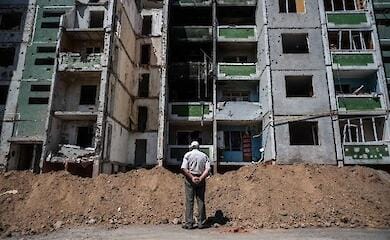
Large capital projects are being implemented in Chernihiv, as well as in the Irpin-Buchanskaya agglomeration. This includes the restoration of heating mains, water pipelines, donations of repair equipment, etc. More than 12 million people have benefited from uninterrupted water supplies due to these restoration efforts.
As for the distribution of humanitarian aid, it covers about 50,000 people. In addition, in cooperation with the Ministry of Social Policy of Ukraine, we provide financial assistance to the most vulnerable categories of the population who live, as of February 24, 2022, in the regions engulfed by the armed conflict. They all receive financial assistance for 2,500 hryvnias per month within three months. The total amount of such aid is about UAH 1 billion. According to the Ministry of Social Policy lists, we pay the money they gave us.
Ten thousand people were evacuated through safe passages (the so-called "humanitarian corridors") from Sumy, Berdyansk, Mariupol, and suburbs.
In addition, there is assistance to medical institutions and work to eliminate mine safety; accurate figures can be reported based on the results of six months of work when we calculate these data.

Is it possible to compare the scale of the work of the Red Cross in Ukraine and other countries engulfed in war? Since there are statements that several humanitarian initiatives have been reoriented to Ukraine?
To some extent, this is true. Regarding the planned budget for this year, the ICRC's activities in Ukraine ranked 10th in the world among all other countries where the ICRC operates. But after the start of a full-scale armed conflict in Ukraine, the budget was increased from 70 to 250 million Swiss francs.
This places operations in Ukraine in the top 3 most significant operations worldwide, along with Afghanistan and Syria.
The Red Cross worked in Ukraine in 2014 and further in "hot spots." What did the organization do, and how did its work change after February 24?
The main change has been the expansion of the territory covered by the ICRC and the number of people needing assistance.
If at the beginning of 2022 we had about 900 missing person cases (mostly missing in 2014-2015), now there are thousands of them.
The same applies to the number of schools, social institutions, and medical institutions that need our help. The program for restoring housing and debugging water and heat supply has been dramatically expanded. The ICRC's approach is determined by our mandate and the four Geneva Conventions that govern the rules of war. But the volume of our assistance in Ukraine has increased significantly compared to 2014-2022.
Were there scandals at that time similar to today? For example, about removing people from danger zones to the territory of the Russian Federation?
We never deal with people's movement except for organ by sizing the population's safe exit from areas covered by hostilities. Therefore, all reproaches of our participation in the direction of people are false information; it does not correspond to reality. The ICRC is a neutral organization working in areas where there is armed conflict to help non-combatants who are suffering as a result of the fighting. Of course, in such conditions, we often face criticism because not everyone likes our neutrality. Therefore, we are accustomed to working in situations of criticism from the parties to the conflict.
Does the organization face similar accusations in other countries torn by war?
Yes. The accusations are different, but mostly they are related to the principle of neutrality and non-support of any side of the conflict. From the latter, one can recall the criticism that the ICRC launched a program of assistance to Ukraine very quickly, in contrast to the situation when in 1996, the Rwandan army invaded the territory of the Democratic Republic of the Congo.
Of course, we also analyze our work in a given situation and try not to repeat the mistakes in previous conflicts.
Another accusation concerns visiting conflict detainees since this type of our activity is strictly confidential, and we discuss any violations that we witness personally with the responsible persons. So for example, when there was a scandal about the violation of the rights of detainees in the Abu Ghraib prison in Iraq, it was widely discussed in the media. During this, it turned out that we knew about the violations in the Abu Ghraib prison, but publicly, they did not state it. Some accusations disclosing these facts could have prevented breaches more than confidential conversations demanding that such abuses be stopped.
Does the organization plan any changes in its work in Ukraine due to the criticism?
This question is difficult to answer because it is pretty broad. We need to look at what kind of criticism we are talking about. If we talk about our approaches and principles, in particular confidential dialogue with the parties to the conflict on the return of the bodies of dead combatants, visits to detainees in connection with the competition, our non-support for any of the parties to the competition, and focus on helping the civilian population suffering as a result of the conflict. These are the main things which cannot be changed. Because they are stipulated by the international mandate of the ICRC and regulate our activities throughout the world, some approaches may need to be modified to assist conflict-affected and suffering populations better.

Expert on women's rights, persons with disabilities, motherhood in the modern context, health care reform, education and social welfare.
Related news
The loss of the middle class: what a new study on Ukrainian refugees showed


Kellogg named the ceasefire condition today and compared Putin to Nicholas II

Britain says under what circumstances Putin will start a war in Europe

Popular news
Orban announces "results" of Hungarian mission on Druzhba oil pipeline


Will maternity leave be shortened in Ukraine? Changes for workers with children

Zelensky said that Russia was preparing a new offensive and pointed out the direction of it
Kellogg named the ceasefire condition today and compared Putin to Nicholas II
News about war
Orban announces "results" of Hungarian mission on Druzhba oil pipeline
Kellogg named the ceasefire condition today and compared Putin to Nicholas II
Zelensky said that Russia was preparing a new offensive and pointed out the direction of it
Russia is destroying Ukraine twice as fast as at the start of the war - international report