
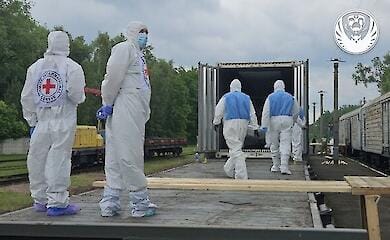

EU extends protection for Ukrainians until 2027: what does it mean
- Home
- Special projects
- EU extends protection for Ukrainians until 2027: what does it mean


on 13 June, the European Commission extended temporary protection for Ukrainians until March 2027. However, after that, the question - whether to integrate or return - will become a question for our fellow citizens.
The Temporary Protection Directive, whose extension was announced by European Commissioner for Home Affairs and Migration Magnus Brunner, guarantees that more than 4.3 million Ukrainian citizens fleeing Russian aggression will continue to receive support. Europe has met the unprecedented influx of people with impressive solidarity: in all EU states, Ukrainians have been granted access to accommodation, medical care, education, and employment. However, the current extension of the protection status is more likely to be the last and further Ukrainians who want to stay in the EU will need to switch to other legal grounds. Socialportal has read the statements of the European Commission and interviewed international experts about what our citizens should prepare for in the EU.
Ukrainians will be offered a "single European path" after 2027
Millions of displaced people from Ukraine have found safety, refuge and new opportunities across the EU thanks to temporary protection. As the situation in Ukraine remains fragile, we will extend this protection for another year, while paving the way for a smooth exit from temporary protection, including support for safe and dignified return - both now and in the future," Brunner said ahead of the protection extension.
At the same time, the European Commission insists that this measure is temporary and is already developing a "common European pathway" for the future: from the gradual integration of refugees in host countries to a phased return and reintegration in Ukraine when the necessary conditions arise.
We must prepare for the transition to other legal statuses, as well as for gradual return and sustainable reintegration when the temporary measures are no longer in force. Today's proposals provide stability in the face of uncertainty for those who remain in the EU and enable those who decide to do so to return home safely," said Henna Virkkunen, Executive Vice-President for Technology Sovereignty, Security and Democracy, in her turn.

At the same time, EU leaders emphasise their commitment to support Ukraine for as long as it takes and their readiness to help Ukrainians determine their future destiny.
Since 2022, we have been providing protection to those fleeing war, and we continue to do so. Together with Ukraine, we are paving the way for people to be able to return and rebuild their homes when it is safe to do so," European Commission President Ursula von der Leyen said.
New EU initiatives are in a similar vein: extending temporary protection is combined with planning for the transition to other legal residency statuses for those who take root in Europe, as well as preparing voluntary return programmes for those who decide to do so.
Integration, assimilation or the formation of a new diaspora
In the more than three years since the full-scale invasion began, a large proportion of Ukrainian refugees have begun to integrate into host countries. Many have learnt the language, found jobs or enrolled in studies. Sociologists note that the rate of outflow from Ukraine has gradually slowed - there seems to be a certain "temporary equilibrium point" where most of those who wanted and could leave have already left. The share of those who still want to leave but cannot is estimated to be significantly lower. This means that new large waves of migration are unlikely, and communities of Ukrainians abroad have begun to stabilise at the current level.
According to experts, if the war drags on, Ukrainians who have settled in Europe will gradually integrate into the local diaspora. Economist Volodymyr Vakhitov, director of the Institute of Behavioural Research and associate professor at the Kyiv School of Economics, said in an interview with Socialportal that there is nothing fundamentally new in the formation of this diaspora.
Most likely, these people will develop according to the same model as previous waves of emigration, only taking into account greater mobility in the modern world. They will probably dissolve more into the local population and will not cluster so compactly because they know the language better or will eventually learn it," Vakhitov suggested.

He compares the current situation of Ukrainians in the EU with the context of the last century in North America, where many Ukrainians then fled.
The European environment is culturally closer to Ukrainians than, say, America was a century ago, so today's refugees are less likely to be confined to their community. Indeed, in the EU countries we do not see the formation of separate "Ukrainian neighbourhoods" - our compatriots are dispersed rather scattered. Nevertheless, such innovations as high mobility and digital communications allow Ukrainians abroad to actively keep in touch with their homeland. Many continue to work remotely for Ukrainian companies or participate in volunteer initiatives. Sociologists call such intangible ties "social remittances" - knowledge, ideas, contacts and experience that migrants pass back to Ukraine. Thanks to them, even Ukrainians living abroad for a long time are able to invest in the development of their native country while remaining abroad," the expert says.
He attributes the lives of Ukrainian refugees simultaneously "two worlds", which has also been described in other studies, to new technologies. This dual situation may also become a "bridge" for the return of refugees to Ukraine.
Will "unity centres" help to bring Ukrainians back?
Despite the successful adaptation of many families in Europe, the question of returning to Ukraine sooner or later arises for each of them. Studies show that most refugees continue to follow the situation in their homeland, and the long term, do not rule out their return. The EU, for its part, is trying to provide them with an informed choice: Unity Hubs are being created - a kind of information and consultation hub where Ukrainians abroad can get information both for integration in the host country and for their return home. In the meantime, the Ukrainian government also says it is counting on the return of its citizens: the country is in dire need of people to rebuild its economy and infrastructure.

Ukraine needs its people, as Commissioner Brunner emphasised, because it is they who will raise cities from ruins and shape the future of the state.
We need to help Ukrainians make informed decisions about their future - whether that means returning home or temporarily continuing to support Ukraine from here. In support of this goal, we will give our full support to the Ukrainian initiative Unity Hubs," he emphasised.
However, are the people themselves ready to return, and under what conditions will this happen? Surveys among Ukrainians in Europe show contradictory trends.
The first is security. Everyone says: we will return when the war is over, when there is sustainable security," Vakhitov states, referring to the typical answer of the respondents.
Indeed, as long as daily missile strikes and shelling continue, few are willing to take their families back. Over time, however, the factors that keep people abroad go beyond purely military risks.
In a protracted conflict, socio-economic reasons why refugees may prefer to stay in EU countries are becoming increasingly important. The difference in quality of life cannot be underestimated, Vakhitov said.
If there is a huge difference in income and infrastructure, it does not favour mass return," the economist said. - Many people don't want to return not because things are bad in their homeland, but because Germany has much better schools. Medicine is much better in Germany. You may not go to the doctor there with every cough, but if you have cancer - here you will die, but there you will survive. Or if you need a serious heart operation, you'll get it there, but here you'll only get it for insane amounts of money that don't exist.
These harsh words reflect the bitter reality: the quality of the medical system and other services in Ukraine is now far inferior to the European level. We should not forget about the education of children, which, during the war, many families managed to organise in new countries. A child who has successfully entered a European school or university is already attached to the new environment, and parents may not want to interrupt their education for the sake of an uncertain prospect at home. Housing and infrastructure is other factors: if the hometown is destroyed or lacks basic amenities, there is simply nowhere to return to. Thus, even after peace, Ukraine will face a massive challenge to create an environment attractive to those who want to return. This means rebuilding homes, hospitals, schools, creating jobs, and ensuring normal security in towns and villages.
How support for IDPs inside Ukraine influences Ukrainians' plans for the EU
the experience of internally displaced persons (IDPs) - those Ukrainians who fled the frontline regions but remained inside the country - can be considered a "dress rehearsal" for return. The International Organisation for Migration notes the link between the integration of IDPs and the prospects for the return of external refugees.
The success of the return of people from abroad is determined primarily by the successful integration of internally displaced persons inside Ukraine. To the extent that our IDPs manage to settle in their new places, people from abroad will be able to return. Especially those who have nothing left. If a displaced person from Mariupol or Bakhmut has no home, no job, no school, no doctor - nothing - and cannot find anything normal for himself in another region of Ukraine, then a person sitting abroad looks at this and thinks: where will I go, I have nothing at all, and I see what problems there are. As long as Ukraine cannot integrate people inside the country in a normal way, there will not be a big wave of return," Vakhitov explains.
This point of view shows that providing a decent life for hundreds of thousands of IDPs is a necessary condition for millions of refugees abroad to believe in the possibility of returning. In the meantime, a significant proportion of internally displaced persons face difficulties, from finding housing and employment to obtaining medical and social services. Their experience serves as a wake-up call: if the state cannot cope with the needs of its citizens displaced within the country, how prepared is it for the influx of citizens who decide to return from abroad?
At the crossroads: what awaits Ukrainian refugees
In the coming years, the fate of Ukrainian refugees in the EU will take different turns. Some of them will stay abroad for a long time, actually forming a new wave of Ukrainian diaspora in Europe. These people will gradually settle down, secure their jobs, and may not want to change their established life. European countries, for their part, are already considering ways of transferring such Ukrainians from temporary protection to other long-term grounds of stay, for example, labour or study visas, national residence permits. The extension of temporary protection status until 2027 gives both refugees themselves and EU governments time to plan the next step. For many families who have put down roots abroad, this step will be the final integration into the host society, with the corresponding rights and obligations. EU countries may also be interested in this. For example, Poland, where Ukrainians generate almost 3 per cent of GDP.
At the same time, a significant proportion of Ukrainians expect to return home as soon as the threat to their lives has disappeared and acceptable conditions are available in their homeland. The EU emphasises that return must be safe, voluntary, and dignified. This means that no one will be forced to leave Europe - rather, on the contrary, people will be supported informationally and organisationally if they wish to return. Ukraine itself has a major role to play in incentivising the return: only sustainable peace, economic recovery, and successful reconstruction will make the return mass and definitive. Ukrainian society will have to face the difficult task of reintegrating returning compatriots, many of whom will bring with them new experience, knowledge, and even capital accumulated abroad.
However, while the war continues, European countries are ready to continue to provide Ukrainians with shelter and support. At the same time, the EU and Ukraine are already laying the foundations for a future transition period - whether it is integrating those who will stay in Europe or helping those who decide to return. For the refugees themselves, this means freedom of choice: to stay and build a new life abroad or to return home and rebuild their country.
Maria Grynevych, project manager, journalist, co-author of Guidebook Sacred Mountains of the Dnieper Region, Lecture Course: Cult Topography of the Middle Dnieper Region.
Related news
The loss of the middle class: what a new study on Ukrainian refugees showed

Berlin suggested that Ukraine reduce the number of men leaving the country for the EU

Politico: EU has effectively abandoned the idea of Ukraine's accelerated accession
An EU country has announced its intention to stop accepting military conscripted men of conscription age
Popular news
Orban announces "results" of Hungarian mission on Druzhba oil pipeline

Will maternity leave be shortened in Ukraine? Changes for workers with children

Zelensky said that Russia was preparing a new offensive and pointed out the direction of it

Kellogg named the ceasefire condition today and compared Putin to Nicholas II

News about war
Orban announces "results" of Hungarian mission on Druzhba oil pipeline
Kellogg named the ceasefire condition today and compared Putin to Nicholas II
Zelensky said that Russia was preparing a new offensive and pointed out the direction of it
Russia is destroying Ukraine twice as fast as at the start of the war - international report