
Charles Darwin's personal address book has been published


The Darwin Online project at the National University of Singapore has published Charles Darwin's personal address book for the first time.
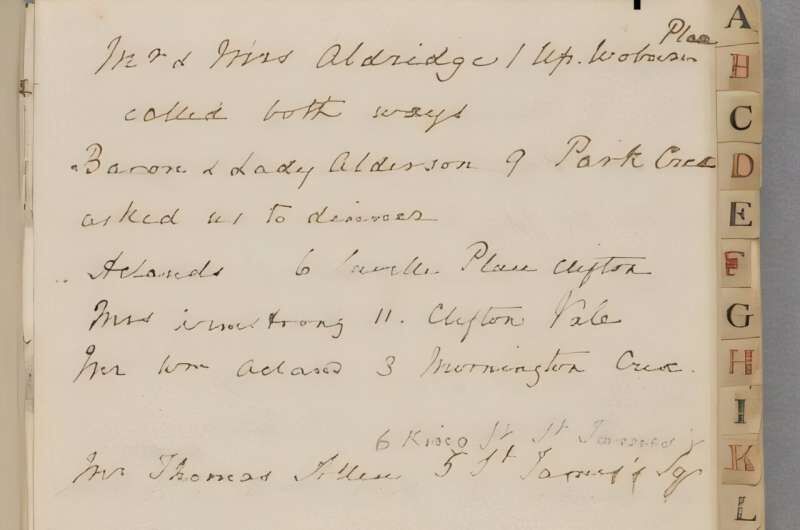
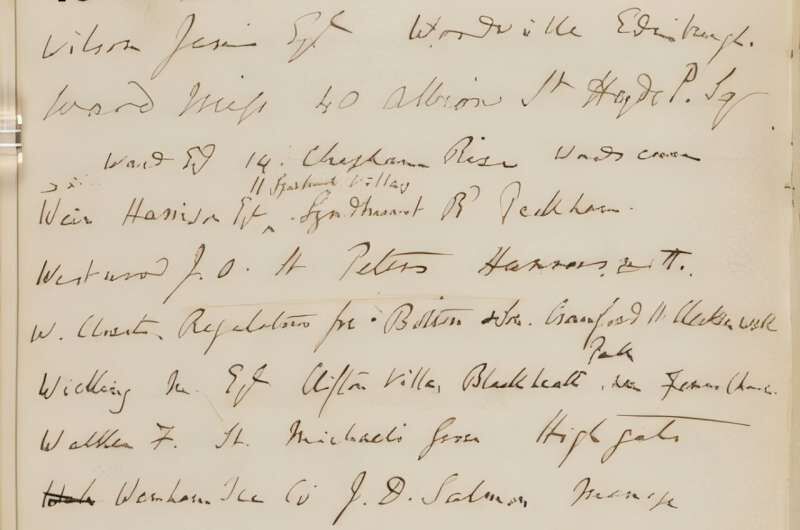
This small brown leather notebook with 'VISITS' and 'ADDRESSES' on the spine and alphabetical dividers has proved to be a truly unique source about his private life and daily work.
In addition to scans of all 48 pages, the researchers deciphered the complex handwriting of Darwin and his wife, and provided the records with hundreds of comments and references - who hides behind the abbreviated names, where these people and firms are mentioned in publications and drafts of the scientist. In all, there are about 500 entries in the book.
A family address book that stayed with Darwin throughout his life
Theaddress book was started by his wife Emma Darwin shortly after their marriage in January 1839, when the couple had just begun their life together in London. Later the entries were kept almost entirely by Darwin himself, both in his flat in the capital and after he moved to Down in 1842. This notebook was used by him for the rest of his life.
It is particularly valuable in that it records contacts and notes not reflected in his surviving correspondence. A multi-volume project to publish Darwin's letters has identified some 15,000 letters, but thousands more have been lost. The Address Book partially fills these gaps.
More than just addresses: from rat poison to fireworks
The notebook is a small encyclopaedia of Darwin's daily life and his home in Down:
links to articles in the Gardeners' Chronicle that he used in his research;
recipes for rat poison - for stables and outbuildings;
instructions for cleaning animal skeletons, making glue, and ordering peat for a greenhouse with experimental plants;
notes on medical procedures, washing machine, lawnmower, scales;
a note about ordering fireworks for a village fete.
There are also more personal details: for example, notes on tailors noting the size of his shirts - '38 across the chest' - as well as prices for materials he needed - scientific labels, clay for the garden, and mentions of 'alternative' treatments like electric battery treatment or 'hydrotherapy'.
From pigeon breeders to the Royal Optician and Singapore
The address book found many unexpected contacts:
pigeon breeders, some of whom had not previously appeared in the literature on Darwin (important for his work on variation and selection);
social activists and scholars, such as Oscar Wilde's father and the reformer Octavia Hill;
a late entry on the opticians Dixey & Son, a firm that supplied spectacles to Queen Victoria and later Winston Churchill and still exists today. Its archives were destroyed during the Second World War, so they did not know that Darwin was their client.
The speed of copyist Ebenezer Norman, who transcribed many of Darwin's drafts, including an outline of the theory of natural selection sent to the American botanist Asa Gray in 1857, is also noted. This text later became part of Darwin and Wallace's 1858 joint materials, prompting the publication of The Origin of Species in 1859.
Of particular interest is the entry:
"Wallace A. R. Ternate. Hamilton, Gray & Co, Singapore."
This is the address of Alfred Russell Wallace's Singapore shipper, his de facto "base" from 1854-1862 while he was collecting in Southeast Asia. Dispatches were received here, which were then redirected to Wallace on the island where he was currently working.
A reminder that it was Wallace who independently formulated the idea of natural selection, and their joint presentation of the ideas in 1858 was the first public announcement of the new evolutionary theory.
The path of the notebook: from family heirloom to online accessibility
After Darwin's death, the notebook remained in the family along with other manuscripts. In 1942, the bulk of the archive was transferred to Cambridge University Library, and in 1948 the address book was deemed more suitable for a museum at Darwin's former home, Down House, where it remains today.
Historian of science John van Wye (NUS) emphasises:
"It is astonishing that this small trove of details from Darwin's life has remained unpublished until now. It provides a fascinating new insight into how he lived and worked."
Since 2005, the Darwin Online project (formerly at Cambridge, now at NUS) has been transcribing and editing virtually the entire Darwin archive, all his publications and even a restored library. Darwin's complete online library was introduced in 2024 to widespread acclaim. Now another important link has been added to it - his personal address book.
An independent researcher, interested in archaeology and sacred geography. He researches them and writes about them.
Related news
Archaeologists have found children's fingerprints in 15,000-year-old clay

Traces of an "ancient machine gun" have been found in Pompeii
100 years ago, the first rocket was launched - this was the beginning of the space age

Popular news

Orban announces "results" of Hungarian mission on Druzhba oil pipeline


Will maternity leave be shortened in Ukraine? Changes for workers with children


Zelensky said that Russia was preparing a new offensive and pointed out the direction of it


Kellogg named the ceasefire condition today and compared Putin to Nicholas II

News about war
Orban announces "results" of Hungarian mission on Druzhba oil pipeline
Kellogg named the ceasefire condition today and compared Putin to Nicholas II
Zelensky said that Russia was preparing a new offensive and pointed out the direction of it

Russia is destroying Ukraine twice as fast as at the start of the war - international report