

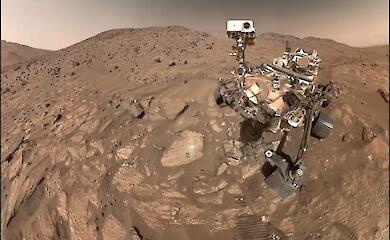
Artificial intelligence has joined the hunt for aliens: what it's already found


Since the 1950s, mankind has continuously searched for extraterrestrial life - launching interplanetary probes, analysing meteorites for molecules, listening to the cosmos with radio telescopes and studying UFOs. But what has actually been found in these seven decades?
A team led by Seyed Sina Seyedpour Layalestani from the Islamic Free University in Iran has analysed the strongest evidence to date, from ancient space rocks to data from space missions, writes Universe today.
The work is published in the International Journal of Astrobiology.
Meteorites: "markers of life" older than the solar system
One of the key objects is the Murchison meteorite, which fell in Australia in 1969. It is estimated to be about 7 billion years old - older than our solar system. Recent analyses have shown that it contains all five nucleobases that make up DNA and RNA: adenine, guanine, thymine, cytosine and uracil.
These molecules are of extraterrestrial origin, which undermines the notion that the "building blocks" of life were formed exclusively on Earth.
A similar story is told by the Orgei meteorite that exploded over France in 1864. In this carbonaceous rock, they found not only amino acids (such as glycine and alanine), but also structures similar to microfossils - miniature forms resembling magnetotactic bacteria from Earth's oceans. At first, scientists wrote them off as pollution or mineral artefacts, but new research has confirmed their extraterrestrial nature.
Water and organics in the solar system
Spacecraft have expanded the search far beyond meteorites. Mars rovers have found evidence of flowing water and ice, and the Phoenix lander has confirmed the presence of water ice just three centimetres below the surface of Mars.
The Cassini probe found powerful ice geysers and icy structures on Saturn's satellite Enceladus. All of these findings show: the key conditions for life - water, organic compounds and energy sources - are much more widely found in the solar system than previously thought.
Radio telescopes have identified more than a hundred organic molecules in interstellar gas and dust clouds, including amino acids and nucleic acid components. This strengthens the panspermia hypothesis: the idea that the "building blocks of life" are scattered throughout space and could seed planets across the galaxy.
But what about intelligent aliens?
Despite decades of UFO reports and the work of SETI programmes sending signals into space and listening to the skies, there is still no confirmed evidence of extraterrestrial civilisations.
Most UFO sightings eventually receive the usual explanations, from ball lightning and atmospheric anomalies to plasma phenomena in the upper atmosphere. The scandalous "alien bodies" displayed in Mexico's parliament in 2023 were quickly recognised by scientists as artificial constructs.
The main problem today is not the lack of "ingredients of life", but the fact that it has not yet been possible to prove that somewhere these ingredients have actually folded into living organisms. Finding DNA components in ancient meteorites does not mean that bacteria existed there - only that the chemistry necessary for life occurs naturally in space.
Artificial intelligence in the search for life
In recent years, artificial intelligence has come into play. New algorithms are helping to analyse the chemical composition of meteorites and distinguish organics of biological origin from abiogenic ones.
Machine learning is being used to filter out noise in radio signals and highlight possible bio-signatures in the atmospheres of exoplanets. Where the human eye and brain fail to cope with huge data sets and subtle patterns, AI is proving particularly effective.
The result of seven decades
Over 70 years of searching, scientists have confidently shown:
"the building blocks of life are spread across the cosmos;
water and organic molecules are found on many bodies in the solar system;
the chemistry necessary for life to begin naturally occurs outside the Earth.
But the big question remains: whether these fragments were able to form somewhere into living organisms - microscopic or intelligent. This remains one of the most intriguing mysteries of the Universe.
Mykola Potyka has a wide range of knowledge and skills in several fields. Mykola writes interestingly about things that interest him.
Related news
Lost satellite 'brought back to life' after a month - scientists talk of a miracle

These microbes survive boiling water and acid - and could help save the Earth
Astronomers have discovered a mysterious source of signals in space
Popular news

Orban announces "results" of Hungarian mission on Druzhba oil pipeline

Will maternity leave be shortened in Ukraine? Changes for workers with children


Zelensky said that Russia was preparing a new offensive and pointed out the direction of it


Kellogg named the ceasefire condition today and compared Putin to Nicholas II

News about war
Orban announces "results" of Hungarian mission on Druzhba oil pipeline
Kellogg named the ceasefire condition today and compared Putin to Nicholas II
Zelensky said that Russia was preparing a new offensive and pointed out the direction of it

Russia is destroying Ukraine twice as fast as at the start of the war - international report