
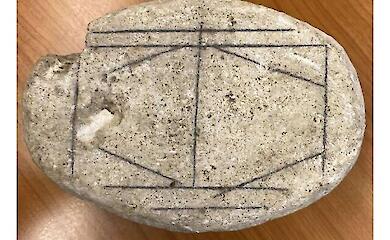

Archaeologists have found proof that a legendary king named Kashkash was a real historical figure


Archaeologists in northern Sudan have found unexpected evidence that a Nubian king named Kashkash was a real historical figure, not just a character in later retellings.
It is about a small Arabic document from the 16th-17th century, which was lifted... from a rubbish heap during the excavations of Old Dongola. The text gives orders "in the name of King Kashkash", and it became one of the most direct written traces of this ruler.
What is Old Dongola in general
Old Dongola was once the capital of the Christian kingdom of Macuria. But from about the middle of the 14th century the city lost its status as capital, and the following centuries in the history of the region are often described as "dark" - there are few sources, and it is not always clear exactly how the Arabisation and Islamisation of Nubia proceeded. The new document is important precisely because it adds "living" everyday detail from this period.
Who is Kashkash
Kashkash is one of the early pre-colonial rulers of Dongola, a figure of the "dark" period of the city's history after the decline of Christian Macuria.
What the archaeologists found
The find was made as part of the UMMA project, which has been re-exploring the citadel and the neighbourhood of Dongola since 2018. Researchers excavated a building that local tradition links to the residence of the rulers. There they found things of "elite" life (fabrics, objects made of bone, etc.) and more than two dozen Arabic texts, among which was an order in the name of Kashkash.
What the order is about
The content of the document is not about wars and "great politics", but about the exchange of things and duties: to whom to give certain items, from whom to take a sheep and a lamb, to whom to give cotton cloths and perhaps a headdress/bandage (there is a place in the text that is interpreted in different ways). The meaning is simple: the king rules through a network of people and errands, and the power relations look like a mixture of orders and exchange of "gifts".
Separately, the researchers note: the headdress mentioned could have been a status item, usually associated with the upper nobility.
What this says about language and 'Arabisation'
Another important part is how the text is written. The language shows that the scribe's command of Classical Arabic was not perfect: there are simplifications, errors and "compressed" writing, similar to colloquial speech. It looks as if Arabic is already becoming the main written language of the court, but is not yet necessarily the mother tongue of everyone in the city.
What's next
The authors believe that other letters found may show how the local system of correspondence worked - not only between administrators and religious elites, but perhaps also with the leaders of nomadic groups around the city.
An independent researcher, interested in archaeology and sacred geography. He researches them and writes about them.
Related news
Archaeologists have found children's fingerprints in 15,000-year-old clay

Traces of an "ancient machine gun" have been found in Pompeii
100 years ago, the first rocket was launched - this was the beginning of the space age

Scientists have found a huge bone from a possible ancestor of T. rex
Popular news

Orban announces "results" of Hungarian mission on Druzhba oil pipeline


Will maternity leave be shortened in Ukraine? Changes for workers with children


Zelensky said that Russia was preparing a new offensive and pointed out the direction of it


Kellogg named the ceasefire condition today and compared Putin to Nicholas II

News about war
Orban announces "results" of Hungarian mission on Druzhba oil pipeline
Kellogg named the ceasefire condition today and compared Putin to Nicholas II
Zelensky said that Russia was preparing a new offensive and pointed out the direction of it

Russia is destroying Ukraine twice as fast as at the start of the war - international report