

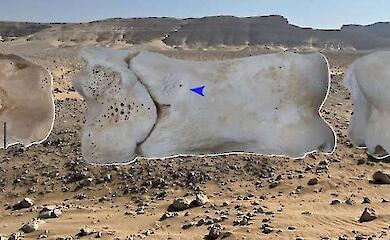
Archaeologists have discovered an ancient "navigation system" through the desert


In Saudi Arabia, 12,000-year-old rock paintings indicating water sources have been found.
About 12,000 years ago, a man or group of men carved life-size images of camels in stone on a sheer cliff in northern Arabia.
The cliff rose 39 metres high, and at its base was a shallow lake that served as a source of water for the locals. Over time, the engravings suffered erosion and were all but lost until an international team of archaeologists rediscovered them just two years ago.
The find was made near the southern border of the Nefud Desert in Saudi Arabia.
The study, published in the journal Nature Communications, showed that the animal images were not random decorations, they served as landmarks marking vital bodies of water in the harsh desert environment.

Scientists have recorded more than 60 panels with rock paintings, a total of 176 engravings. Among them are about 130 images of large animals: camels, ibexes, wild asses, gazelles and even extinct aurochs. Some of the drawings reached three metres in length and more than two metres in height.
Of particular interest was an image of two camels, one of which was depicted in motion. Under the rock, archaeologists found intact cultural layers with flint arrowheads, stone beads and even an engraving tool. The method of luminescent dating showed that the finds are about 12,000 years old.
Interestingly, the jewellery and tools found near the drawings match similar artefacts from the Levant, some 400 kilometres to the north. This indicates that the ancient inhabitants of Arabia were part of a wide network of cultural and trade links.
Archaeologists have also found that the rock paintings were located near ancient seasonal lakes. These bodies of water began to form about 15,000 years ago, after the extremely dry period of the last glacial maximum. Thus, the appearance of water made possible the settlement of previously uninhabitable desert areas.
According to the researchers, the images of animals served as peculiar markers denoting the paths to water and the springs themselves. In the Arabian Desert, the camel became a symbol of survival, which is probably why it was depicted in the first place.
An independent researcher, interested in archaeology and sacred geography. He researches them and writes about them.
Related news
Archaeologists have found children's fingerprints in 15,000-year-old clay

Traces of an "ancient machine gun" have been found in Pompeii


Popular news
Orban announces "results" of Hungarian mission on Druzhba oil pipeline


Will maternity leave be shortened in Ukraine? Changes for workers with children


Zelensky said that Russia was preparing a new offensive and pointed out the direction of it


Kellogg named the ceasefire condition today and compared Putin to Nicholas II

News about war
Orban announces "results" of Hungarian mission on Druzhba oil pipeline
Kellogg named the ceasefire condition today and compared Putin to Nicholas II
Zelensky said that Russia was preparing a new offensive and pointed out the direction of it

Russia is destroying Ukraine twice as fast as at the start of the war - international report