

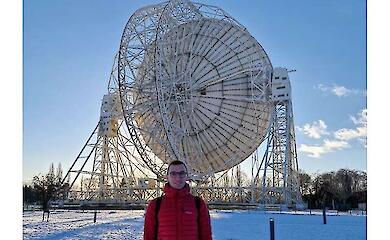
AI reveals chemical traces of the oldest life on Earth 3.3bn years old


A new study has revealed: rocks more than 3.3 billion years old have preserved chemical traces of the oldest life, and molecular "fingerprints" indicate that oxygenic photosynthesis emerged nearly a billion years earlier than previously thought.
This reports Phys.org with reference to the work of an international team led by scientists at the Carnegie Institution for Science.
The researchers combined advanced methods of chemical analysis and artificial intelligence to "hear" faint biosignatures hidden in ancient rocks. Using machine learning, they trained a computer to recognise the subtle molecular fingerprints left by living organisms, even when the original biomolecules have already been completely destroyed.
One of the project participants was Kathy Maloney, an assistant professor in the Department of Earth and Environmental Sciences at Michigan State University. She studies the evolution of early complex life and its impact on ancient ecosystems and provided samples of rare, exceptionally well-preserved fossil algae about 1 billion years old from the Yukon, Canada. These macroscopic algae are among the first known marine algae in the fossil record, when the vast majority of life forms could still only be seen under a microscope.
How AI "reads" the chemical annals
"Ancient rocks are full of mysteries that tell the story of life on Earth, but a few fragments of that mosaic are always missing," Maloney notes. The combination of chemical analysis and machine learning has made it possible to see biological clues that previously remained invisible, she says.
Early life forms on Earth left few direct molecular traces. Single ancient cells and microbial mats were buried, compressed, heated and split in the Earth's mobile crust over billions of years, and then brought back to the surface. These processes have virtually wiped out recognisable biosignatures that could tell us about the origins and early evolution of life.
The new work shows that the distribution of fragments of organic molecules in ancient rocks still holds diagnostic information about the biosphere - even if the original biomolecules did not survive. In fact, life has left far more traces than expected: subtle "chemical whispers" embedded deep within the thickness of ancient rocks.
The scientists used high-precision chemical analysis to "break down" organic and inorganic matter into molecular fragments, and then trained an AI system to recognise the characteristic "fingerprints" of biological origin.
In total, more than 400 samples were studied - from modern plants and animals to billion-year-old fossils and meteorites. The AI model distinguished biological material from non-biological material with an accuracy of more than 90% and identified signs of photosynthesis in rocks at least 2.5 billion years old.
Until now, reliable molecular traces of life could only be confidently detected in rocks younger than about 1.7 billion years. The new approach effectively nearly doubles the temporal window in which chemical biosignatures can be used to study the ancient biosphere.
"Ancient life leaves behind not only fossils but also chemical echoes," says Robert Hazen, lead researcher at Carnegie and one of the paper's co-authors. - "With machine learning, we can reliably interpret these echoes for the first time."
For Katie Maloney, who is investigating how early photosynthesising organisms changed the planet, the implications of the discovery are huge: the new technique allows the fossil record of deep time to be "read" in a fundamentally new way and could help guide the search for traces of life on other planets.
Prospects for astrobiology
The authors emphasise that the same approach could be applied to samples from Mars or other celestial bodies to find out if life ever existed there. If the "chemical whispers" of an ancient biosphere are preserved in Earth rocks more than 3 billion years old, similar signals could theoretically be detected in rocks on other planets.
An independent researcher, interested in archaeology and sacred geography. He researches them and writes about them.
Related news
Archaeologists have found children's fingerprints in 15,000-year-old clay

Traces of an "ancient machine gun" have been found in Pompeii
Scientists have found a huge bone from a possible ancestor of T. rex
Popular news
Orban announces "results" of Hungarian mission on Druzhba oil pipeline


Will maternity leave be shortened in Ukraine? Changes for workers with children


Zelensky said that Russia was preparing a new offensive and pointed out the direction of it


Kellogg named the ceasefire condition today and compared Putin to Nicholas II

News about war
Orban announces "results" of Hungarian mission on Druzhba oil pipeline
Kellogg named the ceasefire condition today and compared Putin to Nicholas II
Zelensky said that Russia was preparing a new offensive and pointed out the direction of it

Russia is destroying Ukraine twice as fast as at the start of the war - international report