


A new study looks at whether memories can be trusted


Could the memories be an accidental illusion?
We used to think that memories are records of things that really happened to us. We also have little doubt that time only goes forward. But there's a strange idea in physics that calls this into question. It's called the Boltzmann brain hypothesis.
The essence of the hypothesis is this: if the universe as a whole tends towards disorder (i.e. entropy is increasing), then sometimes, theoretically, rare "random bursts of order" can occur. In the framework of a mental experiment, it could look like a brain that "thinks", "sees" and even has "memories" appeared somewhere by itself for a moment. The problem is that such memories are then unrelated to the real past - they are just a random collection of sensations and "pictures in your head."
A recent paper by scientists from the Santa Fe Institute - David Walpert, Carlo Rovelli and Jordan Scharnhorst - looks at why this paradox arises in the first place and why there is so much controversy surrounding it. The authors are not trying to prove that we can really be "Boltzmann brains". Their goal is different: to show what hidden assumptions we make when we talk about time and entropy.
One of the key points has to do with the second law of thermodynamics: we usually say that entropy is increasing, so there is a "time arrow". But in statistical physics, some of the formulas are arranged in such a way that they in a sense do not distinguish the direction of time - forwards or backwards. And then a strange thing formally comes out: "random" constructions, similar to memory and observation, can seem even more likely than the real history of the universe.
The authors show that different approaches to this topic depend on what point we consider "given". Some reasoning starts from the present state of the universe and tries to explain what came before. Others rely on the idea that entropy was very low at the very beginning (conventionally, at the Big Bang), and that this already sets the direction of time. But physics itself does not explicitly say which of these choices is "correct" - this is an additional assumption.
The main conclusion of the paper is that many of the usual arguments in this topic are circular. We believe that the past was "present" because we trust memory and records. And then we say that memory is reliable because the laws of entropy growth seem to confirm the existence of a real past. The scientists suggest that we separate the laws of nature from what conclusions we draw from them, and honestly record where our interpretation begins.
In the end, the article doesn't provide a simple answer to the question "what if our memories are an illusion?". But it does make the discussion more transparent: it shows that it is not just the formulas that matter in the debate about "Boltzmann brains", but also what assumptions we accept when we talk about time, entropy and the past.
Mykola Potyka has a wide range of knowledge and skills in several fields. Mykola writes interestingly about things that interest him.
Related news



These microbes survive boiling water and acid - and could help save the Earth

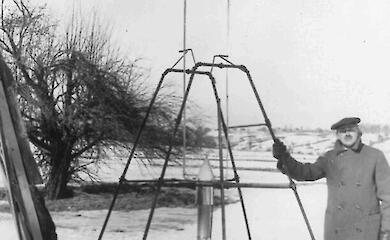
100 years ago, the first rocket was launched - this was the beginning of the space age

Popular news
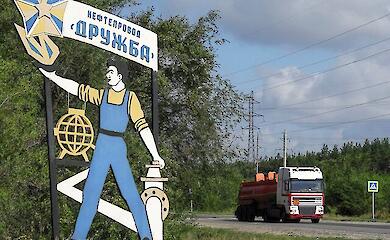
Orban announces "results" of Hungarian mission on Druzhba oil pipeline

Will maternity leave be shortened in Ukraine? Changes for workers with children


Zelensky said that Russia was preparing a new offensive and pointed out the direction of it


Kellogg named the ceasefire condition today and compared Putin to Nicholas II

News about war
Orban announces "results" of Hungarian mission on Druzhba oil pipeline
Kellogg named the ceasefire condition today and compared Putin to Nicholas II
Zelensky said that Russia was preparing a new offensive and pointed out the direction of it
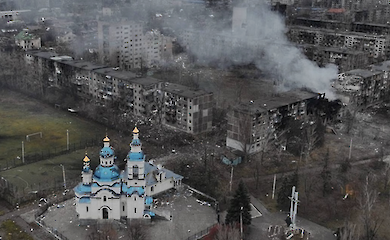
Russia is destroying Ukraine twice as fast as at the start of the war - international report