
8 evidence-based ways to drink less alcohol during party season


"We should definitely meet and have a drink before the New Year!" - This phrase is heard particularly often in December.
The end of the year turns into a continuous marathon of corporate parties, family celebrations and school matinees, where alcohol is almost always the "default". As a result, drinking seems not only normal, but expected.
However, if you want to reduce your alcohol consumption (or give it up altogether) during this "crazy season," relying on willpower alone is not necessary. A premeditated strategy can help. Research shows that when a goal is formulated as a plan of action (exactly how you'll drink less) rather than just a prohibition ("don't drink"), it's easier to stick to it.
The experts at The Conversation offer eight simple, evidence-based steps.
1. Make a plan ahead of time
Our brains tend to choose immediate gratification, sacrificing long-term goals - this is called "present bias." Therefore, it's much harder to think about the benefits of sobriety the moment the glass is in front of you.
If you decide in advance which days you drink and which days you don't, you won't have to make the decision on the spot every time. Look at a calendar, mark the days without alcohol and the days when you allow one or two drinks. A clear plan reduces the risk of "spontaneous" drinking under pressure from company.
2. Keep track of how much you drink
Keeping records is one of the most effective and proven methods of reducing alcohol consumption. Often the mere fact that you are recording how much you drink will make you more mindful of your drinking habits.
You can record in any way you like - on an app, notepad or even on a calendar on your phone. The important thing is to do it regularly, if possible at the time of drinking, and not 'retrospectively'. There are also free specialised apps, such as Drink Tracker, that help you keep track of alcohol and non-alcoholic days.
3. Try non-alcoholic drinks
Non-alcoholic beer, wine and 'spirits' drinks allow you to keep the ritual - glass in hand, toasting, taking part in the festivities - but without getting intoxicated. For many, this makes giving up or cutting back on alcohol much easier.
However, this option is not suitable for everyone: those for whom the very sight, smell or taste of alcohol can be a trigger are better off avoiding such drinks. It is important to orientate yourself to your reactions and not to impose on yourself what prevents you from achieving your goal.
4. Slow down
If you want to drink less, alternate between alcoholic drinks and non-alcoholic drinks. Water is the best option, but zero or low-alcohol drinks will also work. This reduces the total amount you drink and helps you avoid dehydration and therefore a heavy hangover.
It is also helpful to eat before and during the feast. Dense and more or less healthy food prevents rapid spikes in blood alcohol concentration and slows down its absorption, giving your body more time to process it. In addition, healthy food helps to curb the cravings for fatty, salty and sweet foods that often arise after a few drinks.
5. Don't fall into an all-or-nothing approach
A dangerous trap is the so-called "goal violation" effect, when one "weakness" ruins the whole plan. For example, you decided not to drink, but someone persuaded you "just a sip", or one drink turned into five - and you think: "Well, that's it, the day is ruined, you can go on".
It's important to remember: a breakdown is just a breakdown, not a failure of the whole goal. You can stop at any time and go back to the plan - from the next drink or the next day.
6. Arrange for support
Tell a friend or partner that you want to drink less. This creates an element of accountability and gives you emotional support. It's even better if someone decides to join you - it makes it easier to stay on track.
7. Prepare short answers
People may wonder why you don't drink or drink less than usual and offer you another drink. It's helpful to come up with simple phrases in advance:
- "I'll pass for now."
- "I'm slowing down today."
- "I've had enough, I feel great."
The main thing is to choose a wording that is comfortable for you. You don't have to give anyone a detailed explanation.
8. Take care of yourself
Changing habits is a process, not a perfect marathon without a single mistake. What's more important is not that you once drank more than you planned, but how you feel about it.
Shame and guilt often provoke even more drinking. And self-compassion and a sober outlook help you continue to make changes. Instead of "I failed," it's better to ask yourself: what prevented me from holding on? What can I change next time?
Even in the busiest month of the year, lasting change is formed from small but regular steps. It's important to build a relationship with alcohol where you are in control, not him.
Maria Grynevych, project manager, journalist, co-author of Guidebook Sacred Mountains of the Dnieper Region, Lecture Course: Cult Topography of the Middle Dnieper Region.
Related news
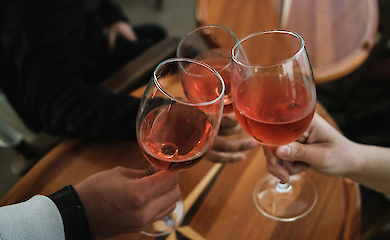
Alcohol on social media feeds increases cravings for booze in 18-24 year olds


A physicist has explained how Santa Claus manages to deliver all the presents overnight


Experts explained when an artificial Christmas tree is more harmful than a live one

'Not in the mood' at Christmas: why it happens and how to help yourself
Popular news

Orban announces "results" of Hungarian mission on Druzhba oil pipeline

Will maternity leave be shortened in Ukraine? Changes for workers with children


Zelensky said that Russia was preparing a new offensive and pointed out the direction of it


Kellogg named the ceasefire condition today and compared Putin to Nicholas II

News about war
Orban announces "results" of Hungarian mission on Druzhba oil pipeline
Kellogg named the ceasefire condition today and compared Putin to Nicholas II
Zelensky said that Russia was preparing a new offensive and pointed out the direction of it

Russia is destroying Ukraine twice as fast as at the start of the war - international report